Word of the Day: CRYPTONYMOUS

ETYMOLOGY
from Greek κρυπτός (hidden) + ὄνοµα (name)

EXAMPLE
“…The Ballad Book. Edinb. 1 827. 8vo. Maillet, Benedict de. Telliamed, being a Translation from the French.
A cryptonymous book — Telliamed being the anagram of M. de Maillet. It consists of * Discourses between an Indian philosopher and a French missionary on the diminuation of the sea, the formation of the earth, the origin of men and animals, and other curious subjects relating to natural history and philosophy. …”

From: The Bibliographer’s Manual of English Literature, Vol. III
By William Thomas Lowndes, 1834

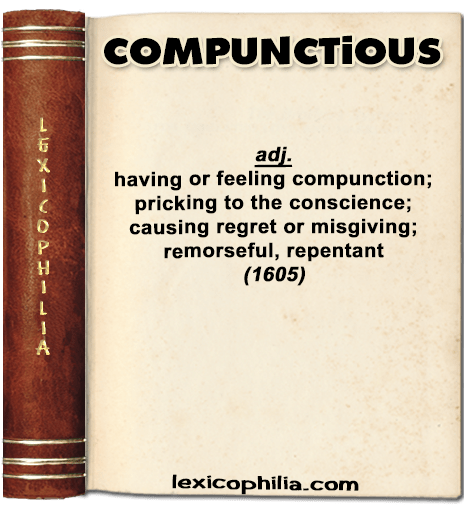
Word of the Day: COMPUNCTIOUS


ETYMOLOGY
from stem of compunction (pricking of the conscience, remorse) + -ous


EXAMPLE
“…The Rauen himselfe is hoarse,
That croakes the fatall entrance of Duncan
Vnder my Battlements. Come you Spirits,
That tend on mortall thoughts, vnsex me here,
And fill me from the Crowne to the Toe, top-full
Of direst Crueltie: make thick my blood,
Stop vp th’ accesse, and passage to Remorse,
That no compunctious visitings of Nature
Shake my fell purpose, nor keepe peace betweene
Th’ effect, and hit. Come to my Womans Brests,
And take my Milke for Gall, you murth’ring Ministers,
Where-euer, in your sightlesse substances,
You wait on Natures Mischiefe. Come thick Night,
And pall thee in the dunnest smoake of Hell,
That my keene Knife see not the Wound it makes,
Nor Heauen peepe through the Blanket of the darke,
To cry, hold, hold
….”

From: Macbeth
By William Shakespeare, a1616

Word of the Day: CONTROVERTISTICAL


ETYMOLOGY
from  controvertist (a person who engages in argument or controversy) [from controvertere (in logic, to invert; to argue, to dispute, to oppose)] + ‑ical 


EXAMPLE
“…The Company began to Smile at this odd Rodomontade, but Eudoxus told him, in controvertistical Debates, there was no Appeal from Reason to the Sword; that it was more prudent to confess Errors, than to defend ’em; to cancel past Crimes, than to commit new ones …”

From: A Gentleman Instructed in the True Principles of Religion
By William Darrell. 1707

Word of the Day: CLINCHPOOP


ETYMOLOGY
of uncertain origin;
perhaps from one who clinches or clenches the poops of vessels,
a clincher (a workman who clinched the bolts in shipbuilding)


EXAMPLE 1.
“…Yf a Gentlemanne haue in hym anye humble behauour, then Roysters doo cal suche one by the name of a Loute, a Clynchepope, or one that knoweth no facyons…”

From: The Institucion of a Gentleman
By Humfrey Braham, 1555


EXAMPLE 2.
“…Cléante
Ma chere, ma chere, c’est vrai, c’est vrai,
But my rival is a juggins –

Angélique
A muggins –

Cléante
A noodle and a looby –

Angélique
A lopdoodle, a dunderhead, a pigsconce and a booby

Cléante
A Clinchpoop, a gobemouche, a snollygoster, a gongoozler

Angélique
A lickspiggot, a fuzzdutty, a jobbernowl, an ass –

Thomas
It’s highly amusing.

Cléante
Who’s in love with the sound of his own braying …”

From: The Hypochondriac
Roger McGough’s translation of Molière’s Le Malade Imaginaire, 2009

Word of the Day: COCKAPERT


ETYMOLOGY
seemingly an alteration of malapert (adj.) after cock (a mature male of the domestic chicken)


EXAMPLE
for adj.

“…Which is terbox to your side: for out of dout,
Your cockapert pride: and your couetous harts.
Haue brought: more than three parts of our ils about.
Your rude rebelins disobedient parts:
Much vnto our (and much more to your own) smarts:
Kicking and wincing at euery good order,
Hath distroide good order in euery border…”

From: The Spider and the Flie
By John Heywood, 1556


for n.

“… I could tell he was cross about something. I didn’t think the blisters were enough to account for it; he’d suffered them for days without complaint. We got under the quilt and I pulled the coverlet over our heads. In the dark I could watch him but he couldn’t see me. There was a strong scent of sweet balm from the foot salve. I said, “I heard about Sire … Lackadaisy, or or Lapscallion – the cockapert who insulted you. Are you still hungry at him?…”

From: Wildfire: A Novel
By Sarah Wicklem, 2009

Word of the Day: CORYBUNGUS


ETYMOLOGY
? perhaps from bung (the buttocks, the backside [obs.]) + -us (abounding in, full of)


EXAMPLE
“…Sims, after a little unartistic squaring, lunged out awkwardly, and caught Tom on the chest with his left. Tom, who was evidently waiting to find out what his adversary could do, returned smartly on the gob, and in getting back, fell on his corybungus…”

From: Tom Sayers, Sometime Champion of England,
His Life and Pugilistic Career
By Thomas Sayers, 1866
‘Fight between Tom Sayers and George Sims, for £75, on Tuesday, the 28th of February, 1854, at Longreach’

Word of the Day: CIRCUMBILIVAGINATE


ETYMOLOGY
in 16th–17th century France: apparently, a fanciful creation of Rabelais


EXAMPLE
“…My counsel to you in that case, my friend, is that you marry, quoth Hippothadee; for you should rather choose to marry once than to burn still in fires of concupiscence. Then Panurge, with a jovial heart and a loud voice, cried out, That is spoke gallantly, without circumbilivaginating about and about, and never hitting it in its centred point…”

From: Gargantua and Pantagruel, Book III.
By Francois Rabelais
Translation by Sir Thomas Urquhart and Peter Antony Motteux, 1693

Word of the Day: CLIP-SHEARS


ETYMOLOGY
formed by compounding clip (that which is clipped or cut);
apparently from the form of its feelers, as having some resemblance to a pair of shears, 
or scissors


EXAMPLE
“…turned out their russet recesses to the birsling sun, and the foggie-toddlers hirpled about their business in the warm sod, among golacks and clip-shears, while the grasshoppers chirped in merry concert…”

From: Proceedings of the Philosophical Society of Glasgow
Edited by Agnes McLean, Vol. XXX. 1898
V. Dr. James Colville on the Scottish Vernacular.