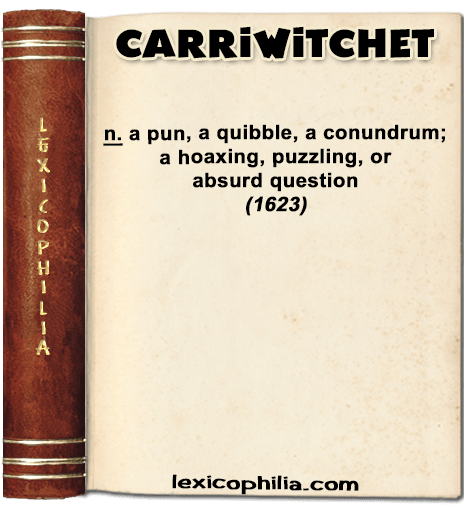
Word of the Day: CARRIWITCHET


ETYMOLOGY
of unknown origin


EXAMPLE
“…That tells vs of Proiects beyond the Moone, of Golden Mines, of Deuices to make the Thames run on the North side of London (which may very easily be done, by remouing London to the Banke-side) of planting the Ile of Dogs with Whiblins, Corwhichets, Mushromes and Tobacco. Tut I like none of these, Let mee see, as I take it, it is an inuectiue against Coaches, or a proofe or tryall of the Antiquitie of Carts and Coaches…”

From: All the vvorkes of Iohn Taylor the Water-Poet 
By John Taylor, 1623
The VVorld runnes on VVheeles

Word of the Day: COCKLE-BRAINED


ETYMOLOGY
of uncertain origin;
perhaps from cockle (to move or rock unsteadily; to totter or wobble)


EXAMPLE
“…Their bind was just a Scots pint over-head, and a tappit-hen to the bill, and no man ever saw them the waur o’t. It was thae cockle-brained callants of the present day that would be mair owerta’en with a puir quart than douce folk were with a magnum…”

From: St. Ronan’s Well
By Sir Walter Scott, 1823

Word of the Day: CLUMPERTON


ETYMOLOGY
from clump or clumper (a lump, mass);
possibly on model of simpleton


EXAMPLE
“…Thus departinge from thence it chaunced him to stray asyde from his companie, and, fallinge into reasoninge and so to altercation with a stronge stubberne clomperton, he was shrowdlie beaten of him, yeat hee kepte him from beinge hurte of his menne, grauntinge that hee hadd well deserved those stripes…”

From: Polydore Vergil’s English History, c1534
from an early translation preserved among the mss. of the old royal library in the British museum

Word of the Day: CRUENTOUS


ETYMOLOGY
from Latin cruentus (bloody) + -ous


EXAMPLE
“…Thus a cruell and most cruentous civill war began which lasted neer upon foure yeers without intermission, wherin there happen’d more battailes, sieges and skirmishes, then passed in the Netherlands in fourescore yeers, and herein the Englishmen may be said to get som credit abroad in the world, that they have the same blood running in their veines (though not the same braines in their sculls) which their Ancestors had, who were observed to be the activest peeple in the field, impatient of delay, and most desirous of battaile then any Nation…”

From: A Venice Looking-Glasse
By J.B.C., 1648

Word of the Day: CHERRY-MERRY


ETYMOLOGY
perhaps from cheery + merry; possibly only a jingling combination


EXAMPLE
“…how few of you are enemies to a glass (or two or three) of generous wine, and how much food of such a heating nature, promotes the circulation of the bottle, it is not at all astonishing, that every convivial assistant should go home cherry-merry, after having been a guest at such a repast…”

From: Yorick’s Sentimental Journey Continued,
By John Hall-Stevenson, 1769

Word of the Day: CHATTERMAG


ETYMOLOGY
from chatter + mag (a chatterbox)


EXAMPLE
“…Now then, stop that; we don’t want no such dal’d nonsense; we come here to work. Now then, you women, divide into twos, and begin at both ends, or we shan’t get any work done for your chattermagging…”

From: Stubble Farm;
Or, Three Generations of English Farmers
By Hubert A. Simmons, Vol. II, 1880
Chapter I. P. 14

Word of the Day: CULLIBLE


ETYMOLOGY
from the Oxford English Dictionary:
“This adjective, which is presupposed in the derivative cullibility (known 1728), would normally be derived from a verb cull ; but none such is recorded”


EXAMPLE
“…The cullibity of man praeterite, I allow, but because men are & have been cullible, I see no reason why shd always continue so, – Have there not been fluctuations in the opinions of mankind; and as the stuff which soul is made of must be in every one the same …”

From: The Letters of Percy Bysshe Shelley,
Edited by Frederick Lafayette Jones, 1964,
– Shelley to Hogg, January 12, 1811