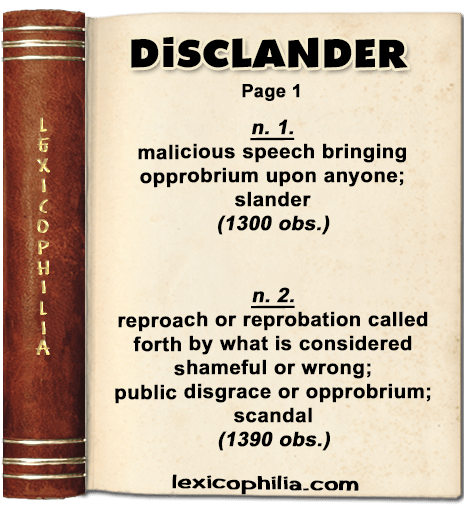
Word of the Day: DISCLANDER

ETYMOLOGY
noun: from Anglo-Norman desclandredesclaundredisclaunderdisclaundre (slander, slanderous statement, scandal, public outrage)
verb: from disclander (noun)

EXAMPLE (for vb. 1.)
“… Þis gode men with ioie inov : heore leue of him heo nome,
And þannes heo wenden sone i-nouȝ : to þe court of rome.
Þare neren heo nouȝt faire onder-fonge : for þe bischopes comen bi-fore
And desclaundreden seint thomas : þat he was fals and for-suore.
Ake naþeles þe grace heo hadden : þat to þe pope heo miȝten go.
him-sulue heo tolden in priuete : al seint thomases wo: …”

From: Laud Manuscript, c1300
In The Early South-English Legendary ; or, Lives of Saints
Edited by Carl Horstmann, 1887

Word of the Day: DEBATIVE

ETYMOLOGY
from debate (vb.) + -ive

EXAMPLE
“… It is a wonder to behold, that in one man should appeare so many tokens of valour, as first to be the ouerthrow of so mighty a kingdome: next of the setting vp & revniting again of the same: Againe, that whersoeuer he tooke part, victory was euermore attendant vppon his actions; which was the onely cause they honored him aboue men, and little lesse than a God, they were driuen into a debatiue meditation, whether they offered him more wrong in his banishment, or more honnor in calling him home: …”

From: The Historie of Iustine Containing a Narration of Kingdomes, from the beginning of the Assyrian Monarchy, vnto the Raigne of the Emperour Augustus
Translated by G.W., 1606

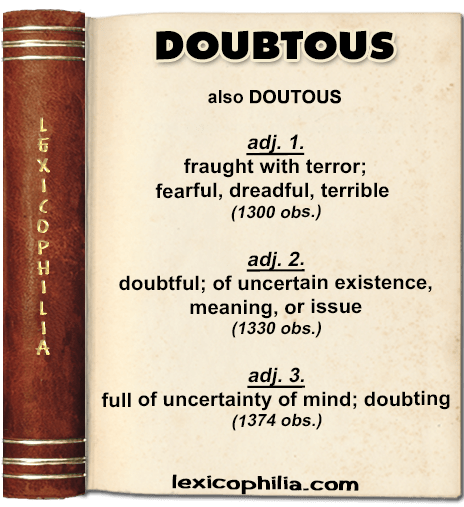
Word of the Day: DOUBTOUS

ETYMOLOGY
Middle English from Old French dutusdotusdoutous;
from modern French douteux, from doute (doubt n.)

EXAMPLE 1 ( for adj. 1)
“…no for al is moch honoure
þat he ne worþ wel sone dede
Þe eiȝt dai so is
dotus 
and þat ful wel þou salt se
ful of tene and angus
…”

From: Early English Poems and Lives of Saints with those of the wicked birds Pilate and Judas
Edited by Frederick James Furnivall, 1862
Fifteen Signs before Judgment‘, a1300

EXAMPLE 2 (for adj. 1)
“… And she said to hym: ‘My swete frend̛, yf it were possyble, soo wold I fayne doo, but it may not be. And wete it wel, that my departyng fro you is more gryeuous & doubtous a thousand tymes to me than to you, but it is the wyƚƚ & playsire of hym that can do & vndoo al thinges.’ and, with these wordes, she embraced & kyssed hym fuƚƚ tenderly, sayeng: ‘Farwel, myn owne lord & husbond̛; Adieu, myn herte, & al my joye; Farwel, my loue, & al myn wele …”

From: Melusine
By Jean d’Arras, c1500
(Published by Early English Text Society, 1895)

Word of the Day: DEROGANT

ETYMOLOGY
from Latin derogantem, present participle of derogare (to derogate)

EXAMPLE
“…If they could foresee future things, they would bragge themselues equall to God: But Secret things belong to GOD, reuealed to vs. The other is both arrogant in man, and derogant to God. And Greg. sayes well: If such a Starre be a Mans Destenie, then is Man made for the Starres, not the Starres for Man. The Diuels know not future euents: and will these boast it? …”

From: The Sacrifice of Thankefulnesse
A sermon preached at Pauls Crosse
By Thomas Adams, 1616

Word of the Day: DUBITABLE

ETYMOLOGY
from Latin dubitabilis, from dubitare (to doubt)

EXAMPLE
“…Has my goodneesse,
Clemency, loue, and fauour gracious rays’d thee
From a condition next to popular labour,
Tooke thee from all the
dubitable hazards
Of Fortune her most vnsecure aduentures?
And grafted thee into a branch of honour,
And dost thou fal from the top bough by the rottennes
Of thy alone corruption, like a fruite
That’s ouer-ripned by the beames of fauour,
Let thy owne weight reward thee, I haue forgot thee
, …”

From: A Game at Chæss as it was acted nine dayes to gether at the Globe on the banks side
By Thomas Middleton, 1625

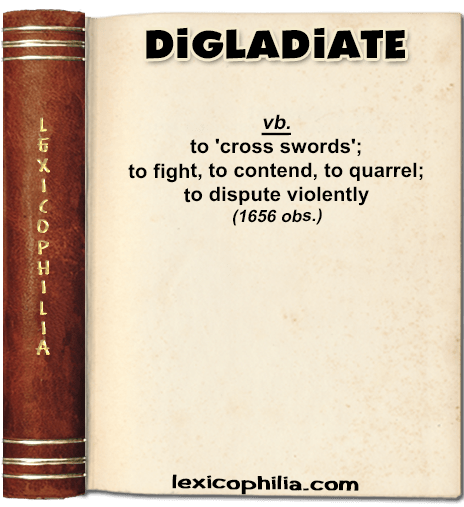
Word of the Day: DIGLADIATE

ETYMOLOGY
from Latin digladiari from di-dis- (asunder, in different directions) + gladius (a sword)

EXAMPLE
“…For what else are the Writings of many men, but mutual Pasquils and Satyrs against each others lives, wherein digladiating like Eschines and Demosthenes, they reciprocally lay open each others filthiness to the view and scorn of the world. The fear therefore of being stained, and publickly disgraced, might be reason enough to keep them back from entring these contentions. …”

From: Golden Remains of the Ever Memorable Mr. John Hales
By John Hales, 1659

Word of the Day: DUBEROUS

ETYMOLOGY
corruption of ‘dubious’

EXAMPLE
“…The Squire,” said he, ” hadn’t a-made him no proposal at all, and was duberous if his charackter would serve. Now, says I to myself, seeing as how the cat jumps, if so be as I steps in, before nothing and scrape of pen, where ‘s the harm ? …”

From: Lawrie Todd, or, The Settlers in the Woods
By John Galt, 1830

Word of the Day: DRY-FIST

ETYMOLOGY
from dry (miserly, stingy) + fist

EXAMPLE
“…Ferentes. Yet again ? nay, an if you be in that mood, shut up your fore-shop, I’ll be your journeyman no longer. Why, wise Madam Dryfist, could your mouldy brain be so addle to imagine I would marry a stale widow at six-and-forty? Marry gip! are there not varieties enough of thirteen? come, stop your clap-dish, or I’ll purchase a carting for you. By this light, I have toiled more with this tough carrion hen than with ten quails scarce grown into their first feathers …”

From: Loves Sacrifice
By John Ford, 1633

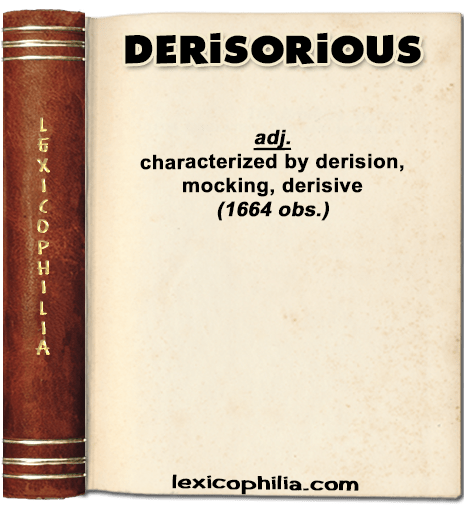
Word of the Day: DERISORIOUS


ETYMOLOGY
from Latin derisorius, from derisor (derider, mocker) + -ous


EXAMPLE
“…And that therefore the Spirit of Prophecy foreseeing these times, whenas for such a space he called Rome Pergamus, this succeeding Scene coming on, he might very well change the title of Pergamus into that of Thyatira, with a derisorious Allusion to the occasion of the name of that City, from the news of a Daughter being born to Nicanor.…”

From: An Antidote Against Idolatry
By Henry More, 1664

Word of the Day: DULCARNON


ETYMOLOGY
from Latin dulcarnon Pythagoras’ theorem
from Arabic ḏu’l-qarnayn (two-horned, lit. ‘possessor of the two horns’)
from ḏu (lord, possessor) + al (the) + qarnayn, dual of qarn (horn)


EXAMPLES
“…Criseyde answerde, :As wisly God at reste
My soule bringe, as me is for hym wo!
If that ich hadde grace to do so.
And eem, y-wis, fayn wolde I doon the beste,
But whether that ye dwelle or for him go,
I am, til God me bettre mynde sende,
At dulcarnoun, right at my wittes ende
…”

From: Letter from Mrs. M. Roper in Thomas More’s Works, 1441


“…Siva holds the drums of creation in one hand and the fires of destruction in the other—an either/or dulcarnon from which there seems no escape…”

From: A Wake Newslitter
December, 1974