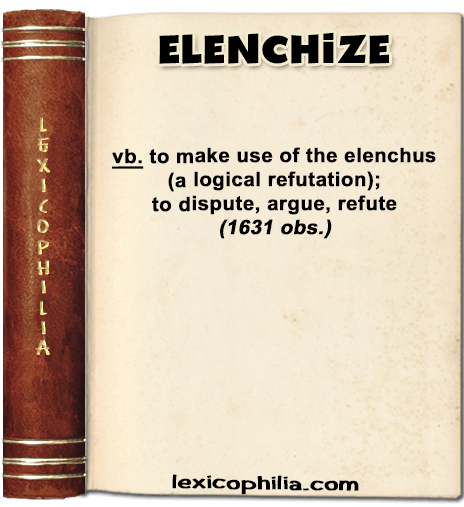
Word of the Day: ELENCHIZE


ETYMOLOGY
from elench ,from Latin elenchus, from Greek ἔλεγχος (cross-examination) + -ize


EXAMPLE
“…Lady. So do all Politicks in their Commendations.
   Host. This is a State-bird, and the verier Fly;
Tipto. But  Hear him problematize.   Prudence. Bless us, what’s that?
   Tipto. Or syllogize, elenchize.   Lady. Sure, petard’s,
To blow us up.   Lat. Some inginous strong words!
   Host. He means to erect a Castle i’ the Air,
And make his Fly an Elephant to carry it
….”

From: The New Inne, or The Light Heart, a Comedy
By Ben Jonson, 1631

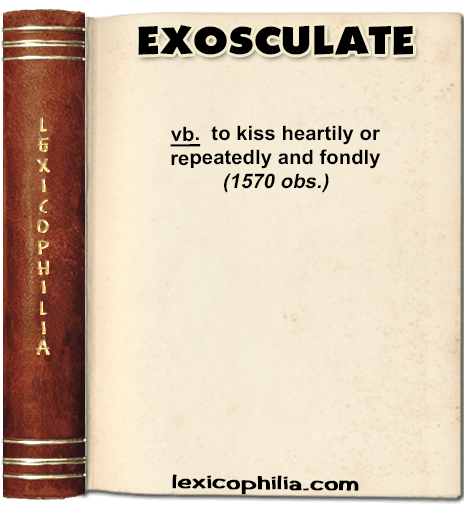
Word of the Day: EXOSCULATE


ETYMOLOGY
from participle stem of Latin exosculari, from ex- + osculari (to kiss), from osculum (a kiss)


EXAMPLE
“…And thus having copulated our plebeian endeavours, we exosculate the subumbrations of your subligacles; and sooner shall the surges of the sandiferous sea ignify and evaporate, than the cone of our duty towards you be in the least uncatenate or dissolved; always wishing you health and happiness…”

From: The Works of Jonathan Swift
By Jonathan Swift, 1814

Word of the Day: EACHWHERE


ETYMOLOGY
from each + where


EXAMPLE
“…A sely synful was she þis
For al hir synne turned in to blis
She was lyuynge in cuntre þere
Whenne ihesus preched vche where
And mony a pert myracle did
Wher wiþ to men he him kid
And mony seke he ȝaf her hele
And as he coom bi o castele
…”

From: Cursor Mundi (The Cursur o the World).
A Northumbrian poem of the XIVth century, a1400

Word of the Day: EDIBILATORY


ETYMOLOGY
badly formed on edibilis (edible),
after adjs. in –atory


EXAMPLE
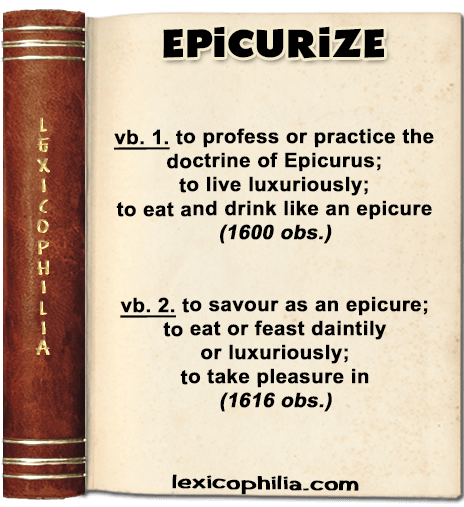
“…“Amen to your creed!” said I: “edibilatory Epicurism holds the key to all morality: for do we not see now how sinful it is to yield to an obscene and exaggerated intemperance?…”

From: Pelham, Or, Adventures of a Gentleman
By Edward Bulwer Lytton, 1828

Word of the Day: EARWIGGING


ETYMOLOGY
 from earwig (to annoy or attempt to influence by private talk) + -ing 


EXAMPLE
“…I remember the first introduction of Boswell on what may be called the Johnsonian stage. What is ludicrously called his earwigging, began to attract notice; and my father enquired of Mr. Langton, who this novel performer was, meaning rather, I believe, to be on good terms with him, as a frequenter in Bolt Court…”

From: Memoirs, Anecdotes, Facts, and Opinions
By Laetitia Matilda Hawkins, 1824