Word of the Day: FLIBBERTIGIBBET

also in forms FLEBERGEBET, FLEBERGEBIT, FLEBERGIBET, FLIBBER DE’ JIBB, FLIBBERGIB(BE), FLIBBER-GIBBET, FLIBBERTY-GIBBET, FLIBERDEGIBEK, FLIBERDIGIBBET, FLIBERDIGIBET, FLIPPERTY-GIBBET, FLYBBERGYBE

ETYMOLOGY
apparently an onomatopœic representation of unmeaning chatter or garrulous speech

EXAMPLE (for n. 1.)
“… Better vnborne then vntaught, I haue herde saie,
But ye be better fed than taught far awaie.
Not veraie fat fed, saied this
flebergebet,
But nede hath no lawe, nede maketh her hither iet.
She comth nece Ales (quoth she) for that is her name
More for nede, then for kyndnes, payne of shame.
…”

From: A dialogue conteinyng the nomber in effect of all the prouerbes in the englishe tongue compacte in a matter concernyng two maner of mariages
By John Heywood, 1546

PRONUNCIATION
FLIB-uh-tee-jib-uht

Word of the Day: FUBS

ETYMOLOGY
onomatopœic: suggested by fullchub, etc.

EXAMPLE
“… Caspia the decrepit old rich Croot,
Whose face (th’antiquity of time bewraying)
Is riueld like a ruffled summer Boot;
Shee that’s in all things, but in wealth, decaying:
Caspia, that same fowle deformed 
Fubs,
Who neuer needs feare coughing out her teeth,
(For she hath none, but a few Holly-stubs)
She that should think of nothing now but death;
Maugre th’imperfections of her Age
…”

From: Rubbe, and a Great Cast Epigrams
By Thomas Freeman, 1614

Word of the Day: FRUISH

ETYMOLOGY
from Old French fruiss- lengthened stem of fruir (to enjoy),
from Latin *fruire (classical Latin frui deponent vb.)

EXAMPLE
“… I may not fruisshe tho iocunde clippinges that are redy to holy spirites. …”

From: The earliest English translation of the first three books of the De Imitatione Christi
By Thomas à Kempis, c1425

Word of the Day: FUDDLECAP

ETYMOLOGY
from fuddle one’s cap or nose (to get drunk);
from fuddle (to tipple, to booze)

EXAMPLE
“… The Fuddlecap, whose God’s the Vyne,
Lacks not the Sun if he have Wine;
By th’ Sun he only finds a way
To some cool Spring, to spend the day.
Shrill Flutes and Trumpets Souldiers love,
And scorn those fears that Women move.
…”

From: The Poems of Horace consisting of Odes, Satyres, and Epistles
Rendred in English verse by several persons
A Paraphrase upon the first Ode by S. W. Esq To MECOENAS

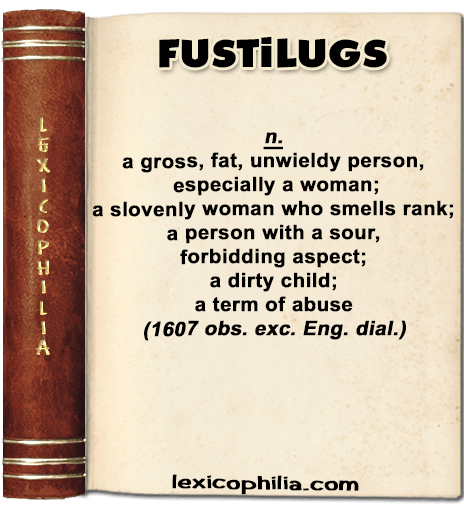
Word of the Day: FUSTILUGS

ETYMOLOGY
? from fusty (having an unpleasant or stuffy smell), + lug (something heavy and clumsy), in the sense of something heavy or slow

EXAMPLE
“… Whereupon the richest Babylonians intending to marry, buy the fairest and most beautifull virgins in the company, one out-bidding another in the bargain. The country swains contenting themselues though they haue not the fairest, take the woodden-fac’d wenches, and the ill-fauourd-foule-fustilugs for a small summe, …”

From: A World of Wonders,
Or an Introduction to a Treatise Touching the Conformitie of Ancient and Moderne Wonders.
By Henri Estienne
Translated by R.C., 1607

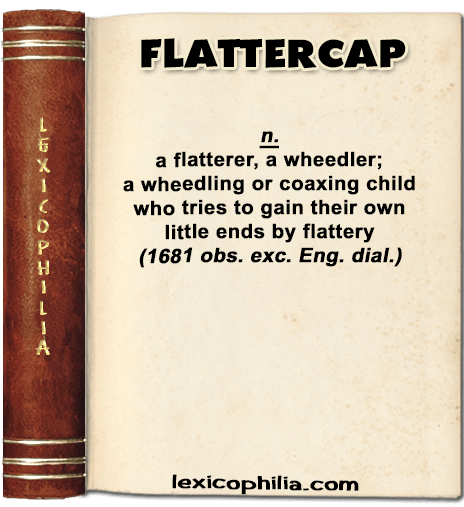
Word of the Day: FLATTERCAP

ETYMOLOGY
from flatter (vb.) + cap

EXAMPLE
“… He’s struggling to learn a lot of new things, but I also think he’s trying to do whatever he can to get on with the men.
I’ve seen him behaving like a 
flattercap, all yes sir, no sir, with a seaman named Brian Blount. …”

From: Trouble on the Voyage : The Strange and Dangerous Voyage of the Henrietta Maria
By Bob Barton, 2010

Word of the Day: FESTIVOUS

ETYMOLOGY
from Latin festivus (festive), from festum (a feast) + -ous

EXAMPLE
“… But goe on boldly, Frestons charmes must end,
See here, a Disinchanter is thy friend;
Who innocent black Art, hath round thee writ
A magick circle of Festivous Wit;
Which will secure thy Fame against that Prime,
And lasting monster, all devouring Time. …”

From: John Speed in Edmund Gayton’s Pleasant Notes Upon Don Quixot, 1654

Word of the Day: FROBLY-MOBLY

ETYMOLOGY
of unknown origin

EXAMPLE
“… If people felt but indifferently well, they said they were frobly-mobly; if they had swollen faces, they spoke of boun muns; if they were ready to faint, they said coath. …”

From: All The Year Round:
A Weekly Journal
Conducted by Charles Dickens, Jun.
Volume IV. From June 4, to November 26, 1870
‘In the Provinces ‘

Word of the Day: FERINE

ETYMOLOGY
from Latin ferinus, from fera (wild beast)

EXAMPLE (for adj. 1)
“… Secondly there are brutish and unnaturall Desires, which the Philosopher calleth 
ferine and inhumane, instancing in those barbarous Countries, where they use to eat mens flesh and raw meat; and in the Woman who ripped up Women with childe that shee might eat their young ones: …”

From: A Treatise of the Passions and Faculties of the Soule of Man
By Edward Reynolds, 1640

Word of the Day: FULGUROUS

also FULGROUS

ETYMOLOGY
from Latin fulgur (lightning, a flash of lightning) + -ous

EXAMPLE
“… and, iust at thinstant, all the canons plaien
frome towne to Campe, from Camp to towne againe,
in suche ann horrid noise, and flaminge light,
as if noone daie weare wedded to midd night:
or as if th’ pitchie clowdes of
fulgrous heavn
had taen their In vp, neath the spheres seaven.
…”

From: John Lane’s Continuation of Chaucer’s ‘Squire’s Tale’
By John Lane, 1616

PRONUNCIATION
FUL-gyuh-ruhss