ETYMOLOGY
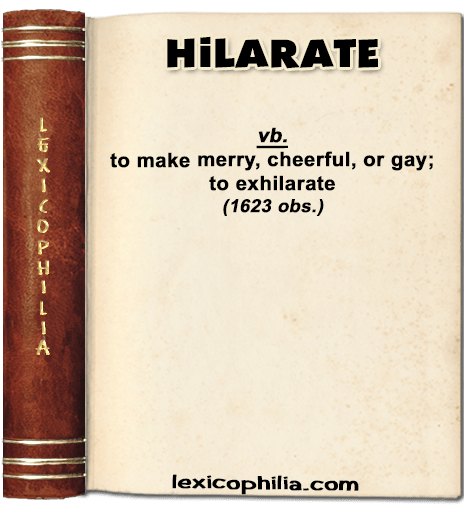
from Latin hilarat- participial stem of hilarare, from hilarus, hilaris, (cheerful, gay)
EXAMPLE
They drank enough wine to hilarate, not intoxicate.
ETYMOLOGY
from Latin hilarat- participial stem of hilarare, from hilarus, hilaris, (cheerful, gay)
EXAMPLE
They drank enough wine to hilarate, not intoxicate.

ETYMOLOGY
from Latin hæsitationem, noun of action from hæsitare (to hesitate) + -ous
EXAMPLE
“… he did not advance with his Army as near as, as he might have done, nor did endeavor to enforce others, nor to be enforced himself to fight, but rather went out of his direct way, which he had taken to come to Vienna, and kept for the most part in strong and commodious seats, as between the two Rivers of Sava and Drava; and if a powerful and vain glorious Prince, who professed that he had undertaken that War meerly out of a desire of glory would make use of haesitatious counsels, where the consequences were so great and so heavie; …”
From:
Politick Discourses written in Italian by Paolo Paruta, a noble Venetian, cavalier and procurator of St. Mark;
Translated by the Right Honorable Henry, Earl of Monmouth, 1657

ETYMOLOGY
an earlier form of hiccup, another being hickock, both apparently with a diminutive formative -et, -ock
EXAMPLE
“… And it is good to caste cold water in the face of him that hath the hicket, and to threaten him, and so put him in feare, and to anger hym, or els to prouoke hym to heauynesse, for by these thinges the naturall heat is reuoked and fortified within, and causeth the hicket to cease. …”
From: A new booke entyteled The Regiment of Lyfe: with a syngular Treatise of the pestilence
By Jean Goeurot
Translated by Thomas Phaer, 1544

ETYMOLOGY
from hare + hearted
EXAMPLE
“… Two right Hare-harted coward Fooles,
Would end their wrath with Cutlers tooles,
And two moft fhifting Knaues intends,
To make thofe Cowards louing friends:
One goes to th’one, and tell’s him tother,
Vowes he doth loue him as his Brother;
And would a Supper on him fpend :
That Cuppes of Sacke their ftrife might end, …”
From: A Fooles Bolt is Soone Shot
By Samuel Rowlands, 1614

ETYMOLOGY
A made-up word, from hum, gruff, griffin.
EXAMPLE
“… The Demoniac crowd
In an instant seem’d cowed;
Not one of the crew volunteer’d a reply,
All shrunk from the glance of that keen-flashing eye,
Save one horrid Humgruffin, who seem’d by his talk,
And the airs he assumed, to be Cock of the walk,
He quailed not before it, but saucily met it,
And as saucily said, “Don’t you wish you may get it?”…”
From: The Ingoldsby Legends
The Lay of St. Cuthbert, or, The Devil’s Dinner-Party
By Richard Harris Barham (Thomas Ingoldsby), 1842
ETYMOLOGY
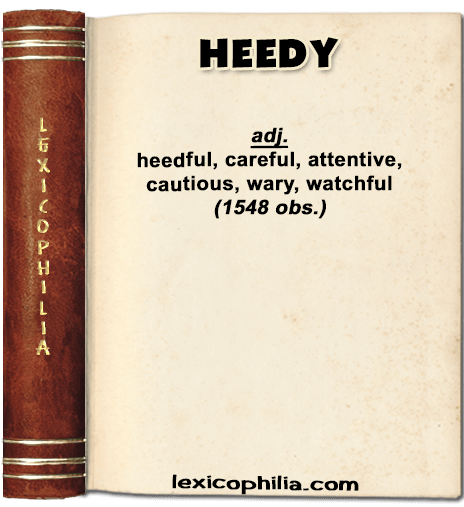
from heed (careful attention, care, observation) + -y
EXAMPLE
“… Not wythstandynge (ryght worshipfull) I haue attempted an enterpryce in prouynge eche parcel of the pryuye masse to dysplease god, whiche I can neyther word, matier, ne reason accordynglye, and so am rather dyslyked then lyked of manye for thys my doyng, rather heady then heedy as they suppose: Howebeyt in case the sayd persons woll wythe me earnestly respect my bounden deutie in the sayd doyng, they (I doubte not (woll be rathere contented then discontented with me for the same. …”
From: A Treatise againste the preuee masse
By Edmund Gest, 1548

ETYMOLOGY
from French hippomobile , from hippo- from Greek ἵππος (horse), from hippos (horse) + ‑mobile after automobile
EXAMPLE
“… Speaking generally, it is the bad driver who uses the horn most, and so brings motor-cars into disrepute by creating unnecessary alarm to other travellers. In overtaking a horse-drawn vehicle it is best to sound the horn when some distance behind, and so soon as it is seen that the signal has been noticed to avoid its use again until past the ” hippomobile.” Of course it is sometimes necessary to use the horn when quite close to a horse-drawn vehicle for instance, when it unexpectedly turns out across one’s path; but even on such occasions two moderate and short blasts are generally sufficient to warn the driver. …”
From: The Motor-Car Journal
London, Friday, March 17th, 1899
Comments, ‘The Motor-Car Horn’

ETYMOLOGY
from hole (n.) + creeper (n.)
EXAMPLE
“…He qualified himself as to the good eating which the statute requires, by ‘hole-creeping’ after his neighbours’ geese and pigs – est communis holecreppar anserum et porcellorum tenentium – and as to the good drinking, we have seen the clandestine but thrice-abundant provision which he made for that. …”
(est communis holecreppar anserum et porcellorum tenentium = is a common hole-creeper of geese and piglets)
From: The Quarterly Review
Vol. XCII. Published in December, 1852, and March 1853
No. CLXXXIV. History of the Ancient Barony Castle Combe in the County of Wilts,
By George Poulett Scrope, 1462
ETYMOLOGY
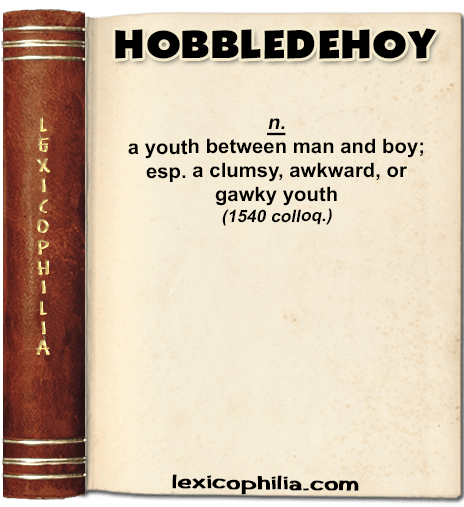
of uncertain origin;
the first element is possibly hob (clown, prankster);
the second element may be from French de haye (worthless, untamed, wild, literally ‘of the hedge’)
EXAMPLE
“…he began to clayme or chalenge his right more and more, and to cal in good lawes … and to desyre to haue the benefite or the succour of the lawes, whiche (were good and reasonable) by whiche they stryue … men vpholde or maynteyne suche as haue ouer shotte … ouer passed theyr fyrste parte of youthe … theyr hobledehoye tyme … the yeres that one is neyther a man nor a boye, at which yeres our voyce chagetij … that suche as haue passed theyr nonage, and be no longer berdelesse boyes, be to be loused from theyr fathers right … that theyr fathers haue no longer the guyding or correction of them, but that they be set at theyr lybertie…“
From: The Comedye of Acolastus
By Gulielmus Gnaphaeus
Translated by John Palsgrave, 1540

ETYMOLOGY
from heart (n.) + quake (n.)
EXAMPLE
“…This disease taketh somtyme the one membre, as hand or fote, somtyme the halfe body, or the tonge, so that a man can not speake: somtyme cometh it of ouermuche ioye, heuinesse, meate or drincke, ouermuche laboure, reste, slouthfulnesse, feare, swounynge, hartequake, and of superfluitye of bloode, flegma, colera or melancoly. …”
From: A Most Excellent and Perfecte Homish Apothecarye or Homely Physik Booke, for all the grefes and diseases of the bodye
By Hieronymus Brunschwig
Translated by Ihon Hollybush, 1561
 Lexicophilia