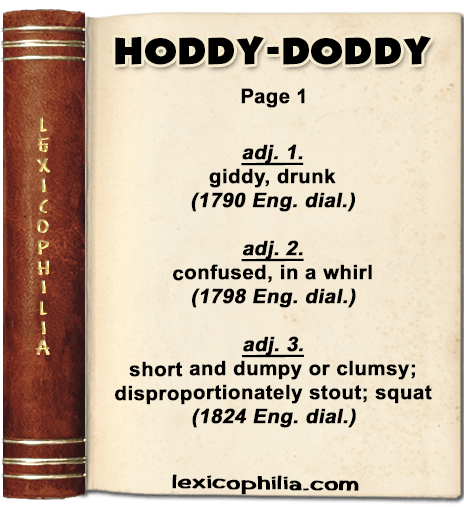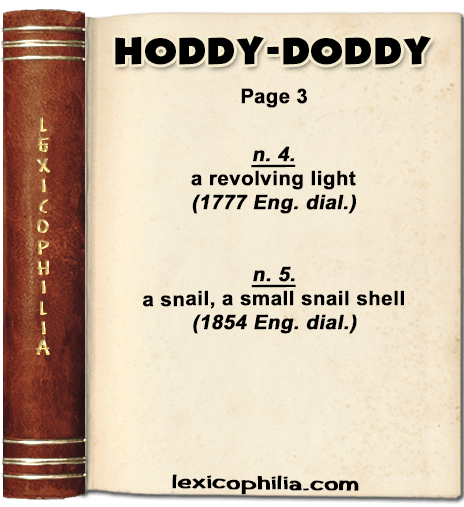
Word of the Day: HODDY-DODDY


ETYMOLOGY
the element dod is evidently the same as in dodman (a shell-snail);
hoddy-dodhoddy-doddy, & hodman-dod, are perhaps from nursery reduplications;
but the element hoddy- appears itself to have come to be associated to mean ‘snail’ (or ? horned);
for n. 2. (a cuckold) – with reference to the ‘horns’ of a cuckold


EXAMPLE (for n. 1.)
“…My living lieth here and there, of God’s grace,
Sometime with this good man, sometime in that place;
Sometime Lewis Loiterer biddeth me come near;
Somewhiles Watkin Waster maketh us good cheer;
Sometime Davy Diceplayer, when he hath well cast,
Keepeth revel-rout, as long as it will last;
Sometime Tom Titivile keepeth us a feast;
Sometime with Sir Hugh Pie I am a bidden guest;
Sometime at Nichol Neverthrive’s I get a sop;
Sometime I am feasted with Bryan Blinkinsop;
Sometime I hang on Hankyn Hoddydoddy’s sleeve;
But this day on Ralph Roister Doister’s, by his leave
…”

From: Ralph Roister Doister,
By Nicholas Udall, a1556

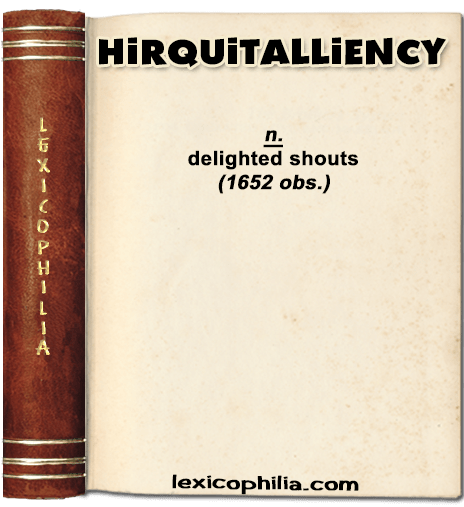
Word of the Day: HIRQUITALLIENCY


ETYMOLOGY
from Latin hirquitallire (of infants: to acquire a strong voice) [from hircus (he-goat)] + -ency


EXAMPLE
“…Here it was that passion was active, and action passive, they both being overcome by other, and each the conquerour. To speak of her hirquitalliency at the elevation of the pole of his microcosme, or of his luxuriousness to erect a gnomon on her horizontal dyal, will perhaps be held by some to be expressions full of obscoeness, and offensive to the purity of chaste ears; yet seeing she was to be his wife, and that she could not be such without consummation of marriage, which signifieth the same thing in effect, it may be thought, as definitiones logicae verificantur in rebus, if the exerced act be lawful, that the diction which suppones it, can be of no greater transgression, unless you would call it a solaecisme, or that vice in grammar which imports the copulating of the masculine with the feminine gender…”

From: Εκσκυβαλαυρον (Ekskybalauron – The Jewel )
By Sir Thomas Urquhart, 1652

Word of the Day: HOMODOX


ETYMOLOGY
from Greek ὁµόδοξος (of the same opinion),
from ὁµο- (homo-) + δόξα (opinion)


EXAMPLE
“…so likewise does the like Catholick Condemnation (from and by all the rest of the Christian Orders) reach the Church of Rome, as well as the Homodox Idolatry of the Cacodox Arians and Socinians.…”

From: Athenæ Britannicæ:
Or, A Critical History of the Oxford and Cambrige Writers and Writings.
By Myles Davies, Part II, 1716

Word of the Day: HIRPLE


ETYMOLOGY
of unknown origin;
the coincidence in sound and sense with Greek ἕρπειν from ἕρπω (hérpō) (to move slowly),
is noticeable.


EXAMPLE
“…The bull: the beir: the bugill: and the bair:
The wodwys: vildcat: and the wild wolfyne:
The hardbakkit hurcheoun: and the hirpland hair:
Baith otter and aip: and pennit porcupyne.
The gukit gait: the selie scheip the swyne:
The bauer bakon and the balterand brok:
The fowmart, with the fyber furth can flok
…”

From: The Morall Fabillis of Esope the Phrygian
“The taill of the sone & air of the forsaid foxe”
Robert Henryson, a1500

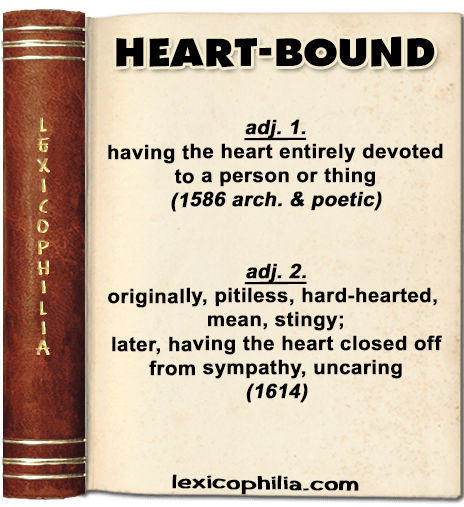
Word of the Day: HEART-BOUND


ETYMOLOGY
from heart + bound


EXAMPLE
“…When Strephon cursing his owne backwardnes
Came to hir back, and so with double warde
Emprison hir, who both them did possesse
As heart-bound slaues: and happy then embrace
Vertues proofe, fortunes victor, beauties place
…”

From: The Countesse of Pembrokes Arcadia.
By Sir Philip Sidney. a1586

Word of the Day: HILUM


ETYMOLOGY
from Latin hilum (little thing, trifle);
according to Festus, thought to have originally meant ‘that which adheres to a bean’;
hence, later used in anatomy (the depression or opening where ducts, vessels, etc. enter an organ) and in biology (a scar on a seed or spore created by detachment)


EXAMPLE
“…Now Solomon was a wise, and an understanding childe. How much more then should you take care of ignorant, knotty, illiterate, and unhewn Sailors, that have no more than a meer hilum of goodness in them?…”

From: Πελαγος or, An Improvement of the Sea
By Daniel Pell


PRONUNCIATION
HIGH-luhm

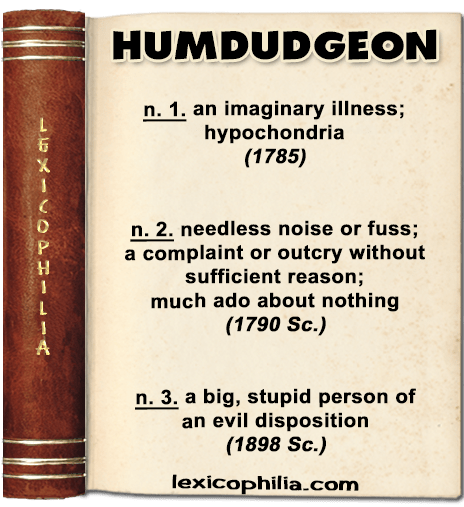
Word of the Day: HUMDUDGEON


ETYMOLOGY
from hum (a piece of humbug, an imposition, a hoax) + dudgeon (a feeling of anger, resentment, offense)


EXAMPLE (for n. 1)
“…”Hout tout, man – I would never be making a hum-dudgeon about a scart on the pow – but we’ll be in Scotland in five minutes now, and ye maun gang up to Charlies-hope wi’ me, that’s a clear case…”

From: Guy Mannering
By Walter Scott, 1815

Word of the Day: HALF-HEADED


ETYMOLOGY
from half + headed


EXAMPLE
“…And there is not a man that is for Paritie, all Fellows in the Church, but he is not for Monarchie in the State. And certainly either he is but Halfe-headed to his owne Principles, or he can be but Halfe-hearted to the House of David…”

From: Seven Sermons Preached Upon Severall Occasions
By William Laud, 1625

Word of the Day: HODIERN


ETYMOLOGY
from Latin hodiernus, from hodie (to-day)


EXAMPLE
“…Hale, sterne superne, hale, in eterne
 In Godis sicht to schyne,
Lucerne in derne for to discerne,
 Be glory and grace devyne.
Hodiern, modern, sempitern,
 Angelicall regyne,
Our tern inferne for to dispern,
 Helpe, rialest rosyne
…”

From: The Poems of William Dunbar (1998)
Ballad of our Lady, a1513