Word of the Day: HYPEROCHALITY


ETYMOLOGY
from Greek ὑπέροχος (eminent, distinguished) + -al + -ity


EXAMPLE
“…correspondent to the Iron-Age of Prelats, so plague the Metropoliticality of York and Canterbury, and the Hyperocality of all the other Prelats, as I will never leave them, till I have sent them to the place where the two Fulmina Belli, Alexander the Great cries Mustard and Green Sauce, and where Julius Caesar plays Plato’s Ratcatcher…”

From: The Letany of Doctor Bastwick
By John Bastwick, 1637

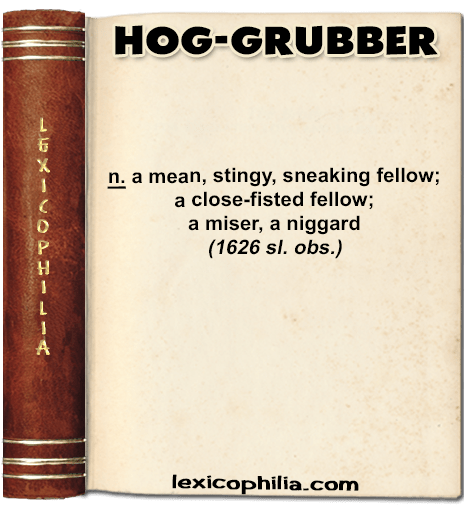
Word of the Day: HOG-GRUBBER


ETYMOLOGY
from hog + grubber (a person who gets wealth by sordid or contemptible methods)


EXAMPLE
“…The next that in our little Ease,
Came to be bit with Lice and Fleas,
Was a spruce Knave, like none of these, But sober,

As the Strand May-pole, – he did go,
In russe, – His thumb th’row ring, did show
A Gentleman seal’d, – for he was no Hog-grubber:

It was a Petty-fogging Varlet,
Whose back worse freez, but burn no scarlet,
And was tane napping with his Harlot, At noddy: …”

From: The Counter-Scuffle
Whereunto is added, the Counter-Ratt
By Robert Speed, 1626

Word of the Day: HONEY-DROP


ETYMOLOGY
from honey + drop


EXAMPLE
“…The younges brother he stepped in,
            Took’s sister by the hand;
            Said, Here she is, my sister Maisry,
            Wi the hinny-draps on her chin.
             ‘O if I were in some bonny ship,
            And in some strange countrie,
            For to find out some conjurer,
            To gar Maisry speak to me!’…”

From: Bondsey and Maisry
in English and Scottish Popular Ballads
By Francis Child, 1886

Word of the Day: HIGHFUL


ETYMOLOGY
either from a) high (adj.) + -ful;
or perhaps from b) the same word as eyeful (arousing or inspiring awe, fear, or dread; terrible, dreadful)


EXAMPLE
“…So þat he was riche him sulf · & þat lond pouere al out
Sturne he was þoru out al · & heiuol & prout
Suiþe þikke mon he was · & of grete strengþe…”

From: The Metrical Chronicle of Robert of Gloucester, c1325-c1425

Word of the Day: HIBBER-GIBBER


ETYMOLOGY
reduplicated derivative of gibber (unintelligible talking, rapid and inarticulate utterance)


EXAMPLE
“…and I wott not what maruelous egges in mooneshine: but a flye for all your flying Speculations, when one good fellow with his oddiestes, or one madd knaue with his awke hibber-gibber, is able to putt downe twentye of your smuggest artificiall men, that simper it so nicely, and coylie in their curious pointes…”

From:  Pierces Supererogation
Or A New Prayse of The Old Asse,
Gabriell Harvey, 1593

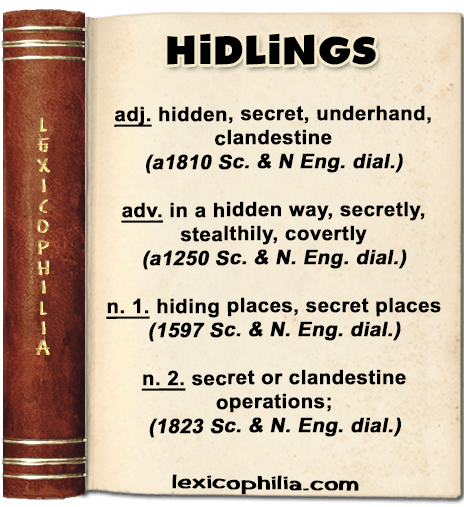
Word of the Day: HIDLINGS


ETYMOLOGY
from hid (adj.) + -ling 


EXAMPLE
“…Anna: Yes: to come to me without loss of time. There is money for thee. Do thy errand speedily and secretly: let nobody know that I have sent thee
Bawldy: An’ she’s to come to you here, hidlings, as it war?
Anna: Yes, Bawldy; and when she comes, let her wait for me in the cattle shed…”

From: Witchcraft
By Joanna Baillie, 1836

Word of the Day: HARRIDAN


ETYMOLOGY
of uncertain origin;
possibly from French haridelle (an old jade of a horse – 1558), (a woman (especially a servant) who is too weak to work – 1690) + a derivative suffix of uncertain origin)


EXAMPLE
“…Parret. Doest take me for a Harridan, or a Cuffey? ha!
Owmuch. I believe thee a very obliging Creature, truely.
Parret. I won’t be believed an obliging Creature by ne’re a Sir Fopling of you all, the Court know me a Creature of Heavens special Handy-work, and if I live to see the City, Bow shall Ring with thy abominations, till Mary-Overs eccho thy lewdness: Tempt me to be an obliging Creature…”

From: Tunbridge-Wells, or, A days courtship a comedy
By Thomas Rawlins, a1670