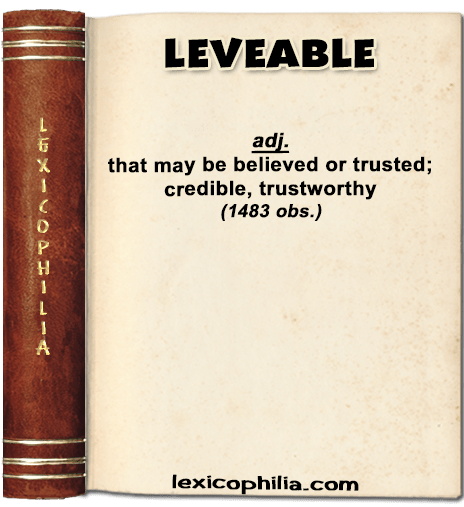
Word of the Day: LEVEABLE

ETYMOLOGY
from leve (to believe, give credence to) + -able

EXAMPLE
“… Fower yomen leveable and discrete, prooved in that facultie of choosing, buyinge, and keepinge of all country wynes; thus everyche of them to pourvey by the Kinge’s commission, to be had by the Thesaurer of housholde’s record and seale, directed to the clerke of the crowne, to make suche commission for suche pourveyours, according to the statutes; …”

From: A Collection of Ordnances and Regulations 
for the Government of the Royal Household
From King Edward III to King William and Queen Mary
Also Receipts in Ancient Cookery
Printed 1790
Liber Niger Domus Regis Edw. IV., a1483

Word of the Day: LEIGHSTER

ETYMOLOGY
representing Old English type líegestre, feminine agent-noun to leogan,
from lie (to tell a lie)

EXAMPLE
“… “Yif ich say ich hadde a hi-leman,
“That ich leighe meselue opon :
“Than ich worth of old and yong
“Be hold
leighster and fals of tong.
“Yete me is best take mi chaunce,
“And sle me childe, and do penaunce.
…”

From: Lai le Freine, c1325
in Metrical romances of the thirteenth, fourteenth, and fifteenth centuries: published from ancient manuscripts
By Henry William Weber, 1810

Word of the Day: LUDIBUND

ETYMOLOGY
from Latin ludibundus, from ludere (to play)

EXAMPLE
“… I promise you, Hylobares, tho’ the fancy of Cuphophron may seem more ordinarily ludibund and lightsomely sportful, yet what he points at seems to be overlamentably true …”

From: Divine Dialogues, Containing Sundry Disquisitions & Instructions Concerning the Attributes and Providence of God
By Henry More, 1668

Word of the Day: LEPID

ETYMOLOGY
from Latin lepidus (pleasant; charming; witty)

EXAMPLE
“… In his daily walks into the fields, nothing pleased him so much as the chat of some well-informed fellow of the college, who would join him in quoting ‘sweet extemporaries’ from Gelius or Macrobius, or ‘in guessing at the lepid derivation’ of English words. To those who were of his own standing, it is to be feared that his conceit and pedantry proved in many cases offensive. …”

From: Simonds D’Ewes in John Howard Marsden’s College Life in the Time of James the First, 1851
Chapter IV: D’ewes’s Diligence in Study, and His Strict Observance of the Duties of Religion, c1619

Word of the Day: LETIFICATE

ETYMOLOGY
from Latin laetificat-, participial stem of laetificare (to make glad),
from laetificus (gladdening), from laetus (joyful)

EXAMPLE
“… There is nothing that doeth comfort the heart so much beside God, as honest myrth and good companie. And wine moderately taken, doeth letificate and doeth comforte the hearte, and good bread doeth confyrme and doeth stablyshe a mannes heart. …”

From: The Breuiary of Helthe
By Andrew Boorde, 1547

Word of the Day: LIP-LICK

ETYMOLOGY
from lip + lick

EXAMPLE
“… Thee gay boy kindlye playing, thee knowne lads phisnomye taking:
That when Queene Dido shal col the, and smacklye bebasse thee,
When quaffing wynebols, when bancquets deyntye be serued,
When she shal embrace thee, when
lyplicks sweetlye she fastneth;
That then thow be suer, too plant thy poysoned hoat looue.
…”

From: Thee first foure bookes of Virgil his Aeneis
Translated intoo English heroical verse by Richard Stanyhurst, 1582

Word of the Day: LEAN-WITTED

ETYMOLOGY
from lean (adj.) + witted (having wit)

EXAMPLE
“… A lunatike leane-witted foole,
Presuming on an agues priuiledge,
Darest with thy frozen admonition
Make pale our cheeke, chasing the royall bloud
With furie from his natiue residence.
Now by my seates right royall maiestie,
Wert thou not brother to great Edwards sonne,
This tong that runnes so roundly in thy head,
Should runne thy head from thy vnreuerent shoulders.
…”

From: The Tragedie of King Richard the Second 
1st Quarto
By William Shakespeare, 1597

Word of the Day: LUCTISONOUS

ETYMOLOGY
from Latin luctisonus (from luctus (grief )+ son- root of sonus (sound)) + -ous

EXAMPLE
“… Let me coacervate a few
Ambagious words amarulent,
Ludificatory, but true,
Ere I become so macilent,
That without voice to ululate
My lov’d one’s
luctisonous name,
My honour I impignorate,
And raise a temulentive flame.
…”

From: The Savage-Club Papers
Edited by Andrew Halliday, 1867
A Social Science Valentine, By Thomas Archer.

Word of the Day: LIRIPOOP

ETYMOLOGY
from Latin liripipiumleropipium, (explained in glosses as ‘tippet of a hood’, ‘cord’, ‘shoe-lace’, and ‘inner sole-leather of shoes’); 
no plausible etymology has been found; connection of the latter part with French pipe (pipe (n.)) is not unlikely;
the form loripipium, which suggests Latin lorum strap, is likely an etymologizing corruption

EXAMPLE (for n. 3)
“… I say againe, my horses:
Are ye so hot? have ye your private pilgrimages?

Must ye be Jumping-Jone? Ile wander with ye:
Ile jump ye, and Ile joggle ye: my horses;
And keep me this young
Lirry-poope within dores,
I will discover, dame. …”

From: Comedies and Tragedies
By Francis Beaumont and John Fletcher, 1647
The Pilgrim