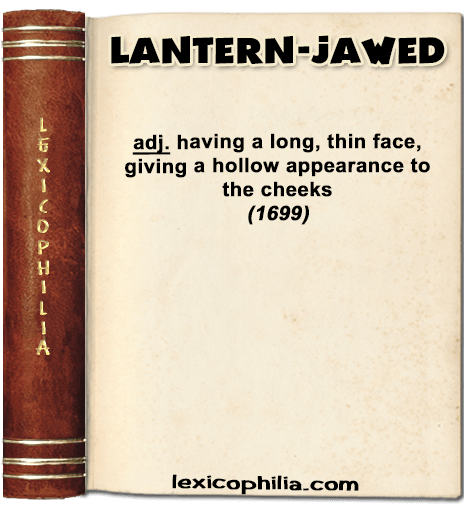
Word of the Day: LANTERN-JAWED

ETYMOLOGY
from the fancied resemblance of the face to the shape of a lantern

EXAMPLE
“…A lanthorn-jaw’d woman, with a hatchet face, sunk eyes, a hook nose, taper lips, leather cheeks, dark Gums, straggling teeth, and such a low forehead, that her hair serves instead of eyebrows…”

From: The Comical Works of Don Francisco de Quevedo
Translated by John Stevens, 1707

Word of the Day: LIBRARIOUS

ETYMOLOGY
from Latin librārius (concerned with books) + -ous

EXAMPLE
“…Garniston. Exactly, This is the illustration and the measure of what you rightly consider our progress in this matter. The acted Shakespearian drama, now attracts crowds of studious people.
Warnford. Or librarious people, at any rate. I don’t say it isn’t the same thing: only I prefer my own word…”

From: MacMillan’s Magazine
Vol. L, May 1884, to October
The Consolations of Pessimism: A Dialogue

Word of the Day: LACHRYMABUND

ETYMOLOGY
from Latin lacrimābundus (weeping, in tears),
from lacrimāre (to shed tears) + -bundus

EXAMPLE
“…that I must soon inevitably succumb, unless you most charitably applicate the balsamic lenitives of complyance to your most agonized,
and lachrymabund slave,
TIMOTHY BLUNDERBUSS
…”

From: The Adventures of Jerry Buck
By John Slade, 1754

Word of the Day: LOGOFASCINATED

ETYMOLOGY
from Greek λόγος (logos) (word)

EXAMPLE
“…by the various ravishments of the excellencies whereof, in the frolickness of a jocound straine beyond expectation, the logofascinated spirits of the beholding hearers and auricularie spectators, were so on a sudden seazed upon in their risible faculties of the soul…”

From: Εκσκυβαλαυρον (Ekskybalauron);
Or, The Discovery of a Most Exquisite Jewel, More Precious Then Diamonds Inchased in Gold
By Thomas Urquhart, 1652

Word of the Day: LACK-BRAIN

ETYMOLOGY
from lack + brain

EXAMPLE
“…Say you so, say you so, I say vnto you againe, you are a shallow cowardly hind, and you lie: what a lacke braine is this? by the Lord our plot is a good plot, as euer was laid, our friends true and constant: a good plot, good friends, and ful of expectation: an excellent plot, verie good friends; what a frosty spirited rogue is this?…”

From: Henry IV, Part I
By William Shakespeare, 1598

Word of the Day: LITTLE SON

ETYMOLOGY
perhaps after Middle French, French petit-fils (grandson, grandchild)

EXAMPLE
“… is the transporting ȝoure littil son and my onelie child in this countrey. To the quhilk albeit I be never sa willing, I wald be glaid to have ȝoure advyse therein, as in all uther thingis tuiching him. I have born him…”

From: The Love Letters of Mary, Queen of Scots
– Hugh Campbell, 1824
Letter written to the Countess of Lennox, July 10, 1570

Word of the Day: LABEFACTATE

ETYMOLOGY
from Latin labefactat-, past participial stem of labefactāre (to make unsteady, to loosen, to undermine)
frequently of labefacere  (to weaken, to impair)

EXAMPLE
“…The judgement seates of Bishops are meerely externall to the Church which they governe: But, Presbyteries and Synods are Courts internall, for the onely members whereof they consist, are the Comissioners of the Churches which they govern; these Churches they represent, the minde and desire of these Churches they doe propose, unto these Churches they give account of all their administration, they confirme and establish the rights of Congregations, they doe not abolish nor labefactate any of them…”

From: A dissuasive from the errours of the time wherein the tenets of the principall sects, especially of the Independents, are drawn together in one map, for the most part in the words of their own authours, and their maine principles are examined by the touch-stone of the Holy Scriptures
– Robert Baillie, 1645

Word of the Day: LANIATE

ETYMOLOGY
from Latin laniāt-, participial stem of laniare (to tear)

EXAMPLE
“…Wail for the little partridges on porringer and plate;
Cry for the ruin of the fries and stews well marinate:
Keen as I keen for loved, lost daughters of the Kata-grouse,
And omelette round the fair enbrowned fowls agglomerate:
O fire in heart of me for fish, those deux poissons I saw,
Bedded on new made scones and cakes in piles to laniate.
For thee, O vermicelli! aches my very maw! I hold
Without thee every taste and joy are clean annihilate
Those eggs have rolled their yellow eyes in torturing pains of fire
Ere served with hash and fritters hot, that delicatest cate
….”

From: Arabian Nights’ Entertainments 
– translated by Richard Francis Burton, 1885