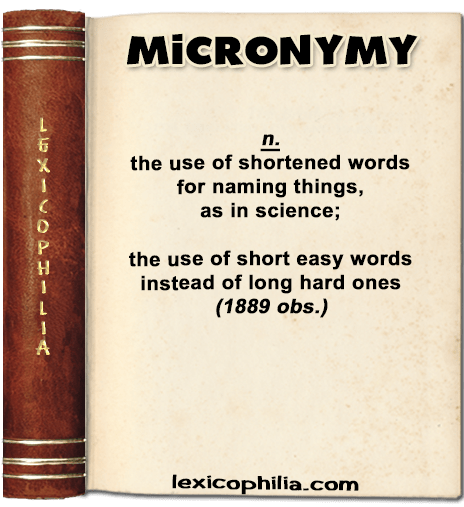
Word of the Day: MICRONYMY


ETYMOLOGY
from Greek µῑκρός (small) + ὄνυµα (name), ὄνοµα, after synonymy, etc.


EXAMPLE
“…Astronomers have set an example in micronymy that anatomists might well fellow; the first asteroid discovered was named Ceres, and many of its successors have dissyllabic or, at most, trisyllabic names. This is the more noteworthy, because, in the first place, these bodies are not, and are hardly likely to become objects of popular discussion; and, secondly, each has its assigned numeric symbol, so that the professional astronomer need not employ the names at all. Now that the choice is offered, the anatomist who deliberately says aponeurosis for fascia, anfractuosity for fissure, and convolution for gyre, runs the risk of association, in the minds of others at least equally well-informed with the “penny-a-liner.” or the village orator who distinctly prefer conflagration to fire …”

From: A Reference Handbook of the Medical Sciences
Edited by Albert H. Buck, 1889

Word of the Day: MALIGNIOUS


ETYMOLOGY
from malign (adj.), from Latin malignus (evil-disposed),
from malus (evil) + -gnus, from base of gignere (to beget, produce, devise)


EXAMPLE
“… for as by the bad is the good knowen, so by the sower is the sweete the better discerned, and by the darkenesse of the night may a man iudge the brightnesse of the day, in so much that I wholy perswade with my selfe that lightly your Honour will pardon my attempt, and fond presumption, in being bold vnder your honours patronage to shield me with defence against such carping, blustering, and malignious tongues, which not onely doo perillously shake at, yea, and indeuour mainely to beat downe, and confute not onely all kind of blossomes, and young budded fruites…”

From: Florio His Firste Fruites which yeelde Familiar Speech, Merie Prouerbes, Wittie Sentences, and Golden Sayings
By John Florio, 1578

Word of the Day: MALLIFUFF


ETYMOLOGY
from Mallie (= English Molly (a girl,. a woman)) + fuff (something easily blown about, a puff)


EXAMPLE
“…And what for should I not be early abroad if I have business? Am I like one of your windlestrae mallifuff madams that cannot stir from their arm-chair till they are drammed up with their green-tea?…”

From: Elizabeth de Bruce
By Christian Isobel Johnstone, 1827

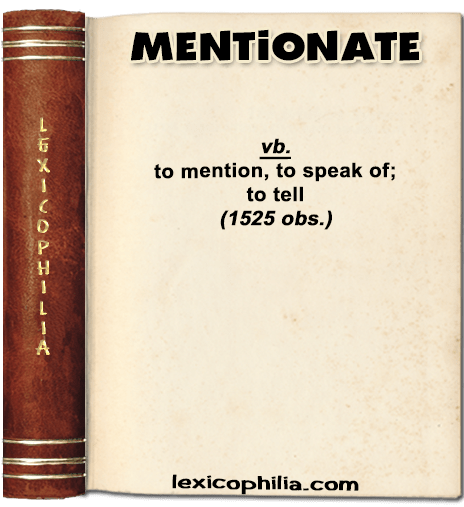
Word of the Day: MENTIONATE


ETYMOLOGY
from Latin mentionatus, pa. pple. of mentionare (to make mention of)


EXAMPLE
“…Ffinally,  in  my  moste  humble  wise,  eftsones  I thanke  your  Grace  for  your  singular  goodenes  afor mentionate  both  concernyng  me  and  also  the  Commons…”

From: Original Letters: Illustrative of English History
Edited by Henry Ellis, 1846
Letter CXXXI. Archbishop Warham to Cardinal Wolsey; c1525

Word of the Day: MARICOLOUS


ETYMOLOGY
from Latin mari-mare (sea) + –colus (inhabiting, colere (to inhabit))


EXAMPLE
“…The members of this genus are small, constantly apterous, gregarious, maricolous, and inhabit relatively still salt and brackish waters of bays, atolls, estuaries, inlets…”

From: Studies on the Fauna of Suriname and Other Guyanas
By D.C. Geijakes, 1962

Word of the Day: MANLING


ETYMOLOGY
from man + -ling


EXAMPLE
“…Marry sir euen all in all, a well lyned pursse, wherwith he could at euery call, prouide such pretie conceytes as pleased hir péeuish fantasie, and by that meanes he had throughly (long before) insinuated him selfe with this amorous dame. This manling, this minion, this slaue, this secretary, was nowe by occasion rydden to London forsothe: and though his absence were vnto hir a disfurnishing of eloquence…”

From: A Discourse of the Aduentures Passed by Master F. I.
In ‘A Hundreth Sundrie Flowres bounde vp in one small poesie’
By George Gascoigne, 1573

Word of the Day: MICACIOUS


ETYMOLOGY
from Latin micare (to shine, sparkle, dart, move swiftly) + -acious 


PRONUNCIATION
migh-KAY-shuhss


EXAMPLE
“…Others little inferior in splendour followed in procession; and what added much to their gorgeous appearance was, that as the oars were lifted, the water was perfectly micacious, and they appeared to glide over a sea of liquid gold…”

From: Constantinople Ancient and Modern:
With Excursions to the Shores and Islands of the Archipelago and to the Troad
By James Dallaway, 1797