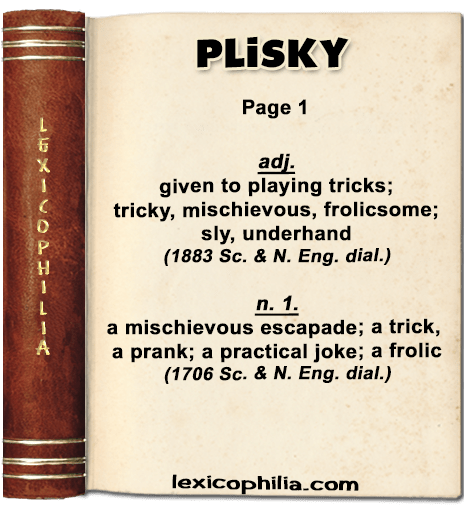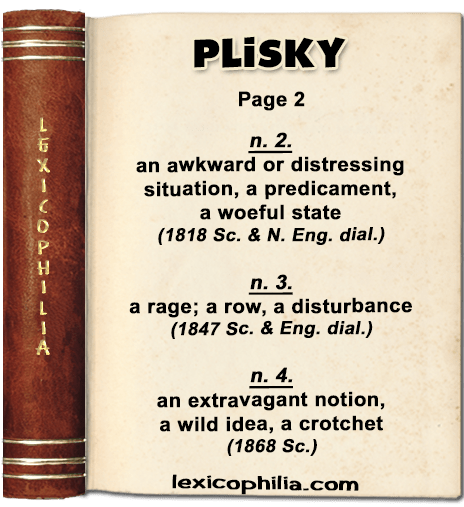
Word of the Day: PLISKY

ETYMOLOGY
of obscure origin

EXAMPLE (for n. 1.)
“… They ‘re fly’d at the heart, it’l be a black Bargain for poor Scotland: for the Engleses are owr auld farren for us, and there’s little Ground to think, they ‘ll gee
us a seen Vantage wee their will, they neer liked us sae well; and its naе forgotten yet, the foul
Plisk they play’d us about our Caledonia Business; …”

From: The Scottish Antiquary Or Northern Notes and Queries
Volume XII, January 1898
A Copy of a Letter from a Country Farmer To His Laird, a Member of Parliament, 1706

Word of the Day: PLURANIMOUS

ETYMOLOGY
from Latin plusplur- (more) + animous;
after unanimous (from Latin unanimisunanimus [from unus (one) + animus (mind)] + -ous)

EXAMPLE
“… Should I make a parallel of this present Basis with the former, & were I sure my Mare would not stumble, I could demonstrate it to be Heterogeneous, Heterodoxous, Incongrous, Omnigenous, Pluranimous, Versipellous, Centireligious, Nummiamorous; I thought I should hit it at length, but I take in Army and all, or else my Mare would soone stand on her head. …”

From: Discolliminium, or, A most obedient reply to a late book, called, Bounds & bonds, so farre as concerns the first demurrer and no further
By B. (Nathaniel Ward), 1650

Word of the Day: PABULOUS

ETYMOLOGY
from Latin pabulasus abounding in pabulum (fodder);
from pabulum (food, nutrient) + –osus (-ous)

EXAMPLE
“… And although the ayre attracted may be conceived to nourish that invisible flame of life, in as much as common and culinary flames are nourished by the ayre about them; I confesse wee doubt the common conceit, which affirmeth that aire is the pabulous supply of fire, much lesse that flame is properly aire kindled: And the same before us, hath been denyed by the Lord of Verulam, in his Tract of life and death, & also by Dr. Jorden in his book of Minerall waters. …”

From: Pseudodoxia Epidemica, or, Enquiries into very many received tenents and commonly presumed truths
By Sir Thomas Browne, 1646

Word of the Day: PREALLABLE

ETYMOLOGY
from Middle French preallable (preceding, preliminary);
from preal(l)er (to precede);
from pre- aller (to go) + -able

EXAMPLE
… And it was not to bee modelled or directed by the patterne of regular and remisse friendship, wherein so many precautions of a long and preallable conversation, are required. This hath no other Idea than of it selfe, and can have no reference but to it selfe. …”

From:  The Essayes, or Morall, Politike, and Millitarie Discourses of Lord Michaell de Montaigne
Translated by John Florio, 1603
Of Friendship

Word of the Day: PINCHPENNY

ETYMOLOGY
from pinch- (comb. form) + penny

EXAMPLE
“… A prince & kyng of al a regioun
Mot avarice thrist a-doune to grounde;
To hym þat lith in helle depe I-bounde,
The, auarice, by-take I to kepe;
Thow
pynepeny, [pynchepeny] ther ay mot þou slepe! …”

From: Hoccleve’s Works,
Edited by Frederick J. Furnivall, 1892
De Regimine Principum
By Thomas Hoccleve, Composed c1412

Word of the Day: PRITTLE-PRATTLE

ETYMOLOGY
reduplicated extension of prattle (to talk in a foolish, childish, or inconsequential way)

EXAMPLE (for vb.)
“… they are poore honest folkes, and haue here an honest company at their mariage, now they lacke wyne, I pray you helpe, She was not long in bibble bable, with saying she wist not what, but sayth at one word, helpe for it is nede. She doth not, as our Papistes do, whiche prittle prattle a whole day uppon their Beades, saying our Ladyes Psalter. But she only sayth, they haue no wyne; helpe. etc. …”

From: Frutefull Sermons
A Sermon Preached by Hugh Latymer, a1552

Word of the Day: PASSANCE

ETYMOLOGY
from passant (passing by or along, going, proceeding; travelling, journeying)

EXAMPLE
“… Thus passed they their passance, and wore out the wéerie way with these pleasant discourses, & prettie posies, where after their tedious toyle, they came to their Inne, where Phemocles coulde neither eate meate for ioy, nor sléepe in his bedde for the pleasure he cōceiued of his trauell. ..”

From: Narbonus The Laberynth of Libertie
By Austin Saker, 1580

Word of the Day: PRIDIAN

ETYMOLOGY
from Latin pridianus (relating to the previous day),
from pridie (adv. on the day before),
from pri- before + dies a day + -anus (-an)

EXAMPLE
“… This Gann, I take it, has similar likings, for I hear him occasionally at midnight floundering up the stairs (his boots lie dirty in the passage)—floundering, I say, up the stairs, and cursing the candlestick, whence escape now and anon the snuffers and extinguisher, and with brazen rattle disturb the silence of the night. Thrice a−week, at least, does Gann breakfast in bed—sure sign of pridian intoxication; and thrice a−week, in the morning, I hear a hoarse voice roaring for ‘my soda−water.’ How long have the rogues drunk soda−water? …”

From:  A Shabby Genteel Story,
And Other Tales.
By: William M. Thackeray, 1840
How Mrs. Gann received two lodgers.