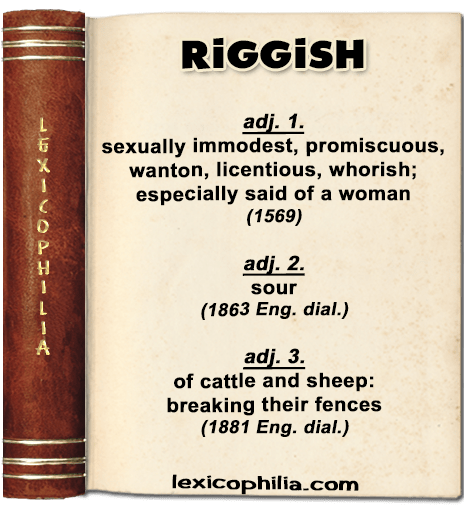
Word of the Day: RIGGISH

ETYMOLOGY
of uncertain origin
n. 1. possibly from rig (a wanton girl or woman)

EXAMPLE (for adj. 1.)
“… As it is to be seene, namely at Rome, what reuenues and rents, that great and soueraign ruffian getteth by his whoores. And afterward of the drouning and killing of children, and secretly murthering, and casting in corners and ditches, as is vsually practised amongst these riggish and lecherous prelates. …”

From:  Jan van der Noot’s Theatre, wherein be represented the miseries that follow the Voluptuous Worldings
By Jan van der Noot
Translated by Theodore Roest, 1569

Word of the Day: RUBICUND

ETYMOLOGY
from Latin rubicundus (ruddy, flushed, reddish, red), either from rubere (to be red) + ‑cundus, or from rubibundus (recorded in post-classical Latin as a rejected form; from rubere + ‑bundus (suffix forming verbal adjectives), with dissimilation of ‑b‑

EXAMPLE (for adj. 2.)
“… Accordyng vnto which rule this fyrst Namer hym selfe, foormed out of ruddy clay, and thearby endued with the purest of complexions (as we tearm them) Rubicund or Sanguine, had hym selfe first to name in the Hebru (the fyrst of langages) Adam. As his make beyng the onely wooman at her creation, counted moother and lyfe to all posteritie, and (for her breakyng the commaundment) the causer also of calamitie and wo, Adam named Eua. …”

From: The calender of Scripture VVhearin the Hebru, Challdian, Arabian, Phenician, Syrian, Persian, Greek and Latin names, of nations, cuntreys, men, weemen, idols, cities, hils, riuers, [and] of oother places in the holly Byble mentioned, by order of letters ar set, and turned into oour English toong.
By William Patten, 1575
The Printer Vnto the Gentle Reedar

PRONUNCIATION
ROO-bick-uhnd

Word of the Day: RATTLE-NODDLED

ETYMOLOGY
from rattle (succession of short, sharp sounds) + noddled

EXAMPLE
“… Well, take this monster all together, and hees a clubfooted, hamble shanck’t, burstengutted, long-neck’t, rattlenodled, large lugg’d eagle eyd Hircocerous, a meere chimera, one of the devils best boys ; but having served him an apprentiship he’s now set up for himself and came out with his wares the last summer cave tertio. …”

From: Confused Characters of Conceited Coxcombs
By K.W., 1661

Word of the Day: RHINOCERICAL

ETYMOLOGY
from rhinoceros + -ical

EXAMPLE (for adj. 1.)
“… Cheat. My lusty rustic, learn and be instructed. Cole is, in the language of the witty, money. The ready, the rhino ; thou shalt be rhinocerical, my lad, thou shalt.

Belf. Admirable, I swear ! Cole ! ready ! rhino ! rhinocerical ! Lord, how long may a man live in ignorance in the country. — And how much cole, ready, and rhino, shall I have? …”

From: The Squire of Alsatia. A comedy
By Thomas Shadwell, 1688

Word of the Day: RORULENT

ETYMOLOGY
from Latin rorulentus (dewy); from ror-ros (dew) + ‑ulentus (‑ulent)

EXAMPLE
“… Anaurus, no such River on Mount Ida, or within any part of the Trojan Territories,
Being only a Name given to any Current raised by Rain, and not sending up
rorulent Steams or Vapors, as all or most Rivers do,
Yet apply’d as a Name to several Rivers, not properly, but to shew how they are qualifi’d like that unſteaming Current …

From: The Tragedies of L. Annæus Seneca the Philosopher;
Translated by Sir Edward Sherburne, 1702

Word of the Day: RENIANT

ETYMOLOGY
from French reniant, pres. pple. of renier (to deny, renounce)

EXAMPLE
“… No helpe to me wardes is shapen: howe shal than straungers in any wyse after socoure loke, whan I that am so privy yet of helpe I do fayle? Further maye I not but thus in this prison abyde: what bondes and chaynes me holden, lady, ye se wel yourselfe? A renyant forjuged hath not halfe the care. But thus syghyng and sobbyng, I wayle here alone, and nere it for comfort of your presence, right here wolde I sterve. …”

From:
The Testament of Love
By Thomas Usk, 1388
In The workes of Geffray Chaucer newly printed. 1532

Word of the Day: RUMBUSTICAL

ETYMOLOGY
possibly an alteration of rumbustious (boisterous, unruly);
or perhaps an alteration of obsolete English robustic (robust, robustious), 
from robust + -ic + -al

EXAMPLE
“… I will, your worship: but I am glad his honour, the Major, is not to be jocum tenus for your worship, he’s so much upon the roguish order with the women, now and ten. I did not care to mention it to your worship before; but as true as I’m alive he was a little rombustical to our Bridget, no longer ago than last Sunday was se’night, as she was coming home from church. …”

From: The Flitch of Bacon; a comic opera
By Henry Bate Dudley, 1779

Word of the Day: RIB-BASTE

ETYMOLOGY
from rib (n.) + baste (to beat or thrash)

EXAMPLE
“… A good Pay-master (answered Sancho) will neuer grudge to giue wages; I thinke to curry or so be-labour my selfe, that without endangering my life, my lashes shall bee sensible vnto me, and therein must the substance of this miracle consist. And immediately Sancho stripped himselfe bare from the girdle vpward, and taking the whip in his hand, began to ribbe-baste and lash himselfe roundly; and Don Quixote to number the strokes. When Sancho had giuen himselfe seuen or eight stripes, hee thought he had killed himselfe; so that pawsing awhile, hee said to his Master, that he was very much deceiued, and would therfore appeale, forsomuch as euery whip-lash did in lieu of a piece of three Blanks, deserue halfe a Ryall. …”

From: The second part of The History of the Valorous and Witty Knight-Errant, Don Quixote of the Mançha
Written in Spanish by Michael Cervantes
Translated by Thomas Shelton, 1620

Word of the Day: RESPECTUOUS

ETYMOLOGY
from respect (n.) + -uous
originally after French respectueux (showing respect, respectful)

EXAMPLE
“… Howbeit, they are themselves partly the cause that they doe incurre this obscuritie and igno­rance: who being of divers and contrarie natures, yet fall into one and the selfesame inconveni­ence. For some upon a certaine respectuous reverence which they bare unto their Reader and Doctour, or because they would seeme to spare him, are afraid to aske questions, and to be con­firmed and resolved in doubts arising from the doctrine which he delivereth: and so give signes by nodding their heads that they approove all, as if they understood everie thing verie well. …”

From: The Philosophie, commonlie called, The Morals
By Plutarch of Chæronea
Translated out of Greeke into English, and conferred with the Latine translations and the French, by Philemon Holland, 1603

Word of the Day: RIDENT

ETYMOLOGY
from Latin rident-ridens, present participle of ridere (to laugh), of uncertain origin

EXAMPLE
“…Bo. Hold up; so, sir, now away. Oh Mistris, your scantling, most sweete mistriss, most derydent starre.

Acut. Then most rydent starre, faire fall ye.

Grac. Nay tis the Moone her self, for there’s her man and her Dogge before. …”

From: Everie Woman in her Humor
Printed by E.A. for Thomas Archer, and are to be solde at his shop in the Popes-head-Pallace, neere the Royall Exchange’ ,1609