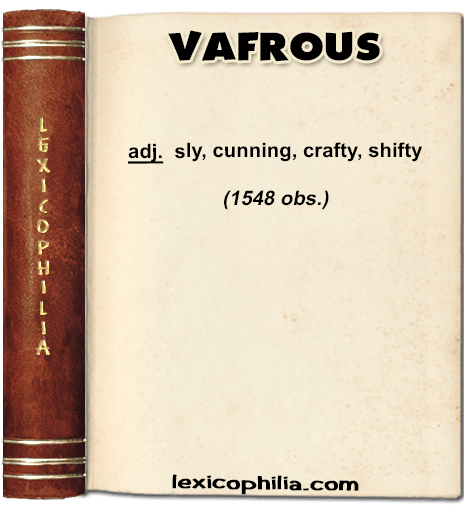
Word of the Day: VAFROUS


ETYMOLOGY
from Latin vafervafr- (sly, cunning, crafty) + -ous


EXAMPLE
“…thinkyng surely that they for the most part, would neuer cosent & longe agree with the Englishmen, accordyng to their olde vaffrous varietie: wherfore least ye he should offend or ministre cause of occasio to them (as in dede all me were not his frendes in Scotlad at that tyme) he desired y Ambassadours to cosent w truce & abstinece of warre for suen yeres…”

From: The Vnion of the Two Noble and Illustre Famelies of Lancastre [and] Yorke
By Edward Hall, 1548

Word of the Day: VAGITATE


ETYMOLOGY
from medieval Latin vagitare, from Latin vagari (to wander)


EXAMPLE
“…But we must consider, that they euermore kept the coast, and crept by the shores, which made the way exceeding long. For before the vse of the Compasse was knowne, it was impossible to vagitate athwart the Ocean; and therefore Salomons ships could not finde Peru in America…”

From: The History of the World
By Sir Walter Raleigh, 1614

Word of the Day: VOUST


ETYMOLOGY
of unknown origin


EXAMPLE
“…Circuland abowt with swift fard of the cart
The feildis our all quhar in euery art,
And schew hir bruthir Turnus in his char,
Now brawland in this place, now voustand thar;
Na be na way wald scho suffir that he
Assembill hand for hand suld with Enee…”

From: The Æneid of Virgil
Translated Into Scottish Verse
By Gavin Douglas, 1513

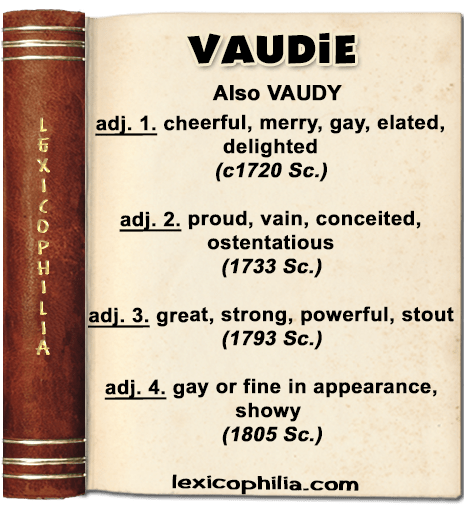
Word of the Day: VAUDIE

ETYMOLOGY
of unknown origin;
possibly an altered form of vandievauntie

EXAMPLE
“…How lang shall our land thus suffer distresses,
Whilst traitors, and strangers, and tyrants oppress us!
How lang shall our old, and once brave warlike nation,
Thus tamely submit to a base usurpation?
Thus must we be sad, whilst the traitors are vaudie,
Till we get a sight of our ain bonnie laddie
…”

From: Jacobite Songs, 1871
How Lang Shall Our Land
By William Meston,

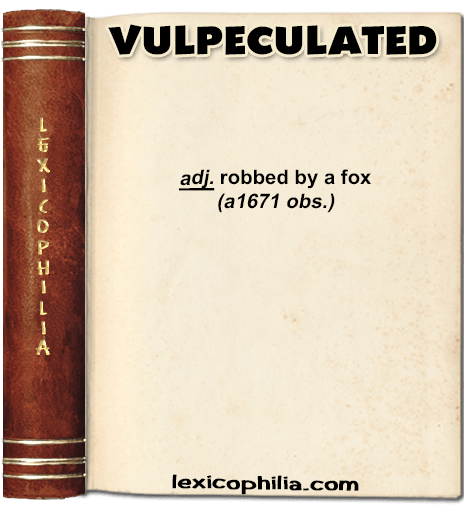
Word of the Day: VULPECULATED

ETYMOLOGY
from Latin vulpecula, dim. of vulpes (fox)

EXAMPLE
“..the Dun Cow went a maskarado last night, and is not as yet returned. Upon the fourth of this month our neighbour Geoffrey’s barn was eclipsed, ab ovo ad mala. And the night before Widdow Wamford was vulpeculated of her brood Goose.—latet anguis in herbâ. The Turkie Cock growes very melancholy…”

From: Mr Hobbs’s State of Nature Considered,
In a Dialogue Between Philautus and Timothy
By John Eachard, 1672