Word of the Day: ZODIOGRAPHER

ETYMOLOGY
from Greek ζῴδιον diminutive of ζῷον (animal) + γράϕειν (to write)

EXAMPLE
“… Notwithstanding upon enquiry we find no mention hereof in Ancient Zodiographers, and such as have particularly discoursed upon Animals,
as Aristotle, Elian, Pliny, Solinus and many more; who seldom forget proprieties of such a nature, and have been very punctual in less considerable Records. …”

From: Pseudodoxia Epidemica
By Sir Thomas Browne, 1650
Of the Picture of the Pelecan
Word of the Day: ZOOPHILIST


ETYMOLOGY
from  zoo + -philist; from Greek ϕίλος (loving, dear) + ‑ist


EXAMPLE
“…A foreigner in America has recently discovered a species of animal which is likely to become as great a favourite among our female zoophilists, and may, perhaps, in future, banish the lap-dog from the drawing-room and the bed-chamber…”

From: The London and Paris Observer:
Or Weekly Chronicle of News, Science, Literature, and the Fine Arts
Volume 5, 1829

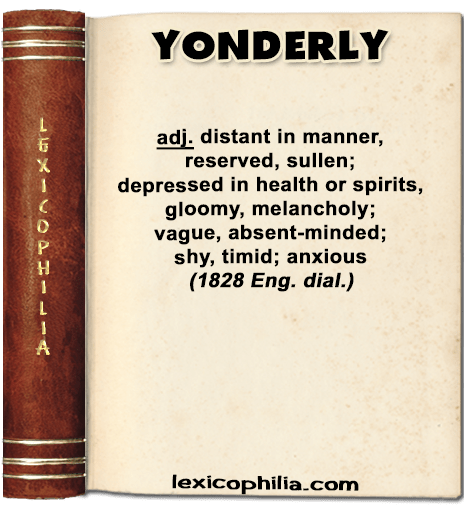
Word of the Day: YONDERLY


ETYMOLOGY
from yonder (adv., adj., pron., & n.) + -ly


EXAMPLE
“…Poor lass, hoo were kinder becose aw were quare;
“Come, Jamie, an’ sattle thisel in a cheer;
Thae’s looked very yonderly mony a day;
It’s grievin’ to see heaw thae’rt wearin’ away,
            An’ trailin’ abeawt,
            Like a hen at’s i’th meawt;
    Do, pritho, poo up to thi tay!
…”

From: Lancashire Songs
By Edwin Waugh, 1863
Jamie’s Frolic

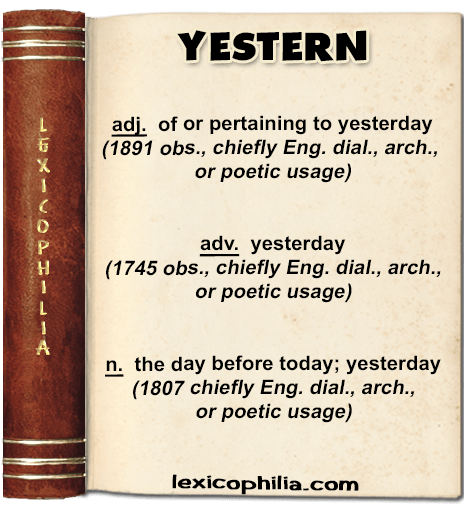
Word of the Day: YESTERN


ETYMOLOGY
? partly a) (in English editions of Scots texts) a variant or alteration of yestreen (adv. during the evening of yesterday), after yester (adv. yesterday); and partly
b) a variant or alteration of yester (adv.), yester (n.), and yester (adj.), respectively


EXAMPLE
“…Now wat ye wha I met yestern,
Coming down the street, my jo?
My mistress in her tartan screen,
For bony, braw and sweet, my Jo…”

From: Allan Ramsay in Aviary, 1745
‘Edinburgh Kate’

Word of the Day: XENOMANIA

ETYMOLOGY
from xen- combining form of Greek ξένος (xenos stranger, guest & adj. foreign, strange) + mania

EXAMPLE
“…Germany received the first caresses of this strange xenomania from the hands of youthful Carlyle and old Coleridge, but the friendship developed into fashion only half a generation later…”

From: The Nineteenth Century
A Monthly Review
Edited by James Knowles, Vol. VI, July-December, 1879
Familiar Letters on Modern England, I.

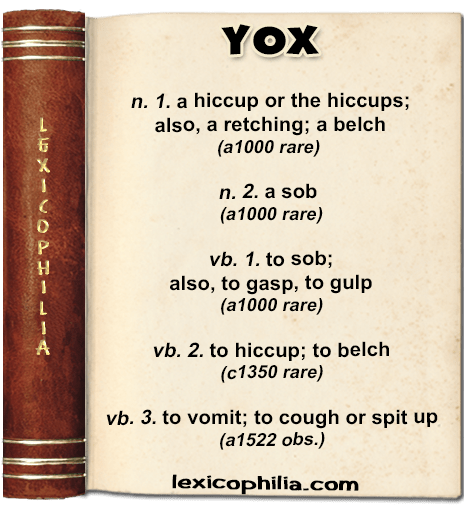
Word of the Day: YOX

ETYMOLOGY
– obsolete or dialect form of YEX – Old English ᵹeocsianᵹiscian
corresponding to Old High German geskôngesgizôn ‘oscitare’: of imitative origin

EXAMPLE (for n. 1.)
“…There throngs a Cutpurse, with his working toole,
And there’s gallant Coxcombe, there’s Fooles
There’s foure or fiue together by the eares,
And tumble in the Dirt like Dogs and Beares.
One staggering there hath got the drunken yox,
And there one swaggering’s fast within the Stocks
Thus with these Gadeymaufry humours still
…”

From: Goose,
Goose Faire at Stratford Bow, the Thursday after Whitsuntide
John Taylor, 1621