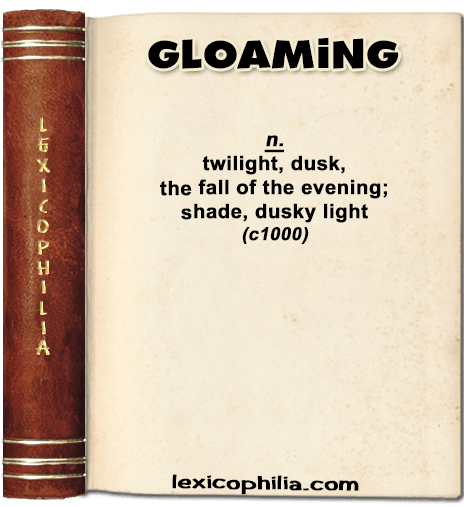
Word of the Day: GLOAMING

ETYMOLOGY
representing Old English glomung strong feminine, from (on the analogy of ǽfning evening) glom (twilight), probably from the Germanic root glo-;
the etymological sense would thus seem to be the ‘glow’ of sunset or sunrise

EXAMPLE
“… There’s some exceptions, man an’ woman;
But this is Gentry’s life in common.
By this, the sun was out o’ sight,
An’ darker
gloamin brought the night;
The bum-clock humm’d wi’ lazy drone;
The kye stood rowtin’ i’ the loan;
When up they gat, an’ shook their lugs,
Rejoic’d they were na men, but dogs;
An’ each took aff his several way,
Resolv’d to meet some ither day.
…”

From: The Twa Dogs. A Tale
By Robert Burns, 1786

Word of the Day: SENNIGHT

ETYMOLOGY
from seven + the plural of night  

EXAMPLE
“… Among other, none was either more grateful to the beholders, or more noble in it selfe, then iusts, both with sword & launce, mainteined for a seuen-night together: wherein that Nation doth so excel, both for comelines and hablenes, that from neighbour-countries they ordinarilye come, some to striue, some to learne, some to behold. …”

From: The Countesse of Pembrokes Arcadia
By Sir Philip Sidney, 1590

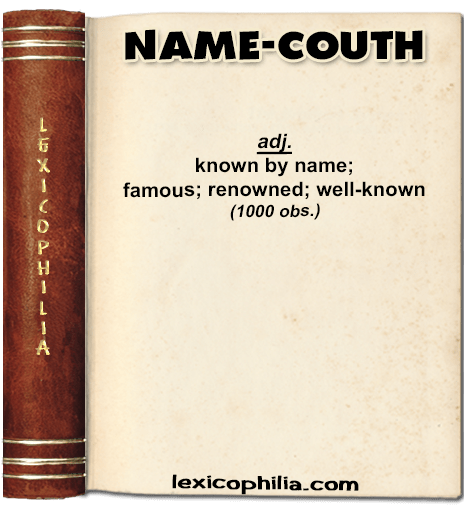
Word of the Day: NAME-COUTH

ETYMOLOGY
formed similarly to Middle Dutch namecontnaemcont, Danish navnkund (obs.); from the Germanic base of name (n.) + the Germanic base of couth (known (obs.)

EXAMPLE
“…In eche of this Epicicles was ficched one of the seven namecouth planetes, that be called sterres Erratikes, saaf only þat the sonne was withowt þe epicicle, fiched evene in the circumference of his difference. ….”

From: The Booke of the Pylgremage of the Sowle
Translated from the French of Guillaume de Guileville
From the Egerton Manuscript, a1500

Word of the Day: BISMER


ETYMOLOGY
from OED: from West Germanic: Old English bísmer-or (strong neuter), identical with Old High German bísmer (ridicule), from bí-, be- prefix (in its strong or accented form) + -smer, which Schmeller connects with Middle High German smier (a smile, laughing), smieren (to smile).
Others have compared Old High German smero, Old English smeoru, Old Germanic *smerwo-(m, ‘fat, grease, butter,’ which seems, on phonetic as well as other grounds, less probable.


EXAMPLE
“…And eek for sche was somdel smoterlich
Sche was as deyne as water in a dich
     As ful of hokir and of bissemare
hir thoughte ladyes oughten hir to spare /
what for hir kynreed and hir nortelrye
…”

From: The Harleian ms. 7334 of Chaucer’s Canterbury Tales
Geoffrey Chaucer, c1386

Word of the Day: HAND-WHILE

ETYMOLOGY
Middle English, from Old English handhwīl, 
from handhond (hand) + hwīl (while);
originally alluding to the short span of a handbreadth

EXAMPLE
“…Thou semste (quoth the spider) a costerde monger.
Conscience euery handwhile thou doste cry.
I muste (quoth the flie) se sum token stronger.
Ere I can suppose you of that mistery.
I call not for conscience more comonly.
Then you speake of it seelde, flie I tolde the erste.
Cause why: that conscience at laste ende shulde be perste
…”

From: The Spider and the Flie
A Parable of the Spider and the Flie
By John Heywood, 1556

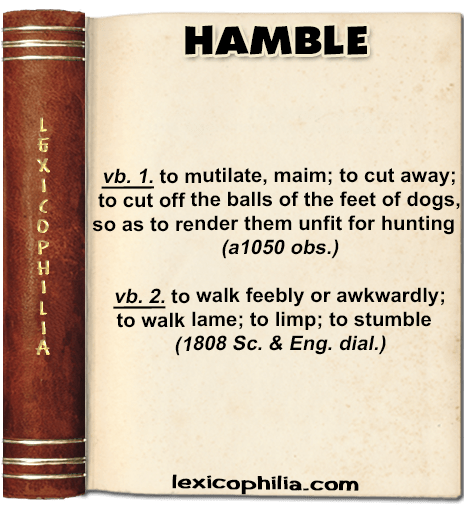
Word of the Day: HAMBLE

ETYMOLOGY
from Old English hamelian (to mutilate);
from an adjective appearing on Old High German as hamal (maimed, mutilated), whence mod.German hammel (a castrated sheep)

EXAMPLE
“…sume hi man bende, sume hi man blende,
sume man hamelode and sume heanlice hattode
…”

(…Some did they bind, some did they blind,
Some did they hamstring, some did they scalp
…)

From: The Anglo-Saxon Chronicle

Word of the Day: OVERSLOP

ETYMOLOGY
Old English oferslop (in Old Norse yfirsloppr), 
from over- + slop (a smock)

EXAMPLE
“…By cause of which men sholde hym reuerence
That of his worshipe rekketh he so lite
His ouerslope nys nat worth a myte
As in effect to hym / so moot I go
It is al baudy and to-tore also
…”

From: Canon’s Yeoman’s Tale
By: Geoffrey Chaucer, c1395

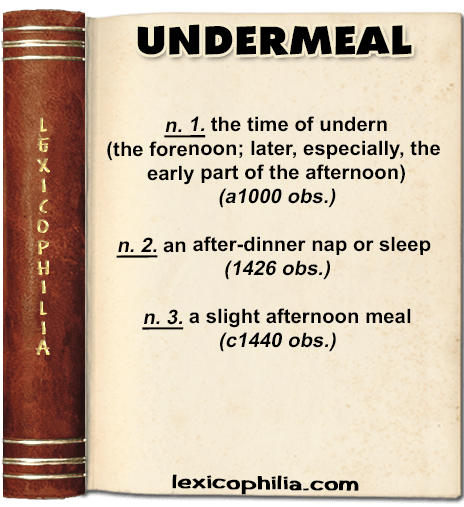
Word of the Day: UNDERMEAL

ETYMOLOGY
Old English undernmǽl

EXAMPLE
(for n. 2.)
“…that drawes deepe, and by that time his Tobacco marchant is made even with, and hee hath dinde at a tauerne, and slept his vnder-meale at a bawdy house, his purse is on the heild and only fortie shillings hee hath behinde, to trie his fortune with at the cardes in the presence…”

From: Lenten Stuffe
– Thomas Nashe, 1599

Word of the Day: MISQUEME

ETYMOLOGY
from mis- (expressing negation of something good or desirable) 
+ queem, queme (to please)

EXAMPLE
“…The kings law wol no man deme
Angerliche without answere:
But if any man these misqueme,
He shall be baighteth as a bere:
And yet wel worse they wol him tere,
And in prison woll him pende,
In giues, and in other gere.
When God woll, it may amend
…”

From: The Ploughman’s Tale, c1535