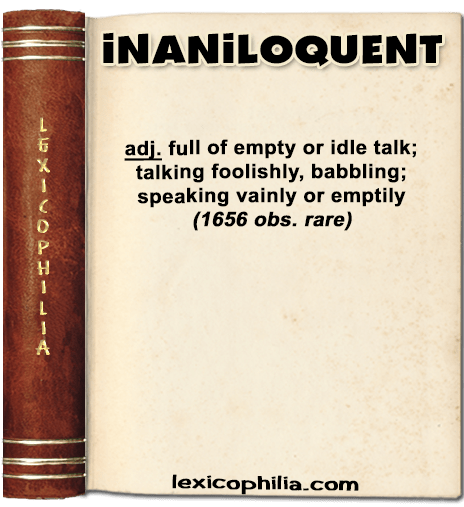
Word of the Day: INANILOQUENT

ETYMOLOGY
from Latin inanis (inane) + loquentem, pres. pple. of loquī (to speak)

EXAMPLE
“…But that is just the beginning. Beginning of the elegantly inaniloquent disassembling of bourgeois literary sensibilities vis-a-vis the text…”

From: The Politics of Style in the Fiction of Balzac, Beckett and Cortazar
By Mark Richard Axelrod, 1992
Beckett’s Metarrhetoric

Word of the Day: SUPERSTITIATE

ETYMOLOGY
from superstiti- + -ate 

EXAMPLE
“…Wherefore I will say to such, as one wiser than Solomon said to the Jews, when they superstitiated the gift, in counting it more honourable than the altar, ‘Ye fools, and blind, for whether is greater, the gift, or the altar that sanctifieth the gift?…”

From: The Saints’ Privilege and Profit
Or, The Throne of Grace
By John Bunyan, a1688

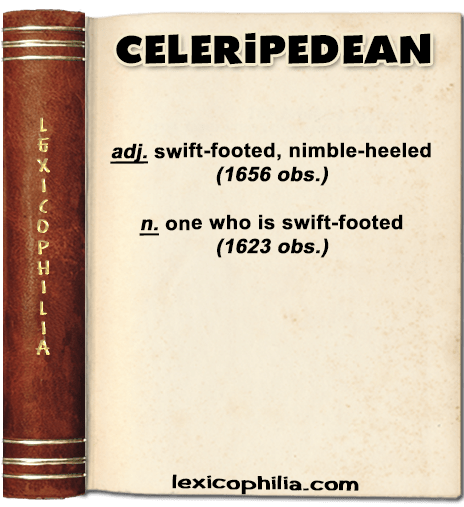
Word of the Day: CELERIPEDEAN

ETYMOLOGY
from Latin celeripedem (swift-footed),
(from celer (swift) + pedem (foot)) + -ean

EXAMPLE
“…with a decutient shrug of his stooped shoulders, as tho to desarcinate himself of funebrous thoughts, departed at a pace very different from the celeripedean gait of pristine years …”

From: American Speech, Volume 2
Edited by Arthur Garfield Kennedy, Kemp Malone, Louise Pound, William Cabell Greet, 1927

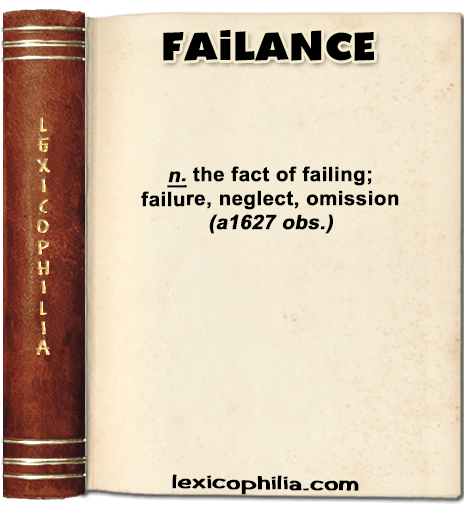
Word of the Day: FAILANCE

ETYMOLOGY
from Old French faillance, from faillir (to almost do something, to fail)

EXAMPLE
“…but when you come to Exercise the whole company ioyned, you may at some times for your owne satissaction in the more ready & gracefull performance of them, command the Postures to bee done by the whole number at once, with such pawse betweene euery Posture, as may afford you meanes to discerne any faylance therein: but whensoeuer you skirmish you shall vse no more of direction then,
1. Make Ready.2. Present.3. Giue Fyre
…”

From: The Compleat Gentleman, fashioning him absolute in the most necessary & commendable qualities concerning minde or bodie that may be required in a noble gentleman
By Henry Peacham, 1627

Word of the Day: LIBRARIOUS

ETYMOLOGY
from Latin librārius (concerned with books) + -ous

EXAMPLE
“…Garniston. Exactly, This is the illustration and the measure of what you rightly consider our progress in this matter. The acted Shakespearian drama, now attracts crowds of studious people.
Warnford. Or librarious people, at any rate. I don’t say it isn’t the same thing: only I prefer my own word…”

From: MacMillan’s Magazine
Vol. L, May 1884, to October
The Consolations of Pessimism: A Dialogue

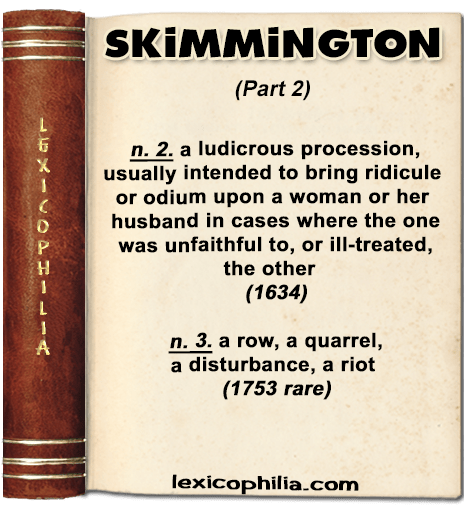
Word of the Day: SKIMMINGTON

ETYMOLOGY
possibly from skimming + -ton as in simpleton, with the object of simulating a personal name

EXAMPLE
“…And then, if they meere with such dull Lubbers as these Drones are; they may may with lesse blame borrow a point of the Law, and enjoy their longing. Yet when they haue it, let them vse poore Skimmington as gently as they may especially in publike, to hide his shame…”

From: The Feminine Monarchie,
Or the Historie of Bees
By Charles Butler, 1623

Word of the Day: LOGOFASCINATED

ETYMOLOGY
from Greek λόγος (logos) (word)

EXAMPLE
“…by the various ravishments of the excellencies whereof, in the frolickness of a jocound straine beyond expectation, the logofascinated spirits of the beholding hearers and auricularie spectators, were so on a sudden seazed upon in their risible faculties of the soul…”

From: Εκσκυβαλαυρον (Ekskybalauron);
Or, The Discovery of a Most Exquisite Jewel, More Precious Then Diamonds Inchased in Gold
By Thomas Urquhart, 1652

Word of the Day: PACIFICATE

ETYMOLOGY
from Latin pacificat-, past ppl. stem of pacificare (to make peace, to pacify)

EXAMPLE
“…It mitigateth anger, letificateth those that bee sad, pacificateth such as are at discord. It temperateth choler, and (to conclude all in a word) it expelleth all vagrant, wandring, and imagi­nary cogitations whatsoeuer…”

From: The Secrets of Nvmbers.
According to Theologicall, Arithmeti­call, Geometricall and Harmoni­call Computation
By William Ingpen, 1624