Word of the Day: EARWIGGING


ETYMOLOGY
 from earwig (to annoy or attempt to influence by private talk) + -ing 


EXAMPLE
“…I remember the first introduction of Boswell on what may be called the Johnsonian stage. What is ludicrously called his earwigging, began to attract notice; and my father enquired of Mr. Langton, who this novel performer was, meaning rather, I believe, to be on good terms with him, as a frequenter in Bolt Court…”

From: Memoirs, Anecdotes, Facts, and Opinions
By Laetitia Matilda Hawkins, 1824

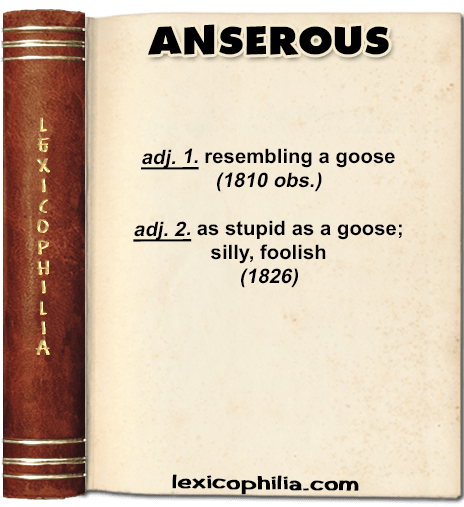
Word of the Day: ANSEROUS

ETYMOLOGY
from Latin anser (goose) + -ous

EXAMPLE
“…Can any one be so anserous as to suppose, that the faculties of young men cannot be exercised, and their industry and activity called into proper action, because Mr. Hamilton teaches, in three or four years, what has (in a more vicious system) demanded seven or eight?…”

From: The Edinburgh Review, June, 1826
Hamilton’s Method of Teaching Languages

Word of the Day: ROUNDABOUTATION

ETYMOLOGY
from roundabout (engaging in circumlocution, long-winded)+ -ation

EXAMPLE
“…At dinner fair Adelaide brought up a chicken
A bird that she never had met with before;
But, seeing him, scream’d, and was carried off kicking,
And he bang’d his nob’gainst the opposite door.
To finish my tale without roundaboutation,
Young master and missee besieged their papa;
They sung a quartetto in grand blubberation
The Stranger cried Oh! Mrs. Haller cried Ah!
Though pathos and sentiment largely are dealt in,
I have no good moral to give in exchange
…”

From: Rejected Addresses;
Or, The New Theatrum Poetarum 
– Horatio Smith and James Smith, 1812

Word of the Day: FLAMBUGINOUS

ETYMOLOGY
– a burlesque formation on flam (a fanciful notion, caprice, whim obs.)

EXAMPLE
“…To these were added a number of the minor order of exhibitors. In one place you saw the miraculous and flambuginous sea-monster, known by the name of the Non-Descript. Next to it stood the Musical Rat, which played most divinely on the mouth-organ…”

From: The Sporting Magazine of the Transactions of The Turf, The Chase,
And every other Diversion Interesting to the Man of Pleasure, Enterprize, and Spirit.
Volume 42, 1813
Easter Amusements of the Year 1813

Word of the Day: DILLY-DAW

ETYMOLOGY
– from dilly as in dilly-dally + daw (n. a slattern, an untidy woman)

EXAMPLE
“…An’ is it no angersome to see her like a dilly daw, an’ bits o’ creatures that she could keep at her fire-side, buskit up like Flanders-babies?…”

From: The Saxon and the Gaël, Or, The Northern Metropolis
Christian Isobel Johnstone, 1814

Word of the Day: LOGOLATRY

ETYMOLOGY
from Greek λόγος (word) + -latry

EXAMPLE
“…but one fanciful process of hypostasizing logical conceptions and generic terms? In Proclus it is Logolatry run mad…”

From: The Literary Remains of Samuel Taylor Coleridge
Edited by Henry Nelson Coleridge, 1839, Volume IV
Notes on Whitaker’s Origin of Arianism Disclosed. 1810. Chapter I.