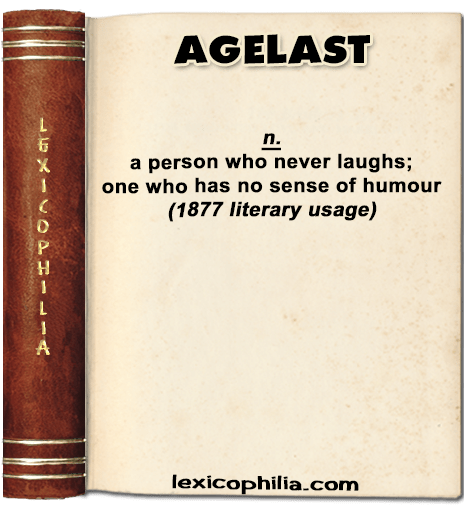
Word of the Day: AGELAST


ETYMOLOGY
from agelaste (person who never laughs),  from Greek ἀγέλαστος (agelastos – not laughing),
from ἀ- (a having sense without) + γελασ-, stem of γελᾶν (to laugh) + ‑τος


EXAMPLE
“…But let us beware lest in our laughter we commit the very sin which raised it, for through all laughter, the most benighted, must arise primarily from an, at least, imagined comic perception, in most the maximum is on the wrong side, Over-laughing, the sin of the ‘hypergelast’ as Mr. Meredith terms him, is even less tolerable to the muse than that of the ‘agelast‘ he who
‘Show his teeth in way of smile
Though Nestor swore the jest be laughable,’
and if we are guilty of it, the muse will but send out another laughter upon ours, which in its turn may need chastening
…”

From: George Meredith: Some Characteristics.
By Richard Le Gallienne, 1890
‘The Comic Muse’


PRONUNCIATION
AJ-uh-lasst

Word of the Day: ASTRAPHOBIA


ETYMOLOGY
from Greek ἀστραπή (astrape lightning) + phobos (fear)


EXAMPLE
“…These nervous perturbations, in their various degrees, have seemed to me to be sufficiently frequent and distinctive to entitle them to be regarded as a separate disease. To this disease I have given the name Astraphobia…”

From: Te Popular Science Monthly
Conducted by E. L. Youmans, Vol. IV. February 1874
Atmospheric Electricity and Ozone

Word of the Day: PHILOTHERIAN


ETYMOLOGY
from Greek ϕιλο-, ϕιλ-, combining form from root of ϕιλεῖν (to love), ϕίλ-ος (dear, friend)
+ θήρ (wild beast)


EXAMPLE
“…It is the reply of an old fisher-woman, when reproved by some Philotherian for skinning eels alive.
“Sir,” said she, “I have skinned them thusly for nearly fifty years; and they have got so used to it, they don’t mind it one bit.”…”

From: The Harvard Advocate
Vol. XI. Cambridge, Mass., February 28, 1871. No. I
Editorial

Word of the Day: RATTLEY-BAGS

ETYMOLOGY
??? – perhaps from the Scottish ‘rattlebag‘ (a bag filled with small stones and hung on the end of a stick to make a rattling noise)

EXAMPLE
“…In the North of England children call, or used to call, thunder Rattley-bags, and to sing this couplet during a storm

Rowley, Rowley, Rattley-bags,
Take the lasses and leave the lads
…”

From: Notes on the Folk-Lore of the Northern Counties of England and the Borders
By William Henderson, 1879

Word of the Day: PORNERASTIC

ETYMOLOGY
from Greek πορνo- (porno- comb. form) + ἐραστής (lover) + –ic

EXAMPLE
“…We hear nothing of those petit creve vices, those pornerastic habits in high places, those Diamond-necklace scandals, those unmentionable gambols of the Porphyro-geniti, which are too often thrust before our eyes in fiction, and indeed in fact…”

From: The Fortnightly Review
Edited by John Morley,
Vol. VII New Series, January to June, 1870
The Romance of the Peerage

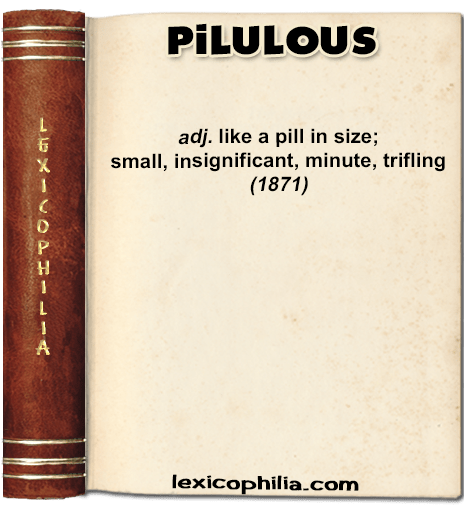
Word of the Day: PILULOUS

ETYMOLOGY
from Latin pilula (pill) + -ous

EXAMPLE
“…Dorothea’s inferences may seem large; but really life could never have gone on at any period but for this liberal allowance of conclusion, which has facilitated marriage under the difficulties of civilization. Has anyone ever pinched into its pilulous smallness the cobweb of pre-matrimonial acquaintanceship?…”

From: Middlemarch
– George Eliot, 1871

Word of the Day: XENOMANIA

ETYMOLOGY
from xen- combining form of Greek ξένος (xenos stranger, guest & adj. foreign, strange) + mania

EXAMPLE
“…Germany received the first caresses of this strange xenomania from the hands of youthful Carlyle and old Coleridge, but the friendship developed into fashion only half a generation later…”

From: The Nineteenth Century
A Monthly Review
Edited by James Knowles, Vol. VI, July-December, 1879
Familiar Letters on Modern England, I.