Word of the Day: WUZZY

ETYMOLOGY
of uncertain origin;
possibly a variant of woozy (dizzy or unsteady); possibly after muzzy (drowsy, spiritless; confused, mentally hazy; dazed and unfocused)

EXAMPLE
“… I am very nearly mad, I am quite slowly turning wuzzy. I see four people instead of one, and I have an irresistible longing to eat the fire and beat my door-handle. …”

From: Antony (Viscount Knebworth): A Record of Youth
By Edward Anthony James Lytton, 1935
Letter written 10 March, 1921

Word of the Day: THINKATIVE

ETYMOLOGY
from think (vb.) + -ative, chiefly after talkative

EXAMPLE
“… They have not known I say, that the knowledge of Observation, doth not introduce an understanding into the essential thingliness of a thing, but erecteth only a thinkative knowledge: For otherwise, the understanding should perceive causes that are before in essence. Then also they have been deceived by the simplicity of the Water, which simpleness they have confounded with the unity of knowledge to us unknown. …”

From: Oriatrike or, Physick Refined
By Jean Baptiste van Helmont
Translated by J. Chandler, 1662

Word of the Day: PODGER


ETYMOLOGY
for n. 1. – a variant of pottinger
for n. 2, 3, 4 – from podge (anything short or thick)  + ‑er 


EXAMPLE
“…He cannot deal the knock-me-down blows of Old Brough, and if you watch your opportunity you may give him a podger. I am seldom in a cause of any consequence before him without getting into some squabble with him…”

From: Life of John, Lord Campbell, 1881,
Letter dated 9 March, 1816

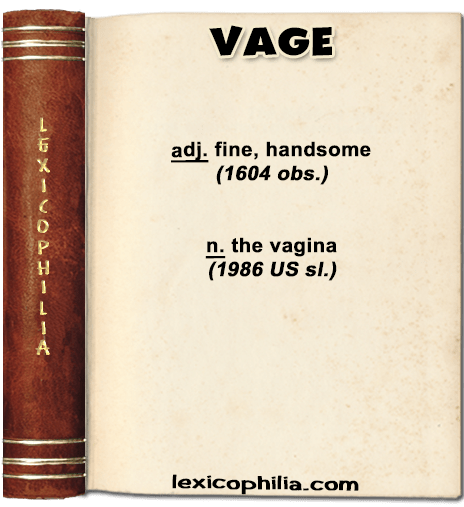
Word of the Day: VAGE


ETYMOLOGY
adj,: apparently from Italian vago


EXAMPLE
“…no doubt but better parts, finer colours, purer lights proportionably combined, cause a more excellent beautie, shew, and lustre: as the siner gold, the richer stones (if art bee correspondent) the more vage and beautifull iewell…”

From: The Passions of the Minde in Generall
By Thomas Wright, 1604