Word of the Day: ATTOXICATED

ETYMOLOGY
from Latin at-ad- (to) + toxicare (to poison) + -ed

EXAMPLE
“… Who seeth and feeleth not, that oftentimes while Reason attendeth to Contemplation, a villanous passion of Loue withdraweth the attention, and with an attoxicated delight imprisoneth the Affection? Who perceiueth not, that diuers times Reason would pardon all iniuries, and Ire opposeth it selfe, importuning reuenge? …”

From: The Passions of the Minde
By Thomas Wright, 1604
Word of the Day: LIVER-FACED

ETYMOLOGY
from liver (the bodily organ regarded as the seat of cowardice (usually characterized as light-coloured or white), obs.) + faced

EXAMPLE
“… “Only a little crack’d, ever since that one-eyed, liver-faced spalpeen came athurt us – a hard hiccup to his dying speech!

“What one-eyed, liver-faced spalpeen do you mean?” asked Elwin.
“Did I say them words then, your honor ?” said Tade, ” ’cause if I did, I must be dreamin’, for divil sich a parson I ever see, since my mother weaned me.”
…”

From: The Prediction
By Isabella Steward, 1834

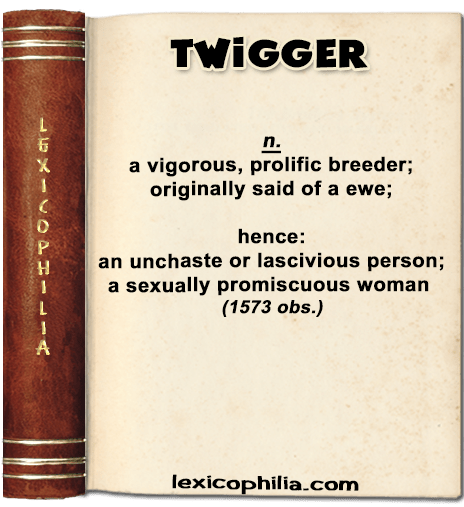
Word of the Day: TWIGGER

ETYMOLOGY
apparently from twig (to do anything strenuously or vigorously, obs.) + -er

EXAMPLE
“… Eaws yerely by twining, rich masters do make the lamb of such twynners, for breeders go take.
For twinlings be
twiggers, encrease for to bring:
though some for their twigging, peccantem may sing
Calues likely, yt come betwene Christmas & Lent,
take huswife to rere, or else after repent.
…”

From: Fiue Hundreth Points of Good Husbandry vnited to as many of good huswiferie first deuised,
By Thomas Tusser, 1573

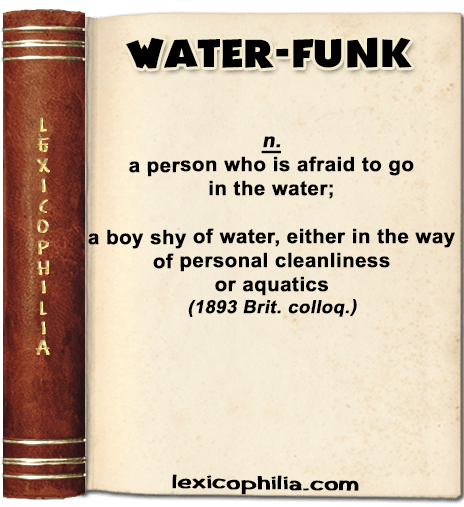
Word of the Day: WATER-FUNK

ETYMOLOGY
from water + funk (a cowardly or nervous person)

EXAMPLE
“… The arms, he may next be taught, do little more in the act of swimming than support the body; the necessary speed is procured by the action of the legs. A sensible lad, who is not a “ water-funk ”— to use the expressive term of the period— if the theory of the art be thus explained to him, ought to swim in six or seven lessons. …”

From: The Academy. A weekly review of literature, science, and art
Swimming. By A. Sinclair and W. Henry
August, 1893

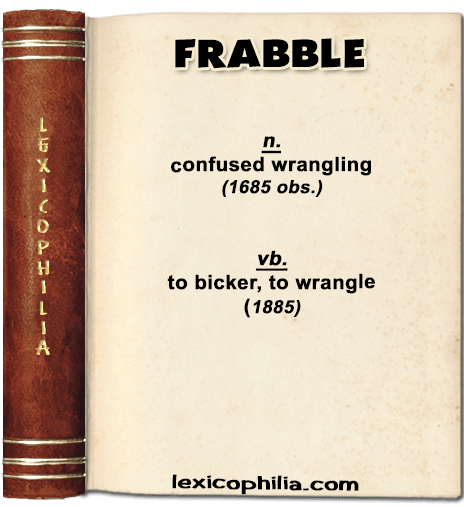
Word of the Day: FRABBLE

ETYMOLOGY
n. of unknown origin
vb. diminutive or frequentative of frab (to harass, worry)

EXAMPLE (for n.)
“… And those more refined Arians, how near they were to the Truth, or how near they might be understood to have come to the Truth, and that it might be proved to be rather a frabble of words than a distinct disagreement of senses, it were too operose a matter to declare here. How much some Fathers have cryed out against the over-much curiosity of Definitions by Councils, History will teach us. …”

From: Paralipomena Prophetica containing several supplements and defences of Dr Henry More his expositions of the Prophet Daniel and the apocalypse
By Henry More, 1685

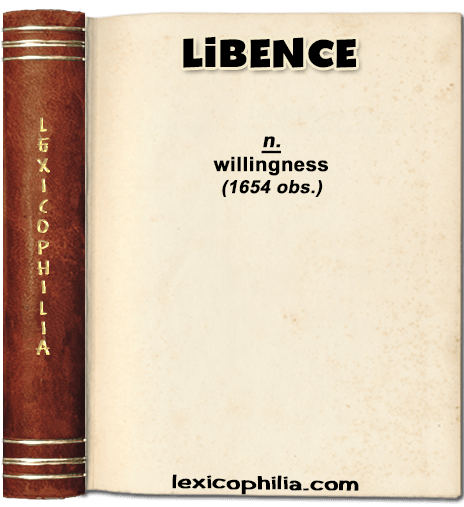
Word of the Day: LIBENCE

ETYMOLOGY
from Latin libentia, from libentemlibens (willing)

EXAMPLE
“… They say the appetit confined to good is volent, and therfore free: but this volence is a meer libence, free from coactiv violence; no tru liberty to chus several objects; and therfore not arbitrary, becaus bar’d of indifferency. …”

From: Theoremata Theologica: = Theological Treatises.:
Octo theses theologicæ: eight theses of divinity
By Robert Vilvain, 1654

Word of the Day: DIMICATION

ETYMOLOGY
from Latin dimicationem, noun of action, from dimicare (to fight)

EXAMPLE
“… At this time there was one Alexander, a godly and worthy man, Bishop of Constantinople. He in the dimication which arose about Arius, shewed himself a very prudent and pious man: For as soon as Arius came to Constantinople, he presently raised divisions amongst the people there also, so that great tumults ensued whilest one part of the people stood for the Faith confirmed by the Nicene Council: …”

From: The Marrow of Ecclesiastical History contained in the lives of one hundred forty eight fathers, schoolmen, first reformers and modern divines which have flourished in the Church since Christ’s time to this present age
By Samuel Clarke, 1654

Word of the Day: FLISKY

ETYMOLOGY
from flisk (to move or dance about in a frolicsome way, to frisk) + -y

EXAMPLE
“… An’ nane can nature’s charms enjoy, or manage weel the day’s employ,
Wha ay gang donarin nidy noy
To houſes
flisky,
An bletherin’ gie douse fock annoy,
Whan ramm’d wi Whisky
…”

From: Poems Pastoral, Satirical, Tragic, and Comic
By John Learmont, 1791
The Condemnation of Whisky

Word of the Day: QUAEDAM

ETYMOLOGY
from Latin quaedam (a certain woman), feminine singular of quidam (somebody)

EXAMPLE
“… So this Piece of his is very sweet in the Composure, and yet very tart against the sinfulness of vain Attire; wherein wanton Quaedams in those days came to that excess, that they delighted altogether in the Garb, and Habit, and roisterly Fashions of Men: This Sermon the King did greatly approve, as a fit Antidote against such corrupt Manners, and commanded it to be Printed. For the Doctor himself never wrote any thing, with intention to let the World see it in the Press, unless necessity constrain’d him. …”

From: Scrinia Reserata a memorial offer’d to the great deservings of John Williams, D. D., who some time held the places of Ld Keeper of the Great Seal of England, Ld Bishop of Lincoln, and Ld Archbishop of York
By John Hacket, 1693

Word of the Day: DESCENTIVE

ETYMOLOGY
from descent + -ive

EXAMPLE
“… howsoeuer I purpose not in the like nice respect to leape ouer the laudable petigree of Yarmouth, but will fetch her from her swadling clouts or infancy, & reueale to you when and by whom she was first raught out of the oceans armes, and start vp and aspired to such starry sublimitie ; as also acquaint you with the notable immunities, franchises, priuileges she is endowed with beyond all her confiners, by the discentiue line of kings from the conquest. …”

From: Lenten Stuffe
By Thomas Nashe, 1599
The Praise of the Red Herring