Word of the Day: WHIZZER


ETYMOLOGY
from whizz (to move swiftly or with such a sound) + -er


EXAMPLE
“…The washerwoman finds her occupation almost gone through the introduction of machinery. The larger part of the city of Troy is devoted to the manufacture of engines, whizzers, starchers, and other machines of the steam laundry. The most interesting machine is the whizzer, which dries clothes in 1,000 revolutions a minute…”

From: The Pall Mall Budget, July 1887
Volume 35
Word of the Day: SOBERSIDES


ETYMOLOGY
from sober + the plural of side


EXAMPLE
“…I am sorry you have been again out of luck with a horse; but do not despair. I have got a sober sides on trial for a week past, but really & truly cannot make time to put him to the proof, & he stands idle in my stable, but hope as I have often, very often hoped before that I shall have more time the next week…”

From: The Selected Letters of Josiah Wedgwood, Feb, 1779
Edited by Anne Finer and George Savage, 1965

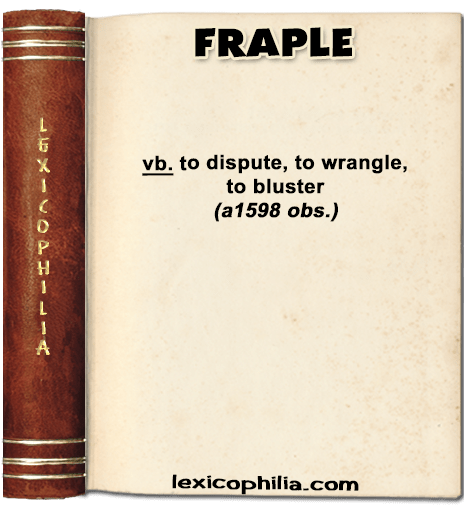
Word of the Day: FRAPLE


ETYMOLOGY
of uncertain origin;
perhaps from the Teutonic root flap and Old French frapillier (to be indignant, murmur)


EXAMPLE
“…Elixir vitae, and the precious Stone,
You know as well as how to make an Apple;
If’te come to the workinge then let you alone,
You know the coullers black brown bay and dapple,
Controwle you once then you begin to fraple.
Swearing and saying, what is fellow is this?
Yet still you worke but ever worke amisse
…”

From: Sir Edward Kelle’s Worke,
In Elias Ashmole’s Theatrum Chemicum Brittanicum, 1652

Word of the Day: WRIXLE


ETYMOLOGY
Old English wrixlian-an (to alter, change, exchange, etc.),
also ᵹewrixlian, altered form of ᵹewixlian, = Old Frisian wixlia, Old Saxon wehsalon, Old High German wehsalon (German wechseln)


EXAMPLE (for vb. 2)
“…Kynges, & knightes, & other kyde Dukes,
That the charge, & the chaunse hase of þis choise wer,
Thurgh oure might & oure monhod maintene to gedur!
What whylenes, or wanspede, wryxles our mynd?
Þat for meuyng of a man,—Menelay the kyng,—
And the wille of a woman, as ye weton all,
Oure londes haue leuyt, & oure lefe godys
…”

From: Destruction of Troy,
The gest hystoriale of the destruction of Troy,
An alliterative romance translated from Guido de Colonna’s Hystoria Troiana

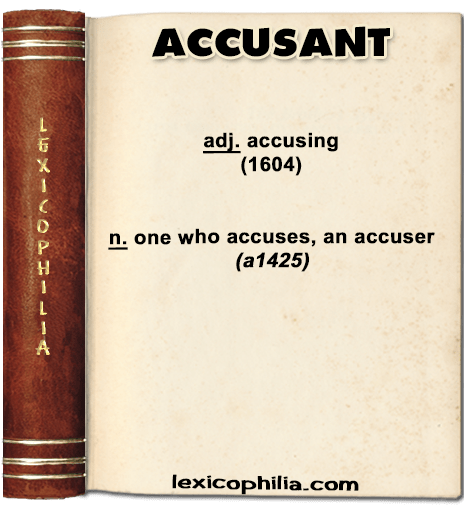
Word of the Day: ACCUSANT


ETYMOLOGY
from French accusant (n. person who accuses), (adj. that accuses)


PRONUNCIATION
uh-KYOO-zuhnt


EXAMPLE
“…The whole Councell beeing afterward called together, they gaue them-selues to the vnderstanding of the matter. As for the crime and the punishment, was of the accusant called vpon in these wordes: The Iudgement of death is due to this man, because hee hath done this or that. But the Defendant repelled it, with these wordes. The Iudgement of death is not due this man, because hee hath not done it, or because hee hath doone it righteously …”

From: A Defence of the Government Established in the Church of Englande
By John Bridges, 1587

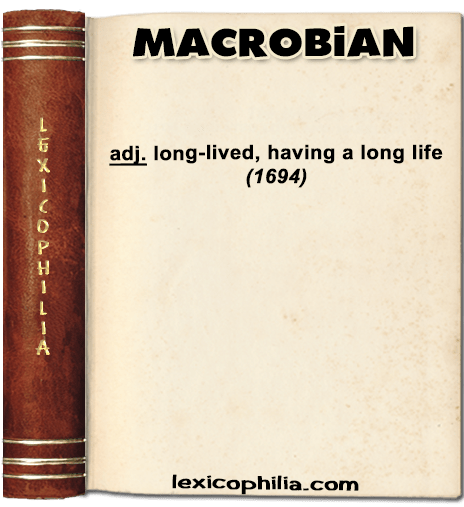
Word of the Day: MACROBIAN


ETYMOLOGY
formed on Greek.µακρόβιος (long-lived (from µακρός (long) + βίος (life)) + -an


PRONUNCIATION
muh-KROH-bee-uhn


EXAMPLE
“…Nor did we think it more reasonable to doubt of the Transmogrification of the Macrobian Children into Swans, or that of the Men of Pallene in Thrace into Birds, as soon as they have bath’d themselves in the Tritonie Lake. After this the Devil a word we could get out of him but of Birds and Cages…”

From: The Fifth Book of The Works of Francis Rabelais, M.D.
Translated by Peter Anthony Motteux, 1694

Word of the Day: BUMFEG


ETYMOLOGY
of uncertain origin;
possibly from bum (to give a beating to, especially as a punishment) + feague (to beat, to whip)


EXAMPLE
“…I wil presently proue both maior and minor of this sillogisme. And hold my cloake there sombody, that I may go roundly to worke. For ise so bumfeg the Cooper, as he had bin better to haue hooped halfe the tubbes in Winchester, then write against my worships pistles…”

From: The Marprelate Tracts
‘Penned and compiled by Martin the Metropolitane’
Hay Any Worke for Cooper, 1523

Word of the Day: SPARROW-FART


ETYMOLOGY
from sparrow + fart


EXAMPLE (for n. 2.)
“…Miss This Miss That Miss Theother lot of sparrowfarts skitting around talking about politics they know as much about as my backside anything in the world to make themselves someway interesting Irish homemade beauties soldiers daughter am I ay and whose are you bootmakers and publicans I beg your pardon coach I thought you were a wheelbarrow…”

From: Ulysses
By James Joyce, 1922

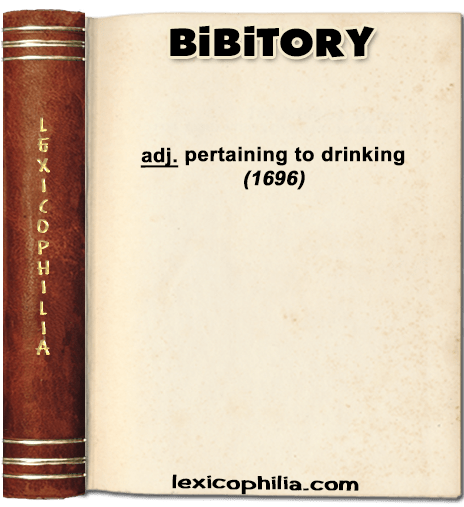
Word of the Day: BIBITORY


ETYMOLOGY
from modern Latin bibitorius, from  bibit- ppl. stem of bibere (to drink)


EXAMPLE
“…The verdict does not favour total abstinence, though it is decidedly against bibitory indulgence. It was clear from the close study of the patient – who was so well-formed and healthy that hey may be regarded corporeally as a typical man – that alcohol was not necessary to him…”

From: The Gentleman’s Magazine and Historical Chronicle
Volume 229, 1870
Notes and Incidents

Word of the Day: MIRLIGOES


ETYMOLOGY
of uncertain origin;
perhaps from Scots mirl (to speckle, to spot),
with reference to the pattern seen before the eyes when in a state of dizziness + -igo 


PRONUNCIATION
MUR-luh-gohz


EXAMPLE
“…Sure Major Weir, or some sic warlock wight,
Has flung beguilin’ glamer o’er your sight;
Or else some kittle cantrup thrown, I ween,
Has bound in mirlygoes my ain twa ein,
If ever aught frae sense cou’d be believ’d
(And seenil hae my senses been deceiv’d),
This moment, o’er the tap of Adam’s tomb,
Fu’ easy can I see your chiefest dome:
Nae corbie fleein’ there, nor croupin’ craws,
Seem to forspeak the ruin of thy haws,
But a’ your tow’rs in wonted order stand,
Steeve as the rocks that hem our native land
….”

From: The Poems of Robert Fergusson
By Robert Fergusson, 1785
The Ghaists: A Kirk-yard Eclogue