Word of the Day

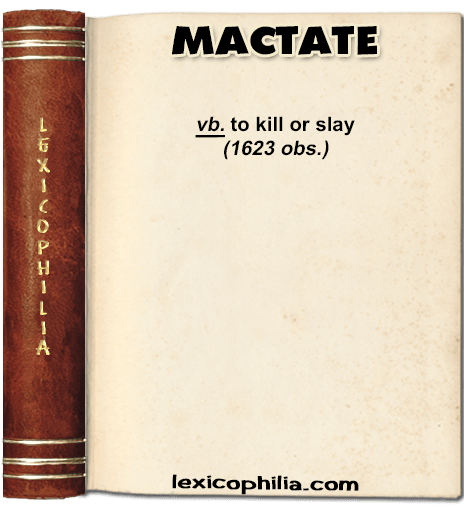
Word of the Day: MACTATE

ETYMOLOGY
from Latin mactat-, past participial stem of mactare (to slay, to honour with sacrifice)

EXAMPLE
“…As has been shown, it is historically true that a vulgar opinion to the effect that CHRIST was separately mactated in the sacrifices of masses prevailed at the time of the Reformation, which opinion being perfectly analogous to that which the Apostle combats, nothing could be more appropriate than to quote his teaching in condemnation of it…”

From: Answers for the Right Rev. Dr. Alexander Penrose Forbes,
Bishop of Brechin
To the Presentment Against Him
William Henderson, 1860
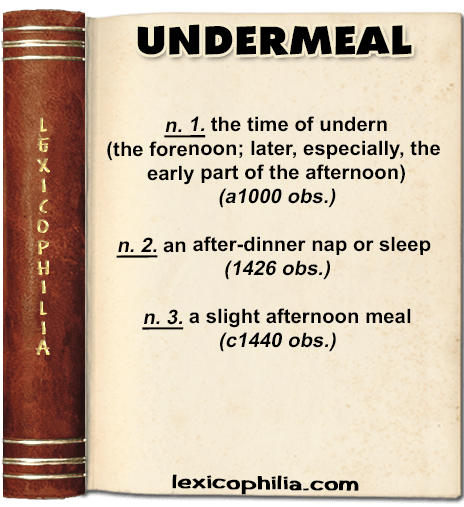
Word of the Day: UNDERMEAL

ETYMOLOGY
Old English undernmǽl

EXAMPLE
(for n. 2.)
“…that drawes deepe, and by that time his Tobacco marchant is made even with, and hee hath dinde at a tauerne, and slept his vnder-meale at a bawdy house, his purse is on the heild and only fortie shillings hee hath behinde, to trie his fortune with at the cardes in the presence…”

From: Lenten Stuffe
– Thomas Nashe, 1599

Word of the Day: BLUTHERBUNG

ETYMOLOGY
of unknown origin

EXAMPLE
“…In a neighbouring parish, a preacher in one of the chapels gave out his text in great form, “Behold the bridegroom cometh.” Just then, in walked a newly-married couple, in all the glory of their wedding attire. They were of course, beheld of all beholders, the whole thing so upset the orator, that quoth he “Well mi brethren I’m clean blutherbunged!” and sat down…”

From: Lincolnshire Notes and Queries,
Volume 2, 1891
The Parish Church of St. Mary, Whaplode
By W. E. Foster, 1889

Word of the Day: LABEFACTATE

ETYMOLOGY
from Latin labefactat-, past participial stem of labefactāre (to make unsteady, to loosen, to undermine)
frequently of labefacere  (to weaken, to impair)

EXAMPLE
“…The judgement seates of Bishops are meerely externall to the Church which they governe: But, Presbyteries and Synods are Courts internall, for the onely members whereof they consist, are the Comissioners of the Churches which they govern; these Churches they represent, the minde and desire of these Churches they doe propose, unto these Churches they give account of all their administration, they confirme and establish the rights of Congregations, they doe not abolish nor labefactate any of them…”

From: A dissuasive from the errours of the time wherein the tenets of the principall sects, especially of the Independents, are drawn together in one map, for the most part in the words of their own authours, and their maine principles are examined by the touch-stone of the Holy Scriptures
– Robert Baillie, 1645

Word of the Day: DICACIOUS

ETYMOLOGY
from Latin dicaxdicaci-(talking sharply) + -ous

EXAMPLE
“…Giovanni (or Lanciotto) deputes his more blandishing and dicacious brother to be his proxy in the marriage ceremonies; and afterwards, as the morning breaks, when the susceptible lady actually discovers her husband to be a wise, stern, moral man…”

From: The North American Magazine
Volume 4, 1834
Francesca Da Rimini
A Tragedy by Silvio Pellico

Word of the Day: RAG-MANNERED

ETYMOLOGY
from rag + mannered (having manners of a specified kind)

EXAMPLE
“…Let us now take a Turn or two with Sir Tunbelly’s Heiress of 1500 pounds a year. This Young Lady swears, talks smut, and is upon the matter just as rag-manner’d as Mary the Buxsome. ‘Tis plain the Relapser copyed Mr. Durfey’s Original, which is a sign he was somewhat Pinch’d…”

From: A Short View of the Immorality, and Profaneness of the English Stage:
Together with the sense of antiquity upon this argument 
– Jeremy Collier, 1698

Word of the Day: FURACIOUS

ETYMOLOGY
from Latin furaci- (nominative furax),
from furari (to steal) + -ous

EXAMPLE
“…This amazing, and indeed murderous villany of the Irishman brought them all to their wit’s ends how to defend themselves from the ruin therein threatened unto them; and whatever methods were proposed, it was feared that there could be no stop given to his furacious exorbitancies any way but one; he could not be past stealing, unless he were past eating too…”

From: Magnalia Christi Americana
Or, The Ecclesiastical History of New-England 
– Cotton Mather, 1702

Word of the Day: IMPOTE

ETYMOLOGY
from im- + Latin potare (to drink)

EXAMPLE
“…I never drunk or saw any usquebah since I came into Ireland, though I have bin at many tables and civilly used in a sober way without impoting: if any thing material doth happen in my concerns, I will send you word…”

From: Life and Letters of George Berkeley
From ye Court of Ireland, October 6, [1721]
– Alexander Campbell Fraser