Word of the Day

Word of the Day: CESSIVE

ETYMOLOGY
from Latin cess- participial stem of cedere (to yield) + -ive

EXAMPLE
“… Yet there is a Diversity in Softness by Argentrive, and in Softness by Sulphur: because Softness by Sulphur is Cessive, but Softness by Argentrive is Extensive. And this must necessarily be proved by Sight; seeing We see Bodies of much Argentrive, to be of much Extension; but Bodies of little, of little. …”

From: The Works of Geber
By Jabir ibn Haiyan
Translated by Richard Russell, 1678

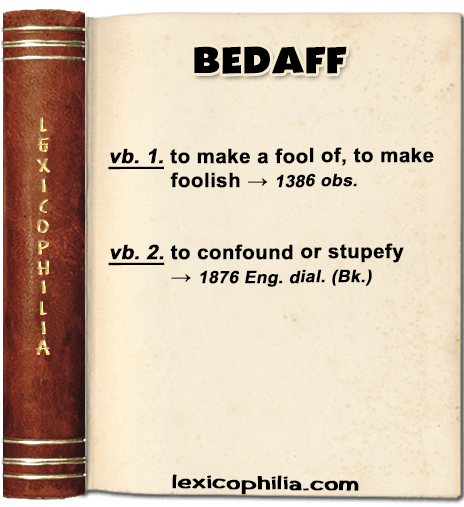
Word of the Day: BEDAFF

ETYMOLOGY
from be- + daff (a fool, a simpleton)

EXAMPLE (for vb. 1.)
“… Folweth ecco, that holdeth no silence,
But ever answereth at the countretaille :
Beth not
bedaffed for your innocence,
But sharply taketh on you the governaille :
Emprenteth wel this lesson in your minde,
For comun profit, sith it may availle.
…”

From: Canterbury Tales; The Clerkes Tale
By Geoffrey Chaucer, c1386

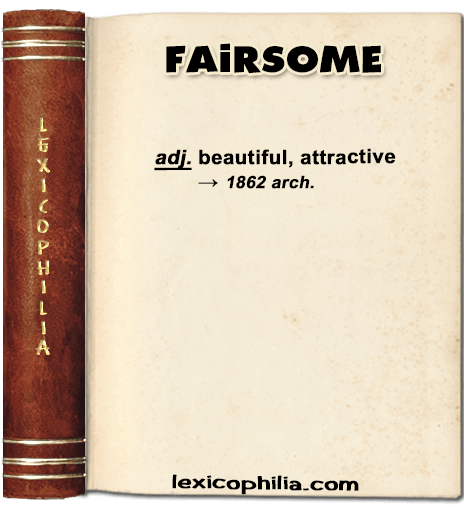
Word of the Day: FAIRSOME

ETYMOLOGY
from fair (adj.) + -some

EXAMPLE
“… Weel, man, tho’ I’m no just every man’s dog that whistles, on me, I see we maun pit our shouthers to the wheel thegither, if it is ainly to mettle up the King no to be sae muckle hoodwinked by yon’ upstart Lord : that the royal Jamie should be sae come ower by a fairsome face an’ a saucy tongue aye gars me think there maun be glamour in the world yet — an’ if ever I saw ane that has the look o’ a witch wife, it wad be my opinion leddy Buckingham has an ower uncanny glint in her eye. …”

From: The Prophecy
By Rachel Evelyn Butler, 1862

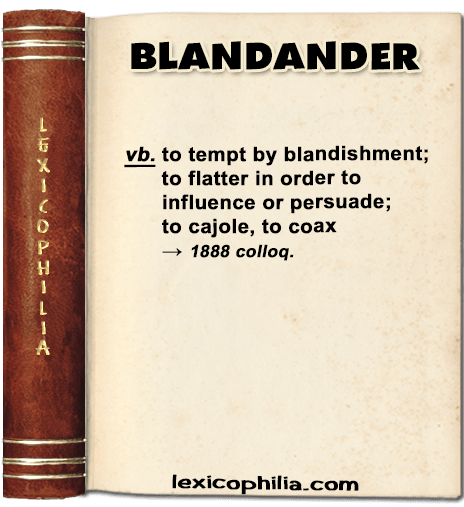
Word of the Day: BLANDANDER

ETYMOLOGY
probably an alteration of blandish (to charm or flatter in order to entice, etc.), perhaps after philander;
apparently intended as a form characteristic of Irish English; (Irish blanndar (dissimulation, flattery))

EXAMPLE
“… He looked at me wearily; his eyes were sunk in his head, and his face was drawn and white. ‘Eyah!’ said he; ‘I’ve blandandhered thim through the night somehow, but can thim that helps others help thimsilves? Answer me that, sorr!’…”

From: Soldiers Three
By Joseph Rudyard Kipling, 1888
With the Main Guard

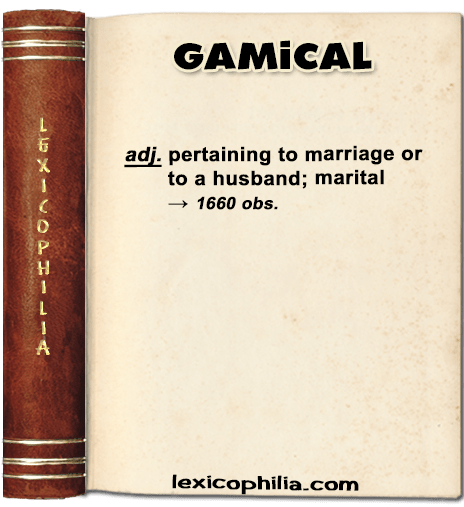
Word of the Day: GAMICAL

ETYMOLOGY
from Latin gamicus or from Greek γαµικός (of or for marriage) + -al

EXAMPLE
“… Humane Laws are threefold, viz. Secular, Temporal, or Civil, such are the Laws of every Country; or Gamacal , viz. the Laws of the Husband; or Paternal, viz. the Laws of Parents to their Children. …”

From: Justice vindicated from the false fucus put upon it, by Thomas White gent. Mr. Thomas Hobbs, and Hugo Grotius: As also elements of power & subjection;
By Roger Coke, 1660

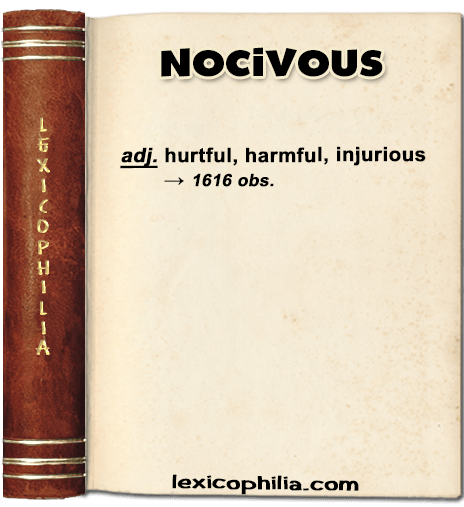
Word of the Day: NOCIVOUS

ETYMOLOGY
from Latin nocivus (harmful, injurious), (from nocere (to hurt)) + -ous

EXAMPLE
“…Phisitions which prescribe a remedy
To each disease & bodies maladie;
That know what is
nocivous & what good,”
When it is fit to bath, to purge, let bloode;
Although they know the nature & the power
Of every simple, every hearbe, & flower,
With Solomon, which from the cedar tall
Vnto the hisope spreading on the wall,
Knew every growing plant, flower, hearbe, or tree,
With their true vse & proper qualitie;
…”

From: The Times’ Whistle: Or, A New Daunce of Seven Satires, and Other Poems
Compiled by R.C., c1616
Published for the Early English Text Society, 1871

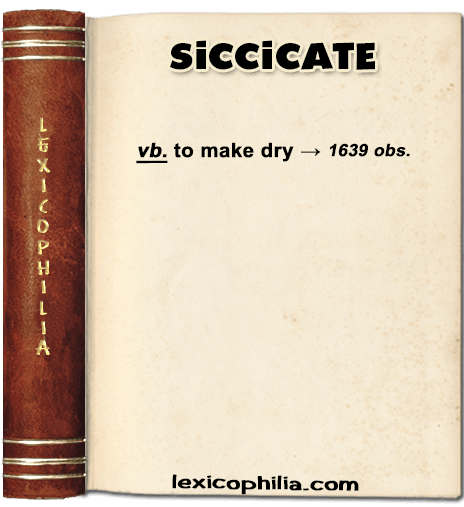
Word of the Day: SICCICATE

ETYMOLOGY
irregularly from Latin siccus or siccare

EXAMPLE
“… Thirdly, when you put forth your horses to run at grasse all, or the most part of Summer, during which time the scorching heats wil so siccicate and dry the planks, which will cause them to warp, and the pinnes which holdeth them down to the joyces will rot, and so the planks give way, especially when horses (who not being handled in some moneths before) becomming wild, rammage, and unruly, are newly brought into the Stable, who feeling the planks to move, yeeld, and give way under them, will fall from starting thereat, to slinging, leaping, bounding and plunging, till they have dislocated the planks, and thereby have endangered both themselves, the residue of their fellowes, and those who might come to their help and succour, which is a thing very frequent in a flore of this nature: …”

From: The Compleat Horseman and Expert Ferrier In two bookes. The first, shewing the best manner of breeding good horses, with their choyce, nature, riding and dyeting … The second, directing the most exact and approved manner how to know and cure all maladies and diseases in horses;
By Thomas de Grey, 1639

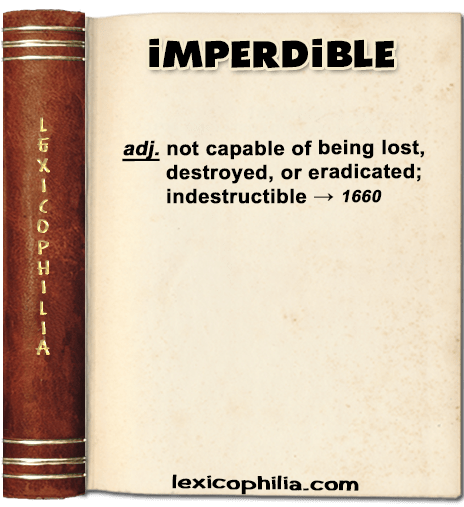
Word of the Day: IMPERDIBLE

ETYMOLOGY
from Latin imperdibilis; from im- + perdere (to lose) + -ibilis (-ible)

EXAMPLE
“… Most men are erroneous in the apprehension of their Felicity, Honour, Glory and Riches being their ordinary objects, are but smoaky substances to make it solid and imperdible; all these are daily subject to casualties: for what with difficulty we have acquired in a year, may by an unexpected accident of fortune be lost in a day, and often times by the same means, we projected to mount the throne of our felicity, we inevitably fall into the abiss of disgrace. …”

From: The Idea of the Lavv Charactered from Moses to King Charles.: Whereunto is added the Idea of Government and Tyranny
By John Heydon, 1660

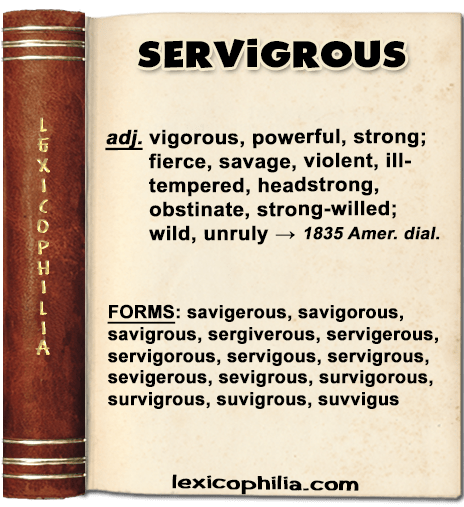
Word of the Day: SERVIGROUS

ETYMOLOGY
of uncertain origin;
possibly an alteration of savagerous (barbarously savage); perhaps influenced by vigorous

EXAMPLE
“… It now came to Spivey’s turn. There was nothing remarkable in his person or manner. He took his place, lowered his rifle slowly from a perpendicular, until it came on a line with the mark — held it there like a vise for a moment, and fired.
” Pretty
sevigrous, but nothing killing yet,” said Billy Curlew, as he learned the place of Spivey’s ball. …”

From: Georgia Scenes, Characters, Incidents, &c. : in the first half century of the republic,
By Augustus Baldwin Longstreet, 1835
“The Shooting Match”

PRONUNCIATION
suhr-VIGH-gruhss

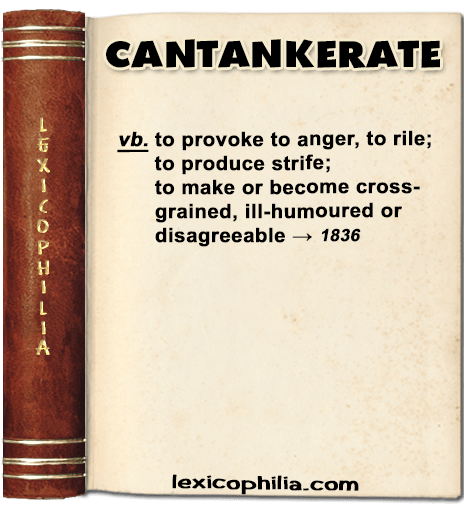
Word of the Day: CANTANKERATE

ETYMOLOGY
from cantankerous

EXAMPLE
“… I never see’d a convart made by that way yet; but I’ll tell you what I have see’d, a man set his own flock a doubtin by his own writin. You may happify your enemies, cantankerate your opponents, and injure your own cause by it, but I defy you to sarve it. …”

From: The Clockmaker,
Or, Sayings and Doings of Sam Slick, of Slickville,
By Thomas Chandler Haliburton, 1836