Word of the Day

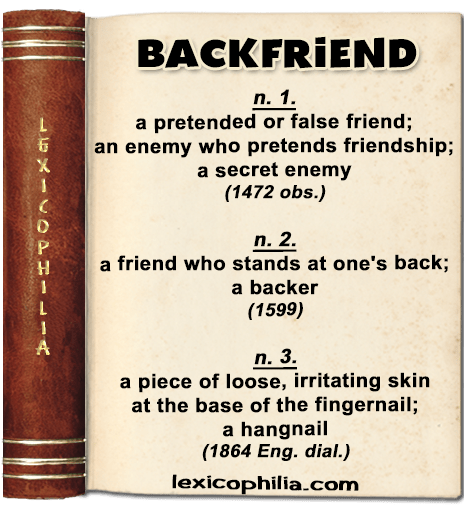
Word of the Day: BACKFRIEND

ETYMOLOGY
from back (n.) or (adv.) + friend;
possibly originally a friend who ‘kept back,’ and did not come forward to assist, and so was no real friend

EXAMPLE (for n. 1.)
“… And as for my lorde chamberleyn, he is nott yit comen to town. When he comythe, than schall I woote whatt to doo. Syr John off Parre is yowre freende and myn, and I gaffe hym a fayre armyng sworde wyth-in thys iij dayes. I harde somwhatt by hym off a bakk freende off yowrys; ye schall knowe moore here-afftre. …”

From: Paston Letters and Papers of the Fifteenth Century
By Paston family, 1472
Published for the Early English Text Society – Edited by Norman Davis, Richard Beadle, and Colin Richmond. 2004
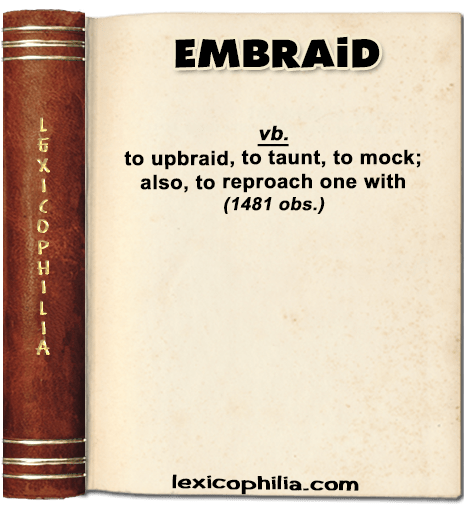
Word of the Day: EMBRAID

ETYMOLOGY
from en- braid (to upbraid, to reproach);
possibly aphetic from abraid (to upbraid)

EXAMPLE
“… No besynes of famylyar thynges shal agayn your wyll departe you from suche plesaunt ydelnes, for I truste to oure goddes that my lytil feelde, of the which I am enbrayded by Corneli, shal suffise for our dayly lyvelode. …”

From: Gaius Flaminius refutes Publius Cornelius, his Rival for the Hand of Lucretia
In Tully of Old Age and Friendship
Translated by William Caxton, 1481

Word of the Day: BY-WIPE

ETYMOLOGY
from by- + wipe (sarcastic reproof or rebuff)

EXAMPLE (for n. 1.)
“… Wherefore should ye begin with the devil’s name, descanting upon the number of your opponents? Wherefore that conceit of Legion with a by-wipe? Was it because you would have men take notice how you esteem them, whom through all your book so bountifully you call your brethren? We had not thought that Legion could have furnished the Remonstrant with so many brethren. …”

From: Animadversions upon the Remonstrants Defence Against Smectymnuus
By John Milton, 1641

Word of the Day: MEDISANCE

ETYMOLOGY
from French medisance, from mesdisant present participle of mesdire (to speak evil), from mes- (mis-) + dire (to say)

EXAMPLE
“… Let every one then make this good use of the respect and difference which is given to their persons or conditions; the taking upon them to discredit this so pernitious fashion of receiving (as justifyable Presents from their observers) the desamation of their brother; for when this humour of Medisance springeth in the head of the company, it runnes fluently into the lesse noble parts; but when it riseth first but in the inferior and dependent persons, it requireth a force of wit and ingeniosity to raise and diffuse it upward, which capacity is not very familiar: …”

From: Miscellanea Spiritualia: or, Devout Essaies
By Walter Montagu, 1648

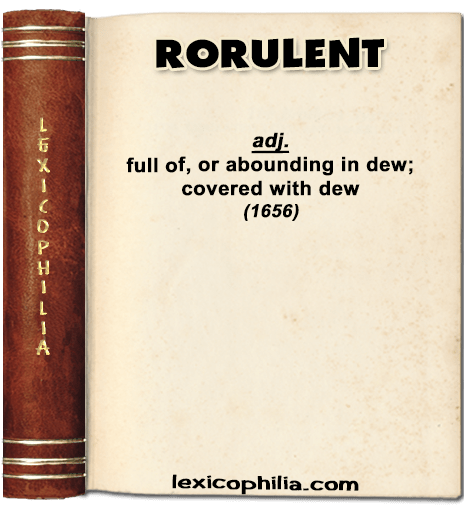
Word of the Day: RORULENT

ETYMOLOGY
from Latin rorulentus (dewy); from ror-ros (dew) + ‑ulentus (‑ulent)

EXAMPLE
“… Anaurus, no such River on Mount Ida, or within any part of the Trojan Territories,
Being only a Name given to any Current raised by Rain, and not sending up
rorulent Steams or Vapors, as all or most Rivers do,
Yet apply’d as a Name to several Rivers, not properly, but to shew how they are qualifi’d like that unſteaming Current …

From: The Tragedies of L. Annæus Seneca the Philosopher;
Translated by Sir Edward Sherburne, 1702

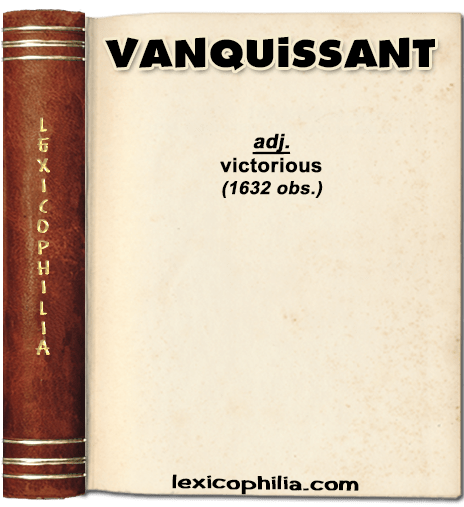
Word of the Day: VANQUISSANT

ETYMOLOGY
from obsolete French vainquissant, present participle of vainquir, a rare variant of vaincre (to conquer, overcome)

EXAMPLE
“… Full glad was Eromena to heare of such things, acknowledging her thankes to heaven for doing them in the favour of her girle. Congratulations she received not as a woman in child-bed, but as a Captaine vanquissant of a battel. Many times and often kissed shee her sweet babe, who without either crying or weeping, beheld stedfastly the faire light of the world; by no meanes possible would the sweet little one endure the swathing bands, but would with a lovely fiercenesse push them off her. …”

From: Eromena, or, Love and Revenge
Written originally in the Thoscan tongue, by Cavalier Giovanni Francesco Biondi
Translated by James Hayward, 1632

Word of the Day: FLIBBERTIGIBBET

also in forms FLEBERGEBET, FLEBERGEBIT, FLEBERGIBET, FLIBBER DE’ JIBB, FLIBBERGIB(BE), FLIBBER-GIBBET, FLIBBERTY-GIBBET, FLIBERDEGIBEK, FLIBERDIGIBBET, FLIBERDIGIBET, FLIPPERTY-GIBBET, FLYBBERGYBE

ETYMOLOGY
apparently an onomatopœic representation of unmeaning chatter or garrulous speech

EXAMPLE (for n. 1.)
“… Better vnborne then vntaught, I haue herde saie,
But ye be better fed than taught far awaie.
Not veraie fat fed, saied this
flebergebet,
But nede hath no lawe, nede maketh her hither iet.
She comth nece Ales (quoth she) for that is her name
More for nede, then for kyndnes, payne of shame.
…”

From: A dialogue conteinyng the nomber in effect of all the prouerbes in the englishe tongue compacte in a matter concernyng two maner of mariages
By John Heywood, 1546

PRONUNCIATION
FLIB-uh-tee-jib-uht

Word of the Day: PLENIPOTENT

ETYMOLOGY
from Latin plenipotensplenipotent, from Latin pleni- (full) + potens (potent, powerful)

EXAMPLE (for adj.)
“… (being now grown by their rents and Lordly dignities, by their power over the Ministers and other liege’s, by their places in Parliament, Council, Session, Exchequer, and high Commission to a plenipotent dominion and greatness) they frame a book of Canons for ruling the Kirk and disposing upon religion at their pleasure. …”

From: The Remonstrance of the Nobility, Barrones, Burgesses, Ministers and Commons within the Kingdom of Scotland,
Church of Scotland. General Assembly, 1639

Word of the Day: UNHEEDY

ETYMOLOGY
from un- + heedy (heedful, careful, cautious)

EXAMPLE
“… Vpon vvhom he is sayd so much to haue doted, that in regard of her excellencie, he scorned & wrote against the beauty of Helena. For which his praesumptuous and vnheedie hardinesse, he is sayde by vengeaunce of the Gods, thereat being offended, to haue lost both his eyes. …”

From: The Shepheardes Calender conteyning tvvelue æglogues proportionable to the twelue monethes
By Edmund Spenser, 1579

Word of the Day: BLOB-TALE

ETYMOLOGY
from blob, variant of blab (to talk indiscreetly) + tale

EXAMPLE
“… These Blob-tales, when they could find no other News to keep their Tongues in motion, laid open our Bishop for a Malignant, because he gave Entertainment at his Board, to such as carried a Grudge to the Lord Duke’s Prosperity; who, if such, came in their course to his House upon old acquaintance, but upon no factious design, that ever was proved. …”

From: Scrinia Reserata; a memorial offer’d to the great deservings of John Williams, D. D., who some time held the places of Ld Keeper of the Great Seal of England, Ld Bishop of Lincoln, and Ld Archbishop of York
By John Hacket, a1670