Word of the Day

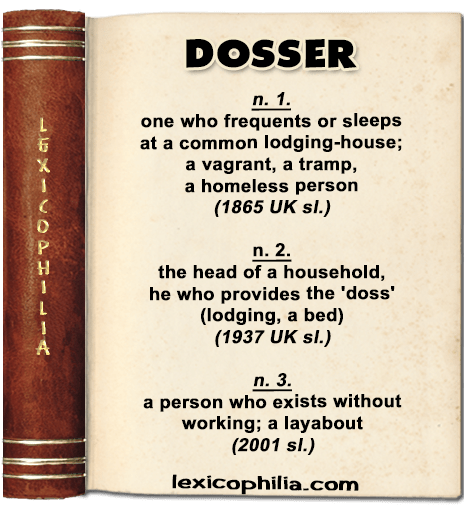
Word of the Day: DOSSER

ETYMOLOGY
from doss (n. lodging, a bed) (vb. to sleep)

EXAMPLE
“… Most of the ‘dossers’ were transient customers, people who were always on the move. …”

From: New York Police Gazette
Leaves from the Diary of a Celebrated Burglar; Being a Compilation of the Events and Occurences of the Most Exciting, Interesting and Extraordinary Character in the Life of a Thief
By Anonymous, 1865

Word of the Day: LUDIBUND

ETYMOLOGY
from Latin ludibundus, from ludere (to play)

EXAMPLE
“… I promise you, Hylobares, tho’ the fancy of Cuphophron may seem more ordinarily ludibund and lightsomely sportful, yet what he points at seems to be overlamentably true …”

From: Divine Dialogues, Containing Sundry Disquisitions & Instructions Concerning the Attributes and Providence of God
By Henry More, 1668

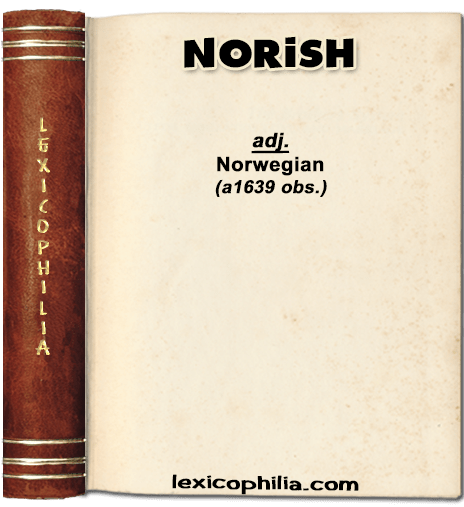
Word of the Day: NORISH

ETYMOLOGY
either an alteration of Norse (adj.) after Scottish, or directly from Norwegian norsk (Norse), with suffix substitution

EXAMPLE
“… for he was in prayer more frequent then yong ones are usually seen to be, of a spare diet, and so compassionate of the poor, as all that came in his hands he distributed among them: Servanus his Master loving him beyond others, was ordinarily wont to call him Mongah, which in the Norish tongue, signifieth a deare friend; and this way came he to be called Mungo. …”

From: The History of the Church of Scotland, beginning in the year of our Lord 203 and continued to the end of the reign of King James the VI
By John Spottiswood, 1677

Word of the Day: VICTITATION

ETYMOLOGY
from Latin victitare (to subsist (on something)); from victus (food, sustenance)

EXAMPLE
“… And soe most commonlye the occasione of death commeth throughe the inordinate state of life, in eatinge, and drinckinge vvithout observinge anye rule of
victitation, hauntinge also of vvoemen, and not suffering themselves to be handled, of the handes of the Chyrurgian, as the cause requireth, it be ether in tenting of the vvounde, by inscisione, by cauterisatian, & by keepinge himselfe quiet vvhich all aunciente Chyrurgians so highly and exactlye commande, …”

From: The Frenche Chirurgerye, or All the Manualle Operations of Chirurgerye, with Divers, & Sundrye Figures, and Amongst the Rest, Certayne Nuefownde Instrumentes, Verye Necessarye to All the Operationes of Chirurgerye
By Jacques Guillemeau
Translated by A.M., 1598

Word of the Day: WUZZY

ETYMOLOGY
of uncertain origin;
possibly a variant of woozy (dizzy or unsteady); possibly after muzzy (drowsy, spiritless; confused, mentally hazy; dazed and unfocused)

EXAMPLE
“… I am very nearly mad, I am quite slowly turning wuzzy. I see four people instead of one, and I have an irresistible longing to eat the fire and beat my door-handle. …”

From: Antony (Viscount Knebworth): A Record of Youth
By Edward Anthony James Lytton, 1935
Letter written 10 March, 1921

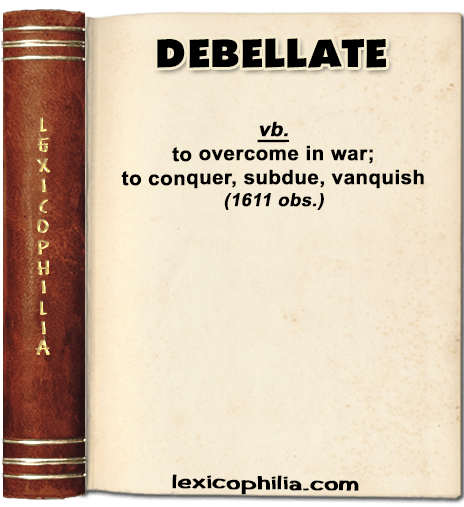
Word of the Day: DEBELLATE

ETYMOLOGY
from Latin debellat-, participial stem of debellare (to subdue in fight)

EXAMPLE
“… But let vs proceed: for now all claimes & quarrels were as open, as if no obstacle had euer beene interposed: the ignominie of their late terrible toiles wounded all true French hearts, and they desire (king Edward growne aged) not to seeme by sitting still vpon so many thornes of disgrace, and losse, to haue beene outwarred, though ouer-warred, and though in two or three battels inferior, yet not to haue beene clearely debellated. …”

From: The History of Great Britaine under the Conquests of ye Romans, Saxons, Danes and Normans
By John Speed, 1611

Word of the Day: PIGRITUDE

ETYMOLOGY
from Latin pigritudo (laziness); from Latin pigr-piger (lazy) + ‑itudo (itude)

EXAMPLE
“… But, with a little thoughtful frequenting, those deserted river-sides become contemplative and pleasant rambling-places, and, if some whim of fashion do not make the bank of the Hudson like the Marina of Smyrna, a fashionable resort, I have my Sunday afternoons provided for, during the pigritude of city durance. …”

From: Dashes at Life With a Free Pencil
By Nathaniel Parker Willis, 1845

Word of the Day: RHINOCERICAL

ETYMOLOGY
from rhinoceros + -ical

EXAMPLE (for adj. 1.)
“… Cheat. My lusty rustic, learn and be instructed. Cole is, in the language of the witty, money. The ready, the rhino ; thou shalt be rhinocerical, my lad, thou shalt.

Belf. Admirable, I swear ! Cole ! ready ! rhino ! rhinocerical ! Lord, how long may a man live in ignorance in the country. — And how much cole, ready, and rhino, shall I have? …”

From: The Squire of Alsatia. A comedy
By Thomas Shadwell, 1688

Word of the Day: MAGIRIST

ETYMOLOGY
from Greek µάγειρος (cook) + -ist

EXAMPLE
“… As no inhabitable Corner of the Earth ever was without a sufficient Medicinal Produce of it’s own for it’s Inhabitants, so the respective Natives never wanted a competent Number of their own, that made it their Business, to cultivate those several natural Physical Productions, and even to Carry on their Intelligence further therewith, so as to dive deeper into the Knowledge of all the Medicinals; that they could come any way to be acquainted with, or to know the Use of. And such were call’d at first variously pro re nata, as Magists, Magirists, Opsonarians, Caterers, Carvars, Nurserists, Geoponists, Hygeisys, Prophylactists, Remedists, Aliptists, Gymnastists, Unguentarians, Emplastrists, Veterinarians, Hippo-Jatrists, Mulomedicists. Operators, Herbalists, Botanists, Anatomists, Naturalists, Physicists, Medicinists, Myropolists, Ropopolists, …”

From: Athenæ Britannicæ; or, a critical history of the Oxford and Cambridge writers and writings
By Myles Davies, 1716