Word of the Day

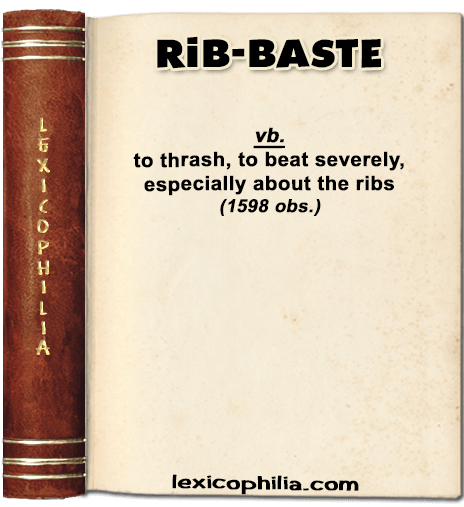
Word of the Day: RIB-BASTE

ETYMOLOGY
from rib (n.) + baste (to beat or thrash)

EXAMPLE
“… A good Pay-master (answered Sancho) will neuer grudge to giue wages; I thinke to curry or so be-labour my selfe, that without endangering my life, my lashes shall bee sensible vnto me, and therein must the substance of this miracle consist. And immediately Sancho stripped himselfe bare from the girdle vpward, and taking the whip in his hand, began to ribbe-baste and lash himselfe roundly; and Don Quixote to number the strokes. When Sancho had giuen himselfe seuen or eight stripes, hee thought he had killed himselfe; so that pawsing awhile, hee said to his Master, that he was very much deceiued, and would therfore appeale, forsomuch as euery whip-lash did in lieu of a piece of three Blanks, deserue halfe a Ryall. …”

From: The second part of The History of the Valorous and Witty Knight-Errant, Don Quixote of the Mançha
Written in Spanish by Michael Cervantes
Translated by Thomas Shelton, 1620

Word of the Day: DOWNSTEEPY

ETYMOLOGY
from down (in a descending direction) + steepy (full of steep places, steep) 

EXAMPLE
“… All which notwithstanding, perceiving life to remaine in him, he tooke heart againe; and getting vp on his feet, all goared with bloud, and loaden with strokes, making way through the prease, came to a craggie and downe-steepie rocke, where vnable to goe any further, by one of his wounds, with both his hands he pulled out his guts, and tearing and breaking them, cast them amongst such as pursued him, calling and attesting the vengeance of God to light vpon them. …”

From: The Essayes, or Morall, Politike, and Millitarie Discourses of Lord Michaell de Montaigne
By Michel de Montaigne
Translated by John Florio, 1603

Word of the Day: PABULOUS

ETYMOLOGY
from Latin pabulasus abounding in pabulum (fodder);
from pabulum (food, nutrient) + –osus (-ous)

EXAMPLE
“… And although the ayre attracted may be conceived to nourish that invisible flame of life, in as much as common and culinary flames are nourished by the ayre about them; I confesse wee doubt the common conceit, which affirmeth that aire is the pabulous supply of fire, much lesse that flame is properly aire kindled: And the same before us, hath been denyed by the Lord of Verulam, in his Tract of life and death, & also by Dr. Jorden in his book of Minerall waters. …”

From: Pseudodoxia Epidemica, or, Enquiries into very many received tenents and commonly presumed truths
By Sir Thomas Browne, 1646

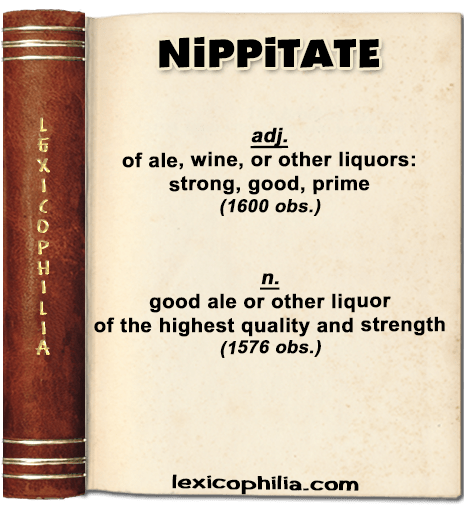
Word of the Day: NIPPITATE

ETYMOLOGY
variant of nippitatum (of unknown origin)

EXAMPLE (for n.)
“… Beside thiz in the field a good Marshall at musters: of very great credite & trust in the toun heer, for he haz been choze Alecuner many a yeere, when hiz betterz haue stond by: & euer quited himself with such estimation, az yet too the tast of a cup of Nippitate, hiz iudgement will be taken aboue the best in the parish, be hiz noze near so red. …”

From: A Letter: whearin, part of the entertainment vntoo the Queenz Maiesty, at Killingwoorth Castl, in Warwick Sheer
By William Patten, 1578

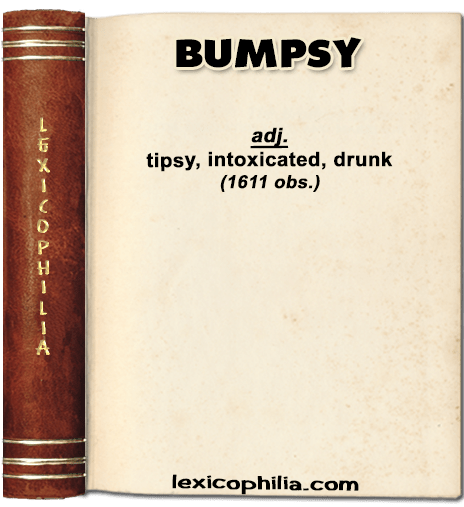
Word of the Day: BUMPSY

ETYMOLOGY
probably from bump (to collide heavily or firmly, to knock) + -sy

EXAMPLE
“… How Tarlton landed at Cuckolds haven.
TArlton being one Sunday at Court all day, caused a paire of Oares to tend him, who at night called on him to be gone. Tarlton being a carousing, drunk so long to the Watermen, that one of them was 
bumpsie, and so indeede were all three for the most part: at last they left Greenwich, the Tide being at a great low fall the Watermen yet afraide of the Crosse Cables by the Lime-house, very dark and late as it was, landed Tarlton at Cuckolds-hauen, and said, the next day they would giue him a reason for it …”

From: Tarltons Jests Drawne into these three parts.
1 His court-witty iests.
2 His sound city iests.
3 His countrey pretty iests.
Full of delight, wit, and honest mirth.
By Richard Tarlton, 1611

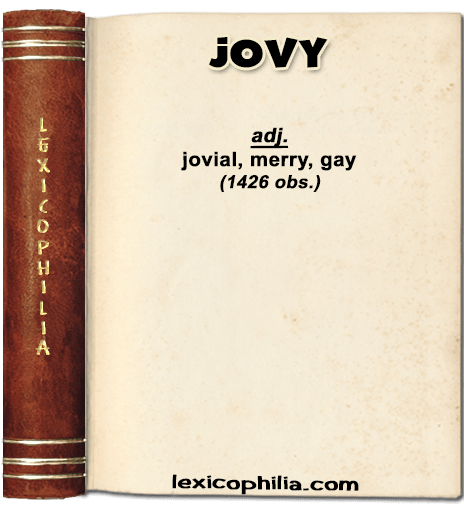
Word of the Day: JOVY

ETYMOLOGY
from Latin Jovius, from Jovis (Jove, poetical equivalent of Jupiter, name of the highest deity of the ancient Romans)

EXAMPLE
“… ‘And now I lepe louy pe [merry foot.] ;
Now I sterte, & now I ffle.
Selde abydyng in O thouht,
Al daungerous I sette at nouht,
…”

From: The Pilgrimage of the Life of Man
English by John Lydgate, 1426,
from the French of Guillaume de Deguileville

Word of the Day: NUPTIALIZE

ETYMOLOGY
from nuptial (relating to marriage or a wedding) + -ize

EXAMPLE
“… Vain.
Thou art enthusiastically congnitiant, but I must make an est inventus of Owmuch.

Fop.
And I’le voyage the while towards the straights of your Sisters affection.

Vain.
Hold Armiger, you must a while retire; the Knight must 
nuptialize before the ‘Squire …”

From: Tunbridge-Wells, or, A Days Courtship A Comedy
By Thomas Rawlins, 1678

Word of the Day: LEAN-WITTED

ETYMOLOGY
from lean (adj.) + witted (having wit)

EXAMPLE
“… A lunatike leane-witted foole,
Presuming on an agues priuiledge,
Darest with thy frozen admonition
Make pale our cheeke, chasing the royall bloud
With furie from his natiue residence.
Now by my seates right royall maiestie,
Wert thou not brother to great Edwards sonne,
This tong that runnes so roundly in thy head,
Should runne thy head from thy vnreuerent shoulders.
…”

From: The Tragedie of King Richard the Second 
1st Quarto
By William Shakespeare, 1597