Word of the Day

Word of the Day: DELITIGATE


ETYMOLOGY
from Latin delitigare (to scold to exhaustion; to dispute wholeheartedly)


EXAMPLE
“…Were our author to change sides (which fanatics oftenest do), we should in all likelihood find him delitigating just as copiously and as loudly against his present idol; perhaps somewhat after this fashion – “He has debauched his visual taste by the use of stimulant colours…”

From: The Athenaeum: Journal of Literature, Science, and the Fine Arts
“Modern Painters: their Superiority in the Art of Landscape Painting”
By a Graduate of Oxford, February 10, 1844
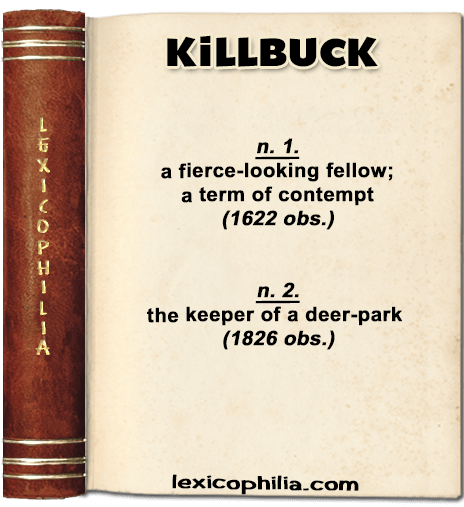
Word of the Day: KILLBUCK


ETYMOLOGY
from kill (vb.) + buck (the male of several animals)


EXAMPLE
“…Tharsalio.  Out, you young hedge-sparrow; learn to tread
afore you be fledge!
[He kicks her out.]
Well, have you done now, lady?


Arsace..  O, my sweet kilbuck!


Tharsalio.  You now, in your shallow pate, think this a
disgrace to me; such a disgrace as is a battered helmet
on a soldier’s head; it doubles his resolution. Say, shall
I use thee?


Arsace.  Use me?
…”

From: The Widdowes Teares
By George Chapman, 1612

Word of the Day: HEART-BOUND


ETYMOLOGY
from heart + bound


EXAMPLE
“…When Strephon cursing his owne backwardnes
Came to hir back, and so with double warde
Emprison hir, who both them did possesse
As heart-bound slaues: and happy then embrace
Vertues proofe, fortunes victor, beauties place
…”

From: The Countesse of Pembrokes Arcadia.
By Sir Philip Sidney. a1586

Word of the Day: CATAGLOTTISM


ETYMOLOGY
from French cataglottisme (‘a kisse or kissing with the tongue’ (Cotgrave)), 
from Greek καταγλώττισµα, (kataglottisma) -ισµός (‘a lascivious kiss’)


EXAMPLE
“…The kiss is not only an expression of feeling; it is a means of provoking it. Cataglottism is by no means confined to pigeons…”

From: Studies in the Psychology of Sex, 
Volume 4: Sexual Selection In Man
Havelock Ellis, 1905

Word of the Day: ANCIPITOUS


ETYMOLOGY
from Latin anceps-cipitis (two-edged or double)


EXAMPLE
“…of Planets amicall, benevolous, auspicious, fortunate; and inimicall, maleficall, unfortunate, exitiall; as also ancipitous, and indifferent to both (and all these sometimes roborated, and holpen; sometimes infirmed, and hindred one by another)…”

From: Πῦς-μαντία. (Pus-mantia) The Mag-Astro-Mancer, 
Or The Magicall-Astrologicall-Diviner posed, and puzzled,
By John Gaule, 1652

Word of the Day: IDIOTICON


ETYMOLOGY
from Greek ἰδιωτικόν, neut. sing. of ἰδιωτικός (idiōtikos – private, unprofessional, ordinary);
taken in the sense of peculiar to oneself


EXAMPLE
“…The one Idea which gives the Tone to each play not seldom implied in the Titles, which deserve to be mentioned as an Idioticon of Shakespears…”

From: Coleridge’s Lectures 1808–19: On Literature, 1987

Word of the Day: OBAMBULATE


ETYMOLOGY
from participle stem of Latin obambulare,
from ob- + ambulare (to walk)


EXAMPLE
“…Again, that al soules departed are in certaine receptacles vntill the generall iudgement, they do not obambulate and wander vp and downe, but remaine in places and states of happinesse or vnhappinesse, either in the hands of God, or in the Deuils prison…”

From: The Workes of John Boys
By John Boys, 1622