Word of the Day

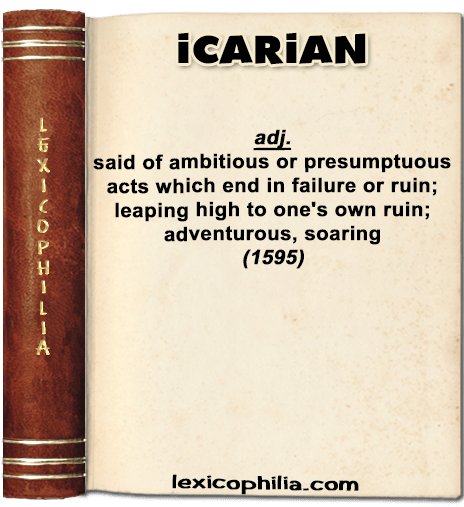
Word of the Day: ICARIAN


ETYMOLOGY
from Latin Icarius = Greek Ἰκάριος, from Icarus, Ἴκαρος the son of Daedalus, in Greek Mythology + -an 


EXAMPLE
“…And yet ’tis a bitter pang under any circumstances to find another preferred to yourself. It is about the same blow as one would probably feel if falling from a balloon. Your Icarian flight melts into a very grovelling existence, scarcely superior to that of a sponge or a coral, or redeemed only from utter insensibility by your very frank detestation of your rival…”

From: Coningsby: Or, The New Generation
By Benjamin Disraeli, 1844

Word of the Day: HOMODOX


ETYMOLOGY
from Greek ὁµόδοξος (of the same opinion),
from ὁµο- (homo-) + δόξα (opinion)


EXAMPLE
“…so likewise does the like Catholick Condemnation (from and by all the rest of the Christian Orders) reach the Church of Rome, as well as the Homodox Idolatry of the Cacodox Arians and Socinians.…”

From: Athenæ Britannicæ:
Or, A Critical History of the Oxford and Cambrige Writers and Writings.
By Myles Davies, Part II, 1716

Word of the Day: BAMBLUSTERCATE


ETYMOLOGY
from bam (to hoax, to make fun of to impose upon the credulous) + bluster


EXAMPLE
“…”In course,” continued Joe, more soothed: “none but a Jolly would go to say anything again it, or doubt the woracity o’ the thing. Well, shipmates, to heave ahead, I’m saying I was reg’larly bamblustercated when one of the genelmen up in the niches squeaks out, ‘King Herod, I’ll just thank your for a thimble-full of the stuff.'” …”

From: Bentley’s Miscellany, Volume II, 1837
‘Nights at Sea’

Word of the Day: ACYROLOGICAL


ETYMOLOGY
from Greek ἀκυρολόγος (akyrologos) (incorrect in speech);
from ἀ (not) + κῦρος (authority) + λόγος (speech) + -ical


EXAMPLE
for adverb form – (‘acyrologically – incorrectly as regards the use of words’)

“…He saith, (but Magisterially without the least proof) that the Apostle speaks Acurologically and abusively; and by sanctified, means quasi, as if they were sanctified…”

From: Plain Scripture Proof of Infants Church-Membership and Baptism
By Richard Baxter, 1651

Word of the Day: BOKO


ETYMOLOGY
of unknown origin


EXAMPLE
“…I fell down, and they all capsized, turned turtle – heels up, nose down – every man Jack, one after the other, over each other’s legs. Never saw such a mix, A common-keeper, one of the lot, got a heavy oner on the boko for his share.’
‘Boys,’ said Mr. Hamblin, ‘who use slang come to the gallows. Boko is …’
‘Conk or boko,.’ said Nicolas the vulgar. ‘It’s all the same. Took it home in a bag made out of a picket-handkerchief.’
…”

From: Time
A Monthly Miscellany of Interesting and Amusing Literature
Edited by Edmund Yates, Volume I, 1879
‘The Seamy Side’
By Walter Besant, and James Rice

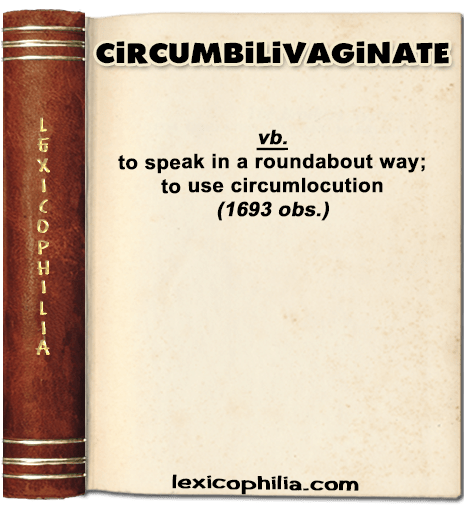
Word of the Day: CIRCUMBILIVAGINATE


ETYMOLOGY
in 16th–17th century France: apparently, a fanciful creation of Rabelais


EXAMPLE
“…My counsel to you in that case, my friend, is that you marry, quoth Hippothadee; for you should rather choose to marry once than to burn still in fires of concupiscence. Then Panurge, with a jovial heart and a loud voice, cried out, That is spoke gallantly, without circumbilivaginating about and about, and never hitting it in its centred point…”

From: Gargantua and Pantagruel, Book III.
By Francois Rabelais
Translation by Sir Thomas Urquhart and Peter Antony Motteux, 1693

Reverse Dictionary: SOILED DOVE


ETYMOLOGY
from soiled (defiled) + dove (gentle, innocent, or loving woman)


EXAMPLE
“…In “A Daughter of Eve,” Mr. Hain Friswell, who is favourably known as a producer of light literature, introduces, by way of arousing a sensation, a young lady, whom he euphemistically styles “a soiled dove.” It is impossible to regard modern society without acknowledging the abundant existence of such persons…”

From: Dublin University Magazine
A Literary and Political Journal
January to June 1863
‘Modern Novel and Romance’

Word of the Day: SPECTIBLE


ETYMOLOGY
from Latin spect-, ppl. stem of specere (to look)


EXAMPLE
“…Furthermore to make him more carefull to regard vertue, he planted into him very deepe rootes and prickes of conscience, hee added moreouer Statutes and Lawes, not onely emprinted within euery ones hart, but engrauen also outwardly in spectible Tables…”

From: Against Ierome Osorius Byshopp of Siluane in Portingall and against his slaunderous inuectiues An aunswere apologeticall.
By Walter Haddon and John Foxe
Translation by James Bell, 1581

Word of the Day: PANGUTS


ETYMOLOGY
apparently from pan- (all) + guts (the belly, stomach)


EXAMPLE
“…”Odzbodkins! You won’t spoil our sport,’ cried her husband. “Your crotchets are always coming in like a fox into a hen-roost.”
“I have work in hand that must be done,” replied his wife.
Panguts!” she exclaimed, raising her voice and her fist at the same time, “what do you do? lazying about here like a mud-turtle nine days after it’s killed
…”

From: Margaret: A Tale of the Real and Ideal, Blight and Bloom
By Sylvester Judd, 1845