Word of the Day

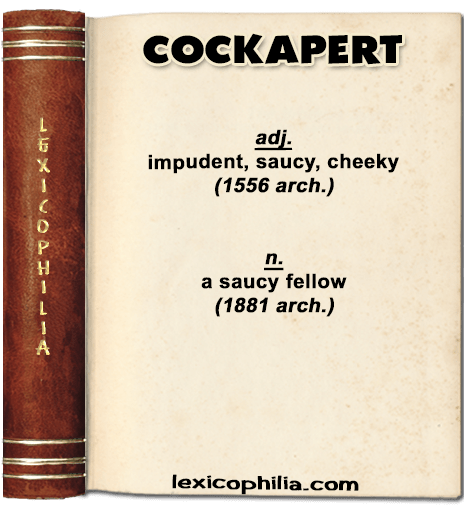
Word of the Day: COCKAPERT


ETYMOLOGY
seemingly an alteration of malapert (adj.) after cock (a mature male of the domestic chicken)


EXAMPLE
for adj.

“…Which is terbox to your side: for out of dout,
Your cockapert pride: and your couetous harts.
Haue brought: more than three parts of our ils about.
Your rude rebelins disobedient parts:
Much vnto our (and much more to your own) smarts:
Kicking and wincing at euery good order,
Hath distroide good order in euery border…”

From: The Spider and the Flie
By John Heywood, 1556


for n.

“… I could tell he was cross about something. I didn’t think the blisters were enough to account for it; he’d suffered them for days without complaint. We got under the quilt and I pulled the coverlet over our heads. In the dark I could watch him but he couldn’t see me. There was a strong scent of sweet balm from the foot salve. I said, “I heard about Sire … Lackadaisy, or or Lapscallion – the cockapert who insulted you. Are you still hungry at him?…”

From: Wildfire: A Novel
By Sarah Wicklem, 2009
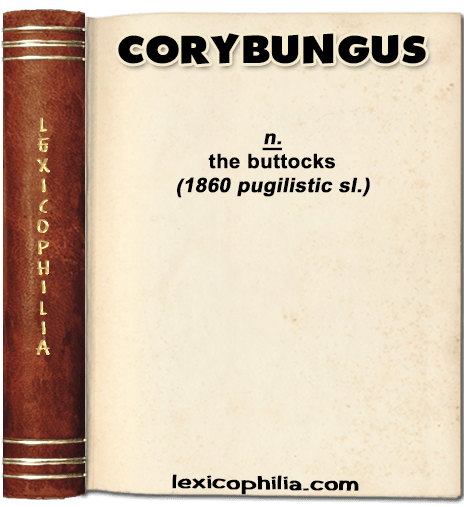
Word of the Day: CORYBUNGUS


ETYMOLOGY
? perhaps from bung (the buttocks, the backside [obs.]) + -us (abounding in, full of)


EXAMPLE
“…Sims, after a little unartistic squaring, lunged out awkwardly, and caught Tom on the chest with his left. Tom, who was evidently waiting to find out what his adversary could do, returned smartly on the gob, and in getting back, fell on his corybungus…”

From: Tom Sayers, Sometime Champion of England,
His Life and Pugilistic Career
By Thomas Sayers, 1866
‘Fight between Tom Sayers and George Sims, for £75, on Tuesday, the 28th of February, 1854, at Longreach’

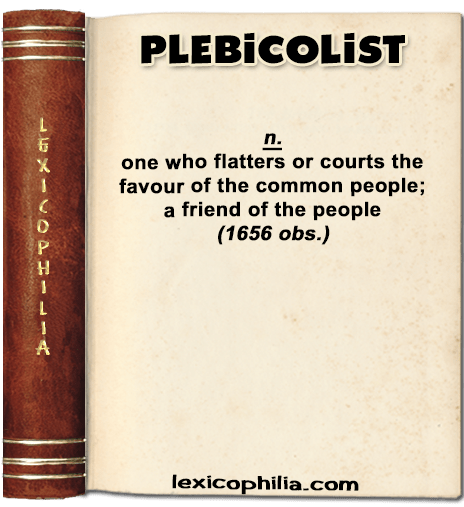
Word of the Day: PLEBICOLIST


ETYMOLOGY
from Latin plebicola one who courts the common people,
from plebs (the ordinary people) + –cola (cole) + -ist


EXAMPLE
“…Alva Adams, the plausible plebicolist who for so many years had prostituted Colorado to the lust of lucre and enslaved her to the corporations to serve his personal ends, was in his political death-struggle and fighting with the desperation of a dog-doomed rat…”

From: The Scarlet Shadow
A Story of the Great Colorado Conspiracy 
By Walter Hurt, 1907

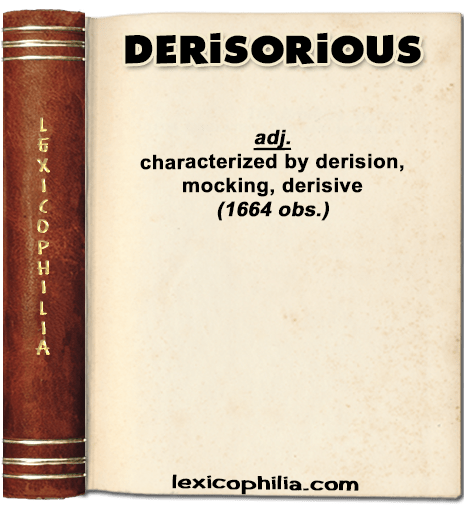
Word of the Day: DERISORIOUS


ETYMOLOGY
from Latin derisorius, from derisor (derider, mocker) + -ous


EXAMPLE
“…And that therefore the Spirit of Prophecy foreseeing these times, whenas for such a space he called Rome Pergamus, this succeeding Scene coming on, he might very well change the title of Pergamus into that of Thyatira, with a derisorious Allusion to the occasion of the name of that City, from the news of a Daughter being born to Nicanor.…”

From: An Antidote Against Idolatry
By Henry More, 1664

Word of the Day: BUCCULENT


ETYMOLOGY
from Latin bucculentus, from bucca (cheek)


EXAMPLE
“… The Royal Game of Goose or the Yorkshire Tragedy, which form the common ornaments of our cottages, are superseded in theirs by some marvellous legend redolent of beatitude; and instead of the Amazonian Trull, or the weather-beaten Admiral which frowns from the bowsprit of a British man-of-war, they carve on their prows the fair image of some bucculent Cherub, or some semi-anatomized Saint …”

From: The British Critic
Volume XIX. January-June, 1823
‘Blunt’s Vestiges of Ancient Manners in Italy’

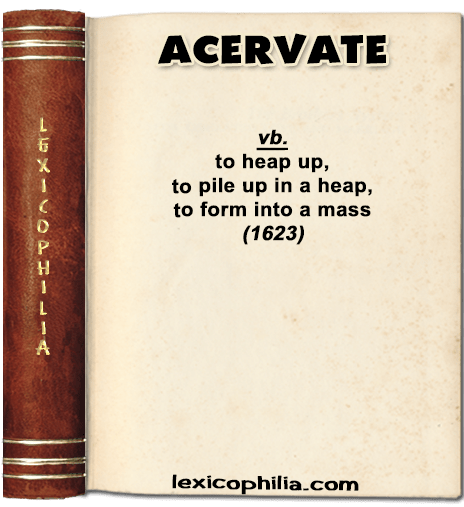
Word of the Day: ACERVATE


ETYMOLOGY
from Latin acervāt- past participial stem of acervare (to make into heaps, to pile up),
from acervus (a heap)


EXAMPLE
“…The mass of burning embers, by which the oven had been heated, was not, as he pretended, fairly swept out. Those that were well ignited were acervated (heaped up) into one corner; and the steak, so far from being left to the action of the heated air of the oven, was put between two tin dishes, and was embedded in the mass of the burning embers in the corners. …”

From: Arcana of Science and Art
Or, An Annual Register of Popular Inventions and Improvements
Printed by John Limbird, 1830
‘Chemical Science. The Fire King’

Word of the Day: TACENT


ETYMOLOGY
from Latin tacentem, present participle of tacere (to be silent)


EXAMPLE
“…And although he was much angred thereat, yet he seemed to be glad: and because he would obliege him further, he went vvith all his Court. Great was the resort thither of Ladies & Knights, and at the Kings entrance there was a fair Tragedy, whose subject I will be tacent of.…”

From: The Loves and Adventures of Clerio & Lozia.: A Romance
By Antoine Du Périer
Translation by F. Kirkman, 1652

Word of the Day: STRIVABLE


ETYMOLOGY
from Old French estrivable, from estriver (to quarrel, contend) + -able


EXAMPLE
“…that eke the lay peple of the newe lawe is bounde, undir perel of greet synne, forto receyve her feith and al the leernyng of Goddis lawe, now beyng, in ech doutable and strivable poynt therof, fro and of the preestis of the newe lawe, and forto obeie to hem therynne, in lasse thanne the case of the seid excepcioun kan be executid …”

From: Book of Faith; a fifteenth century theological tractate
From the manuscript in the library of Trinity college, Cambridge
By Reginald Pecock, c1456

Word of the Day: NEEDLE-SPITTER


ETYMOLOGY
from needle (n.) + spitter (a person who spits)


EXAMPLE
“… At the instant I entered, all the parties were engaged in combat, and my landlady – a perfect needle-spitter – stood with a face like Gorgon, with the iron frying pan in her uplifted hands eagerly waiting to cut down the too powerful knight of the hammer…”

From: The Sporting Magazine,
Or Monthly Calendar of The Transactions of The Turf, The Chace, 
And Every Other Diversion Interesting to the Man of Pleasure, Enterprise, and Spirit
Vol. 25. For March, 1805
‘A Ramble; From Tiverton to Exeter’