Word of the Day

Word of the Day: INCULP


ETYMOLOGY
from Latin inculpare to inculpate, perhaps after French inculper 


EXAMPLE
“…For if Cri­sostomes impatience and headlong desire slew him; why should mine honest proceed­ing and care be inculped therewithall? If I preserve mine integrity in the society of these Trees; why would any desire me to lose it, seeing every one covets to have the like himself, to converse the better among men?…”

From: The History of The Valorous and Witty Knight-Errant, Don-Quixote, of the Mancha
By Miguel De Cervantes Saavedra
Translated by Thomas Shelton, 1612
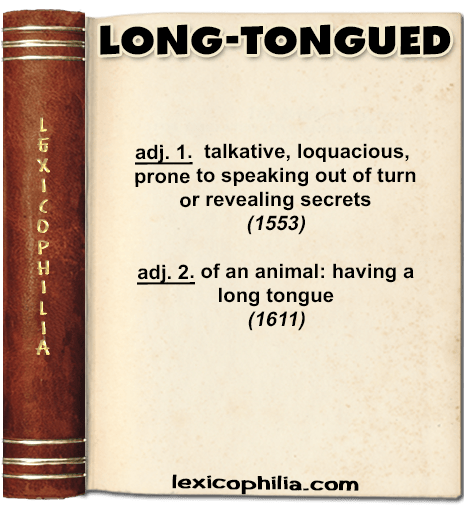
Word of the Day: LONG-TONGUED


ETYMOLOGY
from long + tongued


EXAMPLE
“…And tyme hathe this one vngracious propertee,
   to blab at length open all that he doothe see.
   Than a daughter eke he hath called veritee,
   As vnhappie a longtounged girle as can bee.
   she bringeth all to light, some she bring[eth] to shame,
   she careth not a grote what manne hathe thanke or blame.
   yf men be praise worthie she dothe so declare them
   And if otherwyse in faithe she dothe not spare them
…”

From: Respublica: an interlude for Christmas
Attributed to Nicholas Udall, 1553

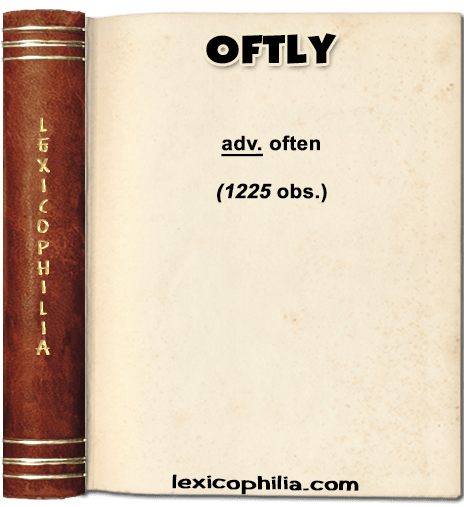
Word of the Day: OFTLY


ETYMOLOGY
from oft (adv.) + -ly


EXAMPLE
“…And faste approcht: which newes when so I knew
I placed me where comming I behold
A seemely band, as eie di euer vewe,
And goodly dight as hart defier cold,
Oftlie returning vnto freends I told,
That I had seene of noblenes the flower
For discipline in ordring of a power
…”

From: The True Vse of Armorie
By William Wyrley, 1592

Word of the Day: EBRIETATING


ETYMOLOGY
from ebriety (a being intoxicated, drunkenness) + ‑ate 


EXAMPLE
“…But what we suppose conduces most to this seeming Magnanimity, is some things their Priests give them before, of an ebrietating Quality, which intoxicates their Spirits, and renders them insensible of what they are going to endure…”

From: The British Apollo, or, Curious Amusements for the Ingenious
May, 1711

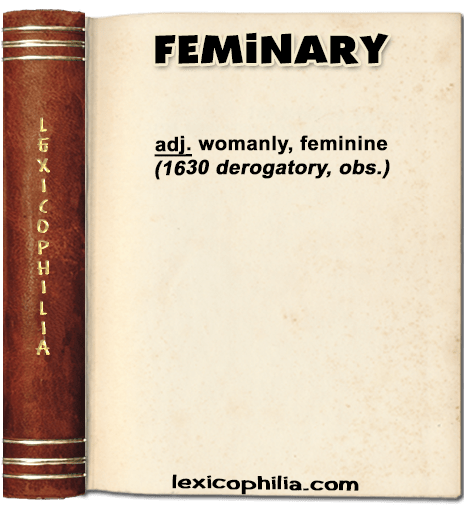
Word of the Day: FEMINARY


ETYMOLOGY
from Latin femina (woman, feminine) + -ary


EXAMPLE
“…and not (lest any bodie should be deceiued) a softnesse, a feminarie, sottish calmenesse and vitious facilitie, whereby a man delighteth to please all, and not to displease or offend any, although he haue a iust and a lawfull cause…”

From: Of Wisdome,
By Pierre Charron
Translated by S, Lennard, 1630

Word of the Day: CONCITATE


ETYMOLOGY
from Latin concitat- participle stem of concitare (to move violently, to excite),
from con- + citāre (to move)


EXAMPLE
“…Cyrus king of Persia, mynding to concitate the myndes of his people, to wery & anger them, with payneful labour, held thē all one day at worke and vtterly tyred thē, in hewing vp a certayne Wood, on the morow after he made for them a very plentitious feast, demaunding in the feast tyme…”

From: A Right Exelent and Pleasaunt Dialogue Betwene Mercury and an English Souldier contayning his Supplication to Mars
Barnabe Rich, 1574

Word of the Day: QUARTER-CLEFT


ETYMOLOGY
from quarter + cleft (n. and adj. split asunder)


EXAMPLE
“…It is the fashion to talk of Lord Ellenborough in contemptuous terms, as a mere nincompoop, or quartercliff, or what else you will, that implies feebleness of intellect and deficiency of talents; but those who so describe him either mistake his character, or wilfully misrepresent it…”

From: Fraser’s Magazine for Town and Country
Vol. IV. August, 1831 to January 1832
Parliamentary Eloquence, No. IV, House of Lords, by Oliver Yorke

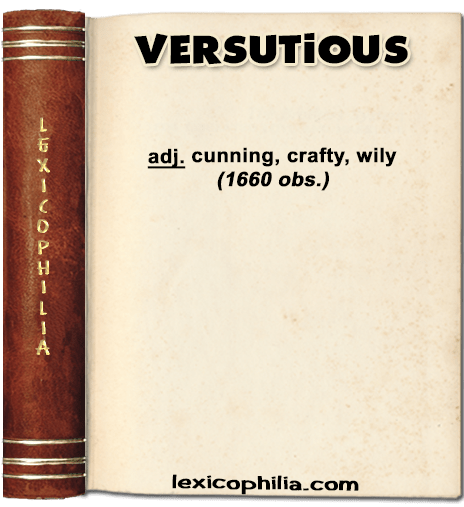
Word of the Day: VERSUTIOUS


ETYMOLOGY
from Latin versutus (wily, cunning) + – ious


EXAMPLE
“…And what do I not ow thee for thy versutious Comple­ments to my Lady Lambert, whose beauty and ele­gance bewitched my affections, as thou well knowest; so that I could not forbear toying and tickling her at my son Ireton’s Funeral in Somerset-house, before all the Company!…”

From: A Third Conference Between O. Cromwell and Hugh Peters In Saint James’s Park, 1660

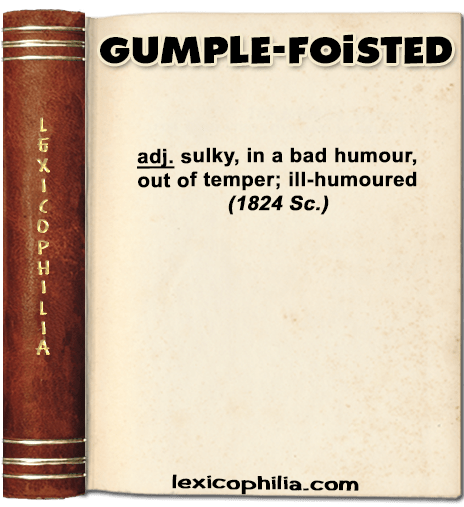
Word of the Day: GUMPLE-FOISTED


ETYMOLOGY
from Scots gumple (to be in a bad mood, to sulk, and as a noun, a fit of the sulks) + feist (found in other formations of similar meaning, e.g. bumple feist (the sulks), amplefeist (a sulky mood)) + -ed


EXAMPLE
“…Aweel, aweel,’ said Peter Peebles, totally unabashed by the repulse, ‘e’en as ye like, a wilful man maun hae his way; but,’ he added, stooping down and endeavouring to gather the spilled snuff from the polished floor, ‘I canna afford to lose my sneeshing for a’ that ye are gumple-foisted wi’ me‘….”

From: Redgauntlet: A Tale of the Eighteenth Century
By Sir Walter Scott, 1824