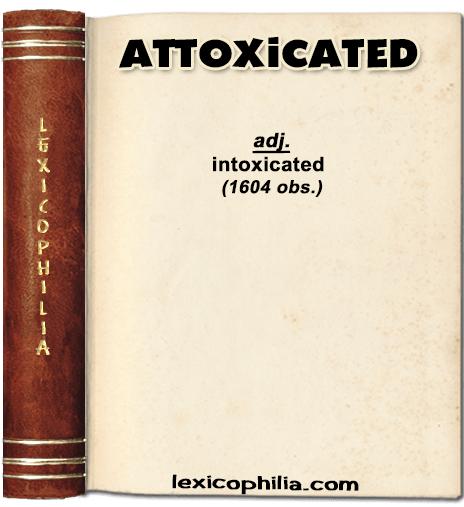
Word of the Day: ATTOXICATED

ETYMOLOGY
from Latin at-ad- (to) + toxicare (to poison) + -ed

EXAMPLE
“… Who seeth and feeleth not, that oftentimes while Reason attendeth to Contemplation, a villanous passion of Loue withdraweth the attention, and with an attoxicated delight imprisoneth the Affection? Who perceiueth not, that diuers times Reason would pardon all iniuries, and Ire opposeth it selfe, importuning reuenge? …”

From: The Passions of the Minde
By Thomas Wright, 1604

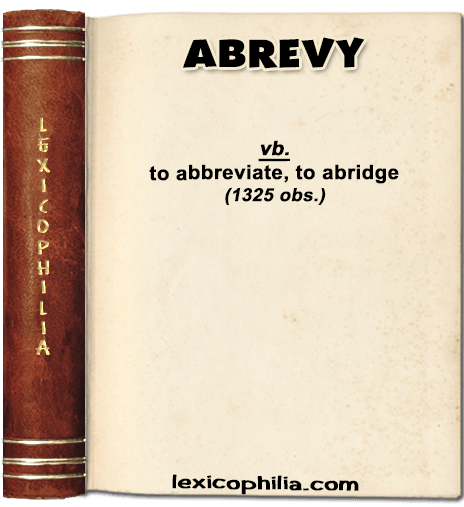
Word of the Day: ABREVY

ETYMOLOGY
from Middle French abrevier, from Latin abbreviare (to abbreviate, to shorten)

EXAMPLE
“… Fyrst, diuide the denominator by hys numerator, and if anye number doe remaine, let your diuisor be diuided by the same number, and so you must continue vntyll you haue so diuided yt there may nothing remaine, then is it to be vnderstande, that your last diuisor (wherat you did ende, and that 0. did remaine after your last diuision) is the greatest number, by the which you must abreuiat, as you did in the laste example, but in case that your last diuisor be 1. it is a token that the same number can not be abreuied. Example, of 54/11 diuide 81. (which is the denominator) by 54. which is his numerator, and there resteth 27. then diuide 54. by 27. and there remaineth nothing, wherefore your last diuisor 27. is the number, by the which you must abreuiat 54/81 as in the last example is specifyed. …”

From: The Welspring of Sciences, which teacheth the perfecte worke and practise of arithmeticke both in vvhole numbers & fractions
By Humfrey Baker, 1564
The thirde Chapter treateth of abbreuiation of one great broken number into a lesser broken

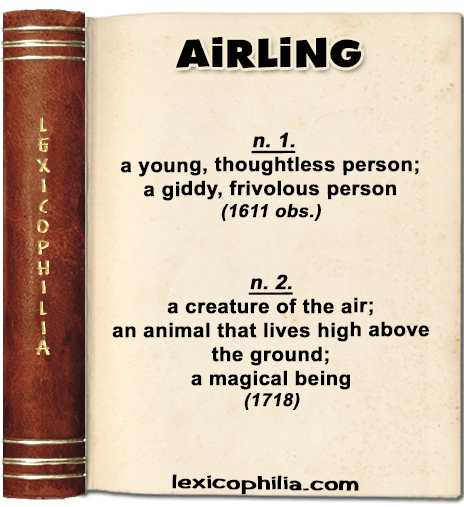
Word of the Day: AIRLING

ETYMOLOGY
apparently from air (n.) + -ling 

EXAMPLE (for n. 1.)
“… Some more there be, slight ayrelings, will be wonne,
With dogs, and horses ; or, perhaps, a whore ;
Which must be had : and, if they venter Hues,
For vs, AVRELIA, we must hazard honors
A little. Get thee store, and change of women,
As I haue boyes; and giue ‘hem time, and place, And all conniuence : be thy selfe, too, courtly ;
And entertayne, and feast, sit vp, and reuell ;
Call all the great, the faire, and spirited Dames
Of Rome about thee ; and beginne a fashion
Of freedome, and community.
…”

From: Catiline His Conspiracy
By Benjamin Jonson, 1611

Word of the Day: ALLEVE

ETYMOLOGY
from Latin adlevareallevare (to lift up, raise, relieve, lighten),
from ad– + levare (to raise )

EXAMPLE
“… there was a plat devised by me and penned by Mr. Southwell, for the winter garrison in such season as th’ enemy could not keep the field, to th’ intent his Majesty’s charges might be aleived, and the victual spared until the year should open: at which time it was thought his Majesty would resolve with what numbers his pieces might be defended. …”

From: The Works of Henry Howard, Earl of Surrey
And of Sir Thomas Wyatt, The Elder
Edited by George Frederick Nott, 1815
Letter XXVI. The Earl of Surrey to Mr. Secretary Paget, 15 March, 1544

Word of the Day: AIDANT

ETYMOLOGY
from Anglo-Norman aidaunt, aydaunt, and from Anglo-Norman and French aidant (helping, and helper, ally), present participle of aider (to aid)

EXAMPLE (for adj.)
“… All blest secrets all you vnpublisht vertues of the earth,
Spring with my teares beaydant (
be aydant) and remediat,
In the good mans distresse, seeke, seeke, for him,
Lest his vngouernd rage dissolue the life.
That wants the meanes to lead it.
…”

From: True Chronicle Historie of the Life and Death of King Lear and his three daughters
By William Shakespeare, 1608

Word of the Day: AWEBOUND

ETYMOLOGY
from awe (a feeling of terror or dread mixed with reverence) + bound (compelled, obliged)

EXAMPLE
“… As she uttered the interrogatory, she raised the rattle-snake in her hands, holding it so that it might be distinctly seen by those whom she addressed. The reptile hissed, accompanying the sibilation with a sharp “skirr” of its tail. Who could doubt that it was an answer in the affirmative?
Not the Yamassees, who stood
awe-bound and trembling in the presence of the mighty sorceress. …”

From: Osceola the Seminole,
Or, The Red Fawn of the Flower Land
By Capt. Mayne Reid, 1858

Word of the Day: ASMATOGRAPHER

ETYMOLOGY
from Greek aσµατογράϕος (from ᾀ̑σμα, -µατ– (song, lyric) + -γράϕος writing, writer) + -er

EXAMPLE
” … (Title) 1639 Songs: – A Collection of Original Songs, by Oddibus, Funnybus, Asmatographer to the Court of Comus…”

From: Catalogue of the Singularly Curious, Very Interesting, and Valuable Library
of Edward Skegg,
Arranged by S. Leigh Sotheby, Auctioneer of Literary Property, and Works of Art,
1842

Word of the Day: AILUROPHOBIA

ETYMOLOGY
from Greek αἴλουρος [ailouros] (cat) + –phobos (fear)

EXAMPLE
“… Of Ailurophobia and the Power to be Conscious of the Cat as Near, when Unseen and Unheard. …” (Title)

From: Transactions of the Association of American Physicians.
Twentieth Session held at Washington, D.C., May 16 and 17. 1905
By S. Weir Mitchell

PRONUNCIATION
ay-lyoor-oh-FOH-bee-uh

Word of the Day: ALIICIDE

ETYMOLOGY
from. Latin alius (another) + -icide (the killing of), in allusion to suicide

EXAMPLE
“… Would the Lord Chief Justice be at all surprised if one of his amiable and interesting, but insane, correspondents were to take a mad freak into her head some day, and commit suicide or allicide? If, instead of adorning the Queen’s Bench, he honoured the chair of an insurance company, what would he think of the rate of payment requisite on the lives of such persons going at large? …”

From:  Punch, or The London Charivari,
December 19, 1868
Look After Lunatics

Word of the Day: AMPUTE

ETYMOLOGY
from French amputer, from Latin amputare (to remove by cutting off)

EXAMPLE
“… The Blood of Christ, as purging away the guilt of sin, was represented in Circumsion as to be shed; but it is represented in Baptism as already shed, and applyed to the party baptized. The body of sin was represented in Circumcision under the notion of a superfluity to be amputed and cut off: ‘Tis represented in Baptism under the notion of a defilement or pollution, which is removed by washing. But the use of the one and the other in general was and is the same, namely to represent to the mind that way, and those means, by and through which the soul hath remission of sin, peace which God, and is brought to future Salvation. …”

From: An essay to revive the primitive doctrine and practice of Infant-Baptism
By Joseph Whiston, 1676