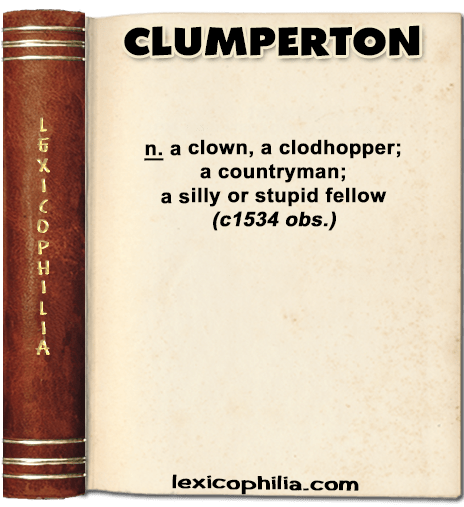
Word of the Day: CLUMPERTON


ETYMOLOGY
from clump or clumper (a lump, mass);
possibly on model of simpleton


EXAMPLE
“…Thus departinge from thence it chaunced him to stray asyde from his companie, and, fallinge into reasoninge and so to altercation with a stronge stubberne clomperton, he was shrowdlie beaten of him, yeat hee kepte him from beinge hurte of his menne, grauntinge that hee hadd well deserved those stripes…”

From: Polydore Vergil’s English History, c1534
from an early translation preserved among the mss. of the old royal library in the British museum
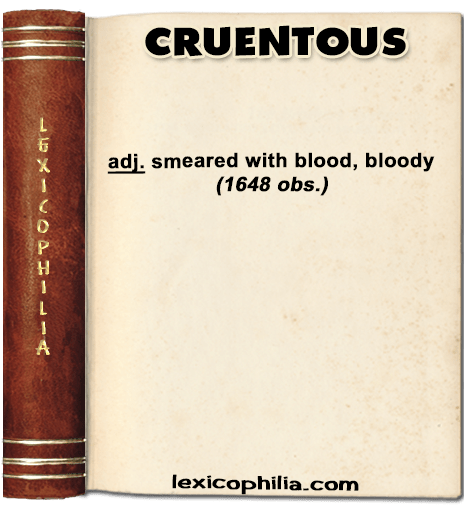
Word of the Day: CRUENTOUS


ETYMOLOGY
from Latin cruentus (bloody) + -ous


EXAMPLE
“…Thus a cruell and most cruentous civill war began which lasted neer upon foure yeers without intermission, wherin there happen’d more battailes, sieges and skirmishes, then passed in the Netherlands in fourescore yeers, and herein the Englishmen may be said to get som credit abroad in the world, that they have the same blood running in their veines (though not the same braines in their sculls) which their Ancestors had, who were observed to be the activest peeple in the field, impatient of delay, and most desirous of battaile then any Nation…”

From: A Venice Looking-Glasse
By J.B.C., 1648

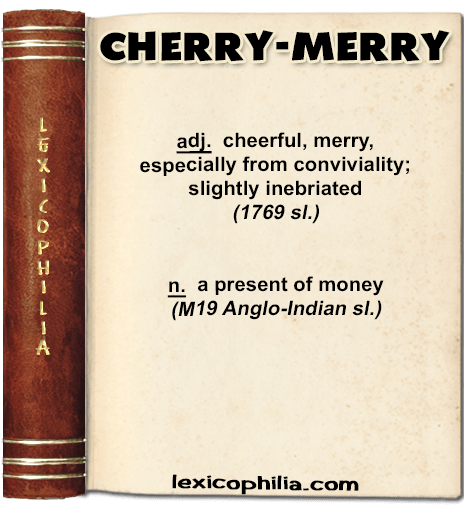
Word of the Day: CHERRY-MERRY


ETYMOLOGY
perhaps from cheery + merry; possibly only a jingling combination


EXAMPLE
“…how few of you are enemies to a glass (or two or three) of generous wine, and how much food of such a heating nature, promotes the circulation of the bottle, it is not at all astonishing, that every convivial assistant should go home cherry-merry, after having been a guest at such a repast…”

From: Yorick’s Sentimental Journey Continued,
By John Hall-Stevenson, 1769

Word of the Day: CHATTERMAG


ETYMOLOGY
from chatter + mag (a chatterbox)


EXAMPLE
“…Now then, stop that; we don’t want no such dal’d nonsense; we come here to work. Now then, you women, divide into twos, and begin at both ends, or we shan’t get any work done for your chattermagging…”

From: Stubble Farm;
Or, Three Generations of English Farmers
By Hubert A. Simmons, Vol. II, 1880
Chapter I. P. 14

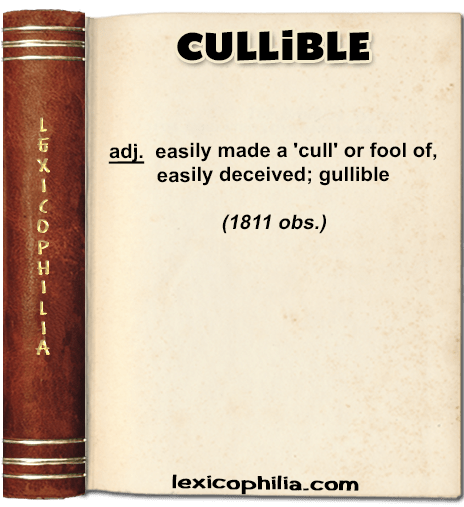
Word of the Day: CULLIBLE


ETYMOLOGY
from the Oxford English Dictionary:
“This adjective, which is presupposed in the derivative cullibility (known 1728), would normally be derived from a verb cull ; but none such is recorded”


EXAMPLE
“…The cullibity of man praeterite, I allow, but because men are & have been cullible, I see no reason why shd always continue so, – Have there not been fluctuations in the opinions of mankind; and as the stuff which soul is made of must be in every one the same …”

From: The Letters of Percy Bysshe Shelley,
Edited by Frederick Lafayette Jones, 1964,
– Shelley to Hogg, January 12, 1811

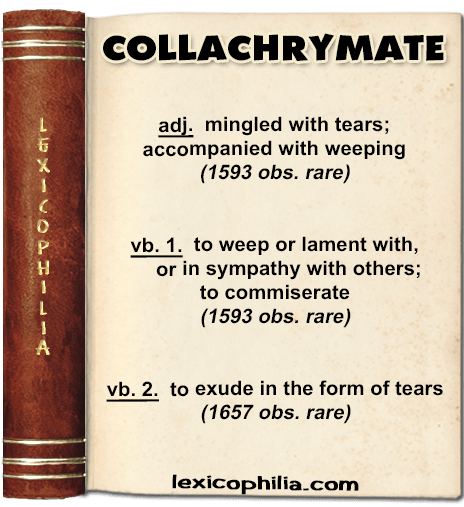
Word of the Day: COLLACHRYMATE


ETYMOLOGY
adj.: from Latin collacrimatus, pa. pple. of collacrimare;
vb. : from Latin collacrimat- ppl. stem of collacrimare, from col- (together) + lacrimāre (to shed tears, weep), from lacrima (tear)


EXAMPLE
“…A tormentor would collachrymate my case, and rather choose to have been tortured himself than torment me with ingratitude as thou dost…”

From: Christs teares ouer Ierusalem,
By Thomas Nashe, 1593

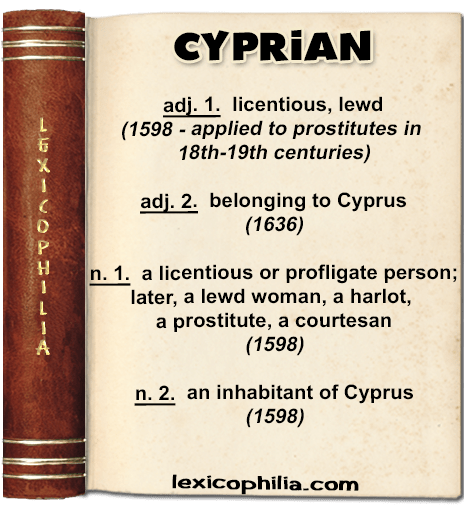
Word of the Day: CYPRIAN


ETYMOLOGY
from Latin Cyprius (of Cyprus) + -an;
in French cyprien


EXAMPLE
“…Shall Curio streake his lims on his dayes couch,
In Sommer bower? and with bare groping touch
Incense his lust, consuming all the yeere
In  Cyprian dalliance, and in Belgick cheere?
Shall Faunus spend a hundred gallions,
Of Goates pure milke, to laue his stallions,
As much Rose iuyce? O bath! ô royall, rich
To scower Faunus, and his salt proude bitch!
…”

From: The Scourge of Villanie
By John Marston, 1598

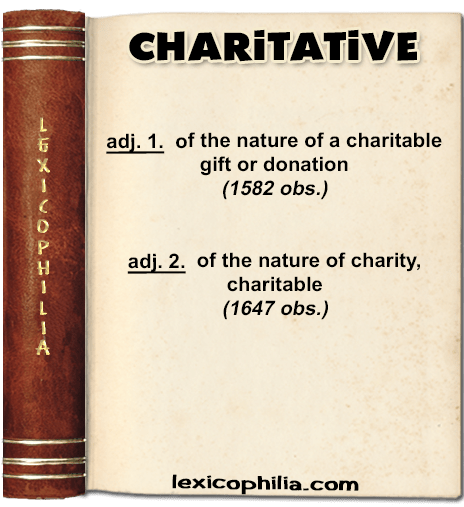
Word of the Day: CHARITATIVE


ETYMOLOGY
from Old French charitatif-ivecaritatif-ive, medieval Latin caritativus (charitable)


EXAMPLE
“…And  for  that  this  only  controversy  is  the  cause  of  this visitation,  I  do  mean  that  it  shall  be  merely  charitative,  and not  to  burden  the  clergy  of  any  procurations  as  yet;  and withal  not  to  trouble  your  lordship  much  longer  about  this matter  there,  than  you  shall  be  occasioned  otherwise  to  tarry for  the  speeding  of  the  visitation  of  the  church…”

From: The Remains of Edmund Grindal, 1843