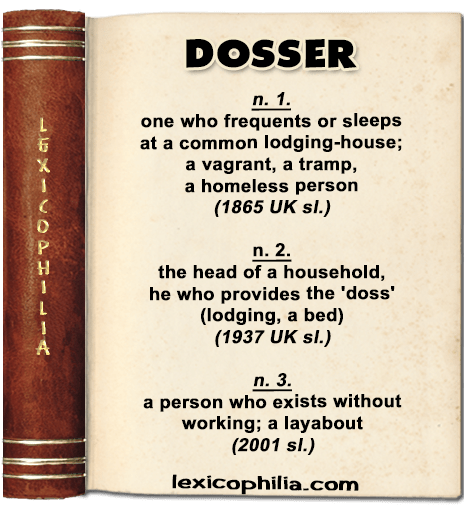
Word of the Day: DOCUS

ETYMOLOGY
of unknown origin

EXAMPLE (for n. 1.)
“… Eh man, but ye maun be an unco docus to mistak the yowlin’ o’ a wheen dougs for the squeelin’ o’ ghaists an’ deevils ! I wonner what ye made o’ the twa grumphies it ye had row’t up amang your falalls; gin ye thought it they war young de’ils or what, snoukin’ for a sappy emmeldyug about the harigals o’ ye. …”

From: Saint Patrick: A National Tale of the Fifth Century
By J. Rennie, 1819

Word of the Day: DROSSEL

ETYMOLOGY
of obscure origin

EXAMPLE
“… But lawfull weare it some be such, should all alike be coy’
Now dwels ech
Drossell in her Glas: when I was yong, I wot,
On Holly-dayes (for sildome els such ydell times we got)
A Tubb or Paile of water cleere stood vs in steede of Glas:
And yeat (which still I beare in mind) for it I schooled was,
Euen by an holy Fryer, that espyde me tooting so,
Who, softly stealing at my backe, cryde suddenly. Ho, Ho.
…”

From: Albions England: A Continued Historie of the same Kingdome, from the originals of the first inhabitants thereof
By William Warner, 1597

Word of the Day: DEXTERICAL

ETYMOLOGY
irregularly formed on Latin dexter (on the right hand or right side) + -ic + -al

EXAMPLE
“… It is called of the Hebrewes, … the hande of the Soule, or … the right hand of the minde, because it makes any conceit dexterical, one of the two things, for which a pregnant Poet (as imagine of Homer, Naso, or any other) especially is to be admired: …”

From: The optick glasse of humors.
Or The touchstone of a golden temperature
Or, The philosophers stone to make a golden temper.
By Thomas Walkington, 1607

Word of the Day: DOG-BOLT

ETYMOLOGY
of origin uncertain

EXAMPLE (for n.1.)
“… And as for Ser John Hevenyngham, Ser John Wyndefeld, and othere wurchepfull men ben mad but here doggeboltes, the which I suppose wull turne hem to diswurchep here-after…”

From: Paston Letters and Papers of the fifteenth century
Edited by Norman Davis, Richard Beadle, and Colin Richmond, 2004
Letter from Margaret Paston to John Paston, 1465

Word of the Day: DOWNSTEEPY

ETYMOLOGY
from down (in a descending direction) + steepy (full of steep places, steep) 

EXAMPLE
“… All which notwithstanding, perceiving life to remaine in him, he tooke heart againe; and getting vp on his feet, all goared with bloud, and loaden with strokes, making way through the prease, came to a craggie and downe-steepie rocke, where vnable to goe any further, by one of his wounds, with both his hands he pulled out his guts, and tearing and breaking them, cast them amongst such as pursued him, calling and attesting the vengeance of God to light vpon them. …”

From: The Essayes, or Morall, Politike, and Millitarie Discourses of Lord Michaell de Montaigne
By Michel de Montaigne
Translated by John Florio, 1603

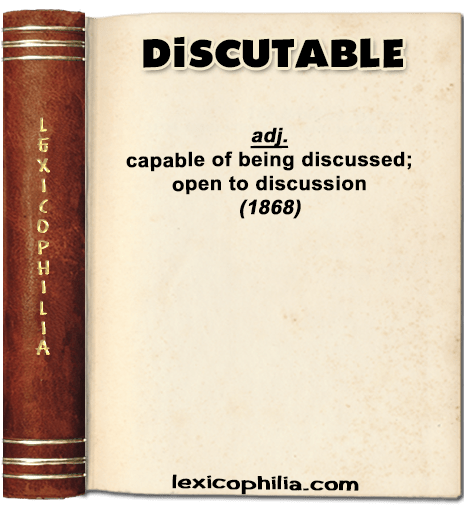
Word of the Day: DISCUTABLE

ETYMOLOGY
from French discutable,
from discuter (to discuss),
(from Latin discutere (to discuss) + -able)

EXAMPLE
“… A definite and complete study of all literary works of the period inspired by the event would be not only an enterprise worthy of an inquisitive erudition, but also a useful help in tracing a line of demarcation between legend and history, and would throw a flood of light on many insoluble or discutable points. …”

From: The Saturday Review of Politics, Literature, Science and Art, 1893
Christopher Columbus and Lope de Vega

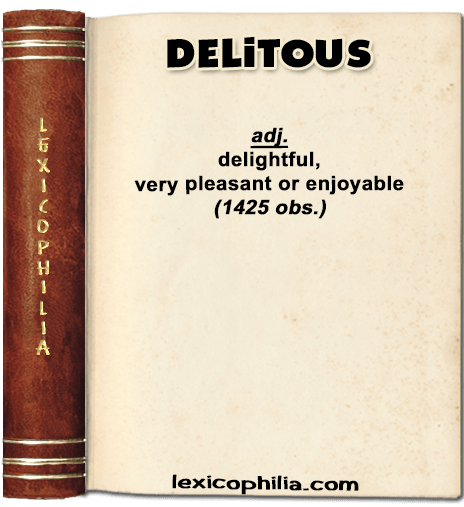
Word of the Day: DELITOUS

ETYMOLOGY
from Anglo-Norman delitous, Middle French deliteux;
from delit (delight) + ‑ous 

EXAMPLE
“… For sich solace sich ioie and play
I trowe that neuere man ne say 
As was in that place delytous
The gardeyn was not daungerous
To herberwe briddes many oon
So riche a yeer was neuer noon …”

From: The Romaunt of the Rose
By Guillaume de Lorris and Jean de Meun
Translated by Geoffrey Chaucer, a1425

Word of the Day: DUPLE

Note: the obsolete adjective definition is a general sense.
In mathematics, it is applied to the proportion of two quantities one of which is double of the other; 
in music, it is applied to ‘time’ or rhythm having two beats in the bar.

ETYMOLOGY
Adj. and n.:  from Latin duplus (double), from duo (two) + -plus, from root ple- (to fill);
Vb.:  from Latin duplare (to double), from dupl-us (duple)

EXAMPLE (for vb.)
“… She mixd of Quick-silver a deadly weight,
That dupled force his murder hasten might.
Then while those baneful pots betwixt them strov,
The helpful swaying the hurtfuls bane out drov. …”

From: Enchiridium epigrammatum Latino-Anglicum:
An epitome of essais,
Englished out of Latin by Robert Vilvain, 1654

Word of the Day: DEBLATERATE

ETYMOLOGY
from Latin deblaterare transitive (to prate of, blab out), from de- blaterare (to prate)

EXAMPLE
“… Robert Louis Stevenson, the traveler and author, writes: I conceived a great prejudice against missions in the South Seas, and I had no sooner come there than that prejudice was first reduced and then annihilated. Those who deblaterate against missions have only one thing to do, to come and see them on the spot. They will see a great deal of good done, and I believe, if they be honest persons, they will cease to complain of mission work and its effect. …”

From: What is a Christian and A Talk on Books,
By Henry Drummond, 1891
Thomas E. Watson “exposed”; an examination of his “Foreign missions exposed”.

Word of the Day: DILOGICAL

ETYMOLOGY
from Greek δίλογος (dilogos) (doubtful), διλογία (repetition) + -ic + -al, after logical

EXAMPLE
“… Therefore some of the subtler, haue deliuered their opinions in such spurious, enigmaticall, dilogicall termes, as the Diuell gaue his Oracles; that since Heauen will not follow their Instructions, their Constructions shall follow Heauen. And because the Weather hath not fallen out, as they haue before tolde, they will now tell as the weather falles out. …”

From: The Sacrifice of Thankefulnesse 
By Thomas Adams, 1616