Word of the Day: DEVENUSTATE

ETYMOLOGY
from late Latin devenustare (to disfigure, deform),
from de- venustare (to beautify), venustus (beautiful)

EXAMPLE
“…but that Christ and his Servants may have comfort and stability amongst us, that those who Rule would fence the Vine, Learning, against beasts of Prey, and Foxes of spoil, who would rejoyce to see what yet remains of beauty and order, devenustated and exposed to shame and dishonour…”

From: An Humble Apologie for Learning and Learned men
By Edward Waterhouse, 1653

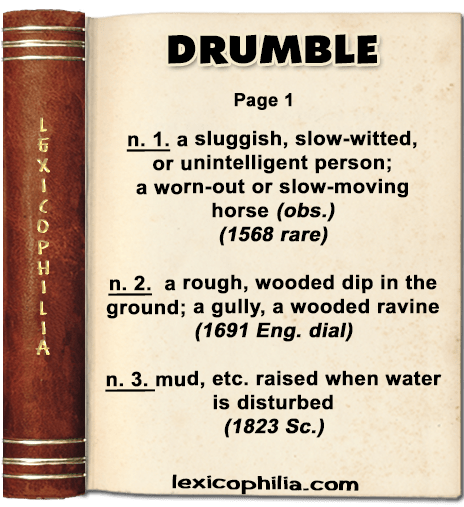
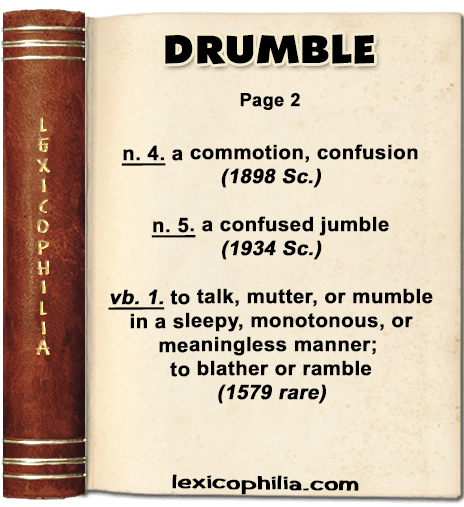
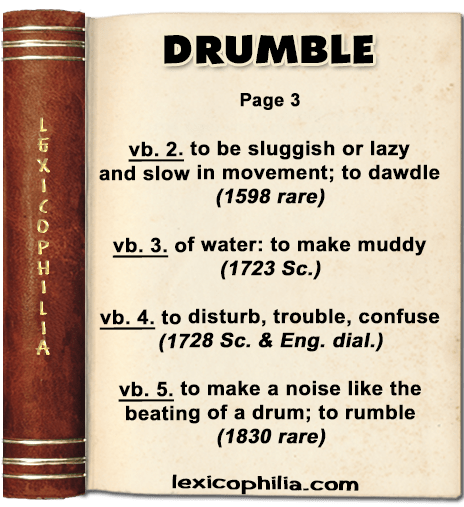
Word of the Day: DRUMBLE

ETYMOLOGY
n. 1.: ? variant of dumbledummel (Eng. dial., a stupid, slow person)

n. 2.: a variant or alteration of dimble (a deep, shady dell, a dingle)

vb. 4.: apparently a nasalized form of drubble (to trouble, disturb), parallel to drumblydrumly (adj.) from drubly; but possibly a back-formation from the adj.

vb. 5.: blend of drum and rumble

EXAMPLE
“…Yea but what am I, a Scholer, or a scholemaister, or els some youth.
A Lawier, a studient or els a countrie cloune
A Brumman, a Baskit maker, or a Baker of Pies,
A flesh or a Fishmonger, or a sower of lies:
A Louse or a louser, a Leeke or a Larke:
A  Dreamer, a Drommell, a fire or a sparke:
A Caitife, a Cutthrote, a creper in corners,
A herbraine, a hangman, or a grafter of horners
…”

(Note: drommell is the earliest variant of drumble)

From: A New Tragicall Comedie of Apius and Virginia
By R.B., 1575

Word of the Day: DISMARRY

ETYMOLOGY
from 16th century French desmarier (‘to diuorce, vnwed, or vnmarrie’, Cotgrave),
from des- (dis-)  + marier (to marry)

EXAMPLE
“…And he was heyre to his father, and had fayre herytages, and was lykelye to enjoye more; howebeit, agaynst the yonge mannes mynde he was dismaryed, and maryed agayne to another gentylwoman, at the pleasure of the duke of Burgoyne and of the lorde de la Tremoyle…”

From: The Cronycle of Syr John Froissart
Translated out of French by Sir John Bourchier Lord Berners, 1525

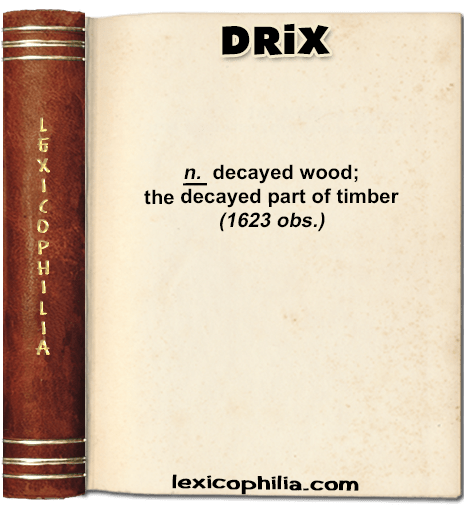
Word of the Day: DRIX

ETYMOLOGY
of uncertain origin

EXAMPLE
“…The Waspes neast is begun by one great Waspe, which you may therefore call the Mother-waspes, the which in Cancer (or in hot and dry springs somewhat rather) within some hole, vsually made in the ground by a Moale, Mouse, or other meanes, worketh a comb of the vtter drix of pales or other timber, in forme of a round tent hanging by the top to the ouer-part of the hole.…”

From: The Feminine Monarchie,
Or the Historie of Bees
By Charles Butler, 1623

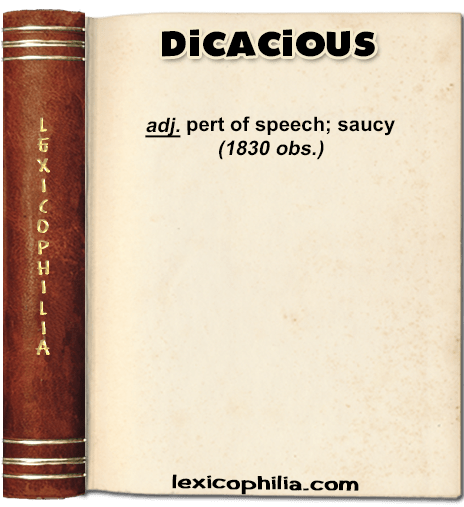
Word of the Day: DICACIOUS

ETYMOLOGY
from Latin dicaxdicaci-(talking sharply) + -ous

EXAMPLE
“…Giovanni (or Lanciotto) deputes his more blandishing and dicacious brother to be his proxy in the marriage ceremonies; and afterwards, as the morning breaks, when the susceptible lady actually discovers her husband to be a wise, stern, moral man…”

From: The North American Magazine
Volume 4, 1834
Francesca Da Rimini
A Tragedy by Silvio Pellico

Word of the Day: DELAYOUS

ETYMOLOGY
from Old French delaieus, from delai (delay) + -ous

EXAMPLE
“…Neuyrthelesse I remembere well that ye delt wythe ryght delayous peple, my lord Archbyshop and othere of my lordys, and I dempte by-cawse of youre long tarryng that by youre sad dyscrescyon all hadde ben sett thorow…”

From: Paston letters and papers of the fifteenth century
– John Paston, 1469
– Edited by Norman Davis, Richard Beadle, and Colin Richmond, 2004

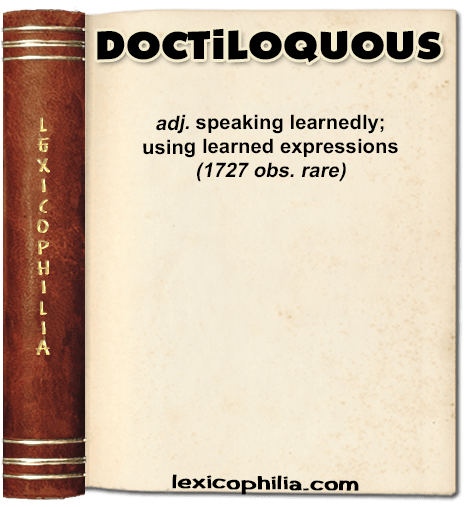
Word of the Day: DOCTILOQUOUS

ETYMOLOGY
– from Latin doctiloquus (learnedly-speaking)

EXAMPLE
“…Most prudent,
Most grave,
Most scientific Jordan,
the most religious admirer of,
Sir,
Your very high Doctiloquous Sapience
…”

From: Posthumous Works of Frederic II, King of Prussia, Vol. IX,
Correspondence. Letters Between Frederic II and M. Jordan
Translated From the French By Thomas Holcroft, 1789
Letter LIV, From the King, The Camp of Molwitz, May 13, 1741

Word of the Day: DUNCIFY

ETYMOLOGY
from dunce (n.) + -fy

EXAMPLE
“…I would gladly rid my hands of it cleanly if I could tell how, for what with talking of coblers, & tinkers, & roapemakers, and botchers, and durt-daubers, the marke is cleane gone out of my muses mouth, and I am as it were more than dunsified twixt diuinitie and poetrie…”

From: The Vnfortvnate Traveller
Or, The Life of Iacke Wilton
Thomas Nashe, 1594