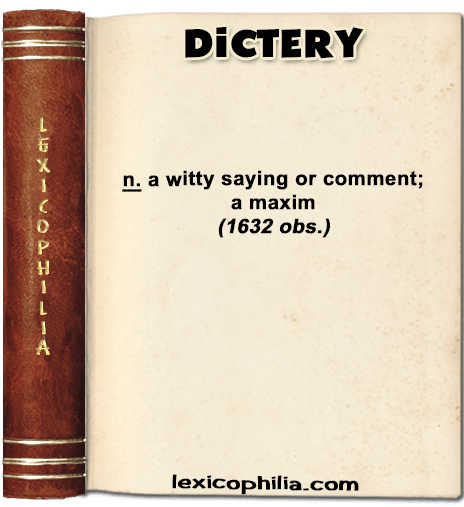
Word of the Day: DICTERY


ETYMOLOGY
from Latin dicterium (a witty saying, bon-mot), of uncertain origin


EXAMPLE
“…I took a snatch where I could get it; nay more, I railed at marriage downright, and in a public auditory, when I did interpret that sixth Satire of Juvenal, out of Plutarch and Seneca, I did heap up all the dicteries I could against women; but now recant with Stesichorus…”

From: The Anatomy of Melancholy
By Robert Burton, 1632
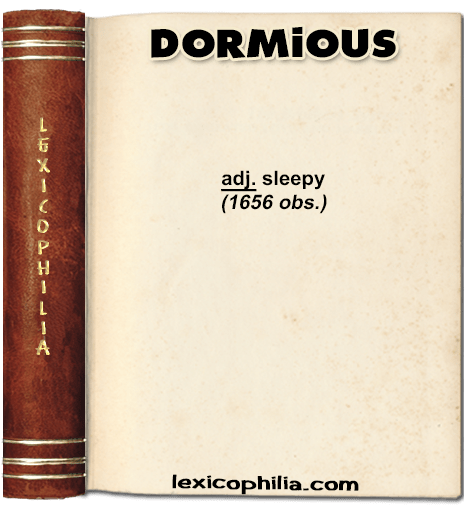
Word of the Day: DORMIOUS


ETYMOLOGY
from Latin dormire (to sleep) + -ous


EXAMPLE
“…and the busie Bell-man bounced twice at the door, and as well the Champion as Soto began to grow dormious, which occasioned the Host to petition their present departure to bed, which (with heavie heads heaven knows) they went to…”

From: Don Zara del Fogo: a Mock-Romance
By Samuel Holland, 1656

Word of the Day: DEROGATORIOUS


ETYMOLOGY
from Latin derogatorius derogatory + -ous


EXAMPLE
“…if the said archbishop intermeddled after the said provocation, his doings were derogatorious not only to the dignity of the patriarche but to the supremacy of the Pope and to the authority also of the general Counsell…”

From: A Treatise on The Pretended Divorce Between Henry VIII and Catharine of Aragon
By Nicholas Harpsfield, a1575
Modernized Text By Nicholas Pocock, 1878

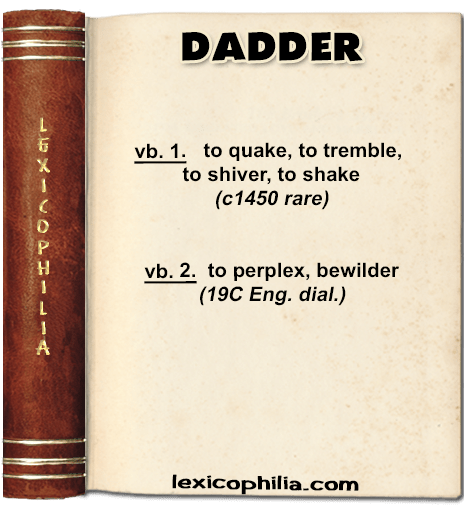
Word of the Day: DADDER


ETYMOLOGY
possibly imitative (perhaps of the chattering of teeth)


EXAMPLE
“…Full gayly was that grete lorde . girde in the myddis,
A brighte belte of ble, . broudirde with fewles,
With drakes and with dukkes, . daderande tham semede,
For ferdnes of fawcons fete, . less fawked thay were…”

From: Winnere and Wastoure 
(“Winner and Waster” is a Middle English poem written in alliterative verse around the middle of the 14th century)

Word of the Day: DETESTATE


ETYMOLOGY
from Latin detestat-, ppl. stem of detestare (-arī) (to detest)


EXAMPLE
“…the whiche in all kinde of liuing and conuersacion is vtterly geuen and married vnto this worlde, whiche as a mortall enemy, the doctrine of the gospell doeth detestate and abhorre? with cleane handes and verye reuerentlye we vse to touche the holy boke of the gospell…”

From: The First Tome or Volume of the Paraphrase of Erasmus vpon the Newe Testamente
By Erasmus, Desiderius
Translated by Nicholas Udall, 1548

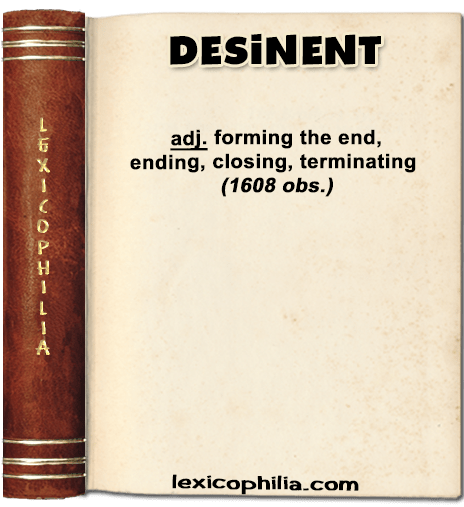
Word of the Day: DESINENT


ETYMOLOGY
from Latin desinentem, present participle of desinere (to leave off, close),
from de- + sinere (to leave)


EXAMPLE
“… In front of this sea were placed six tritons, in moving and sprightly actions, their upper parts human, save that their hairs were blue, as partaking of the sea-color: their desinent parts fish,  mounted above their heads, and all varied in disposition. From their backs were borne out certain light pieces of taffata, as if carried by the wind, and their music made out of wreathed
shells…”

From: The Masque of Blackness in Characters Two Royall Masques
By Benjamin Jonson, 1608

Word of the Day: DECURTATE


ETYMOLOGY
adjective: from Latin decurtatus, pa. pple. of decurtare (to cut off, curtail)
verb: from participial stem of Latin decurtare + -ate


EXAMPLE
“…hee sendes for his Barber to depure, decurtate, and spunge him, whome hauing not paide a twelmonth before, he now raines downe eight quarter angels into his hande…”

From: Lenten Stuffe
By Thomas Nashe, 1599

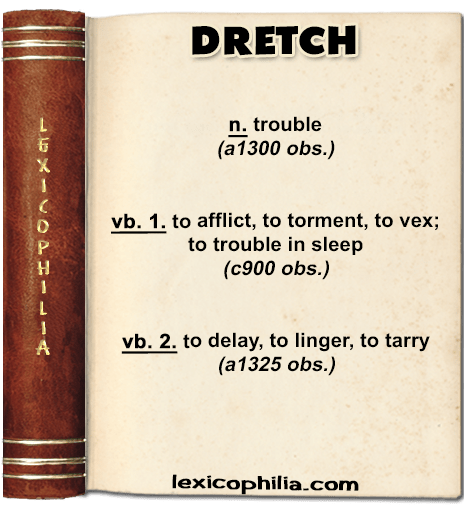
Word of the Day: DRETCH

ETYMOLOGY
from Old English drecc(e)an: unknown in the other Germanic languages


EXAMPLE
“…Sir sayd sir Bors after ye were departed from vs we alle that ben of youre blood and youre well wyllers were soo dretched that somme of vs lepte oute of oure beddes naked & some in their dremes caughte naked swerdes in their handes therfor said sir Bors we deme there is some grete stryf at hand…”

From: Le Morte Darthur
By Sir Thomas Malory, 1470

Word of the Day: DOITRIFIED

ETYMOLOGY
blend of doited (having the faculties impaired by age) and petrified

EXAMPLE
“…“What passed, say ye? O, there wasna muckle: I was in a great passion, but she was dung doitrified a wee. When she gaed to put the key i’ the door, up it flew to the fer wa’. ‘Bless ye, jaud, what’s the meaning o’ this?’ quo she. ‘Ye hae left the door open, ye tawpie!’ quo she.…”

From: The Private Memoirs and Confessions of a Justified Sinner
By James Hogg, 1824