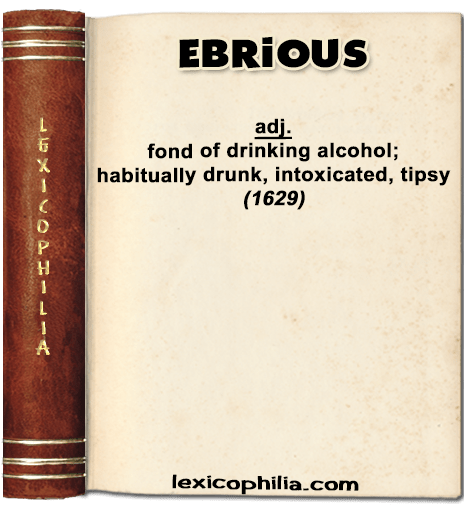
Word of the Day: EBRIOUS

ETYMOLOGY
from Latin ebrius (drunk intoxicated_ + -ous

EXAMPLE
“…This branded and illegall witnesse then, being at the very best a forraigner, doth only marre, not helpe their cause: The second was but an Anglo-Belgicus, a dissolute, ebrious and luxurious English-Dutchman…”

From: The Church of Englands Old Antithesis to New Arminianisme 
By William Prynne, 1629

Word of the Day: EXPLORATE

ETYMOLOGY
adj.: from Latin exploratus past participle of explorare (to explore)
vb.: from Latin explōrāt- past participial stem of explorare (to explore)

EXAMPLE
“…The consideration whereof (most iudicious Men) though I looke not to be of that weigh with you, as to moue you ac­tually to implant your selfs in our Catholicke Church; yet since you are wyse, learned, and loth (no dowbt) to commit any such explorate errours, as the force of Naturall Reason and your owne Consciences may freely check; I am in good hope, that the serious perusall of the poynts aboue disputed, will at least preuayle thus far with diuers of you; …”

From: The Converted Jew
By John Clare, a1628

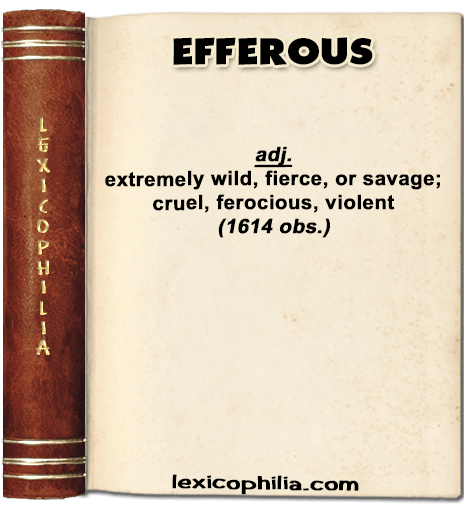
Word of the Day: EFFEROUS


ETYMOLOGY
from Latin efferus [from ex– out + ferus (fierce)] + -ous


EXAMPLE
“…But whatsoeuer be done with the foxes, yet from the teeth of that efferous beast, from the tuske of the wild bore, from the sucking and drawing of Romish horse-leaches, from the bloud-thirsty dropsie of Antichrist and his adherents, from the cursed Assasinates of Iesuites and their darke disciples, from the peremptory knife of Popish, worse then paganish, pruners, ô thou that art the root & generation of Dauid preserue our root and all his generation, together with his most glorious stemme…”

From: Vitis Palatina
A sermon appointed to be preached at VVhitehall vpon the Tuesday after the mariage of the Ladie Elizabeth her Grace.
By Bishop John King, 1614

Word of the Day: EXFLUNCTICATE


ETYMOLOGY
quasi-Latin elaboration of flunk (to fail)


EXAMPLE
“…Though at my old Kenawa home,
They named me there afore I come,
For short, and caze it was my natur,
‘Half hoss and half an alligator’;
But that is nuther here nor there;
But I’m resolved, and now declare,
I’ll go along with you and fight,
As long as I can see the light;
If not, may I be regulated, —
Tee-totally exfluncticated
…”

From: The Forest Rangers:
A Poetic Tale of the Western Wilderness in 1794
By Andrew Coffinberry, 1842

Word of the Day: ELF-LOCKED


ETYMOLOGY
from elf-lock (a tangled mass of hair, superstitiously attributed to the agency of elves, especially Queen Mab: ‘which it was not fortunate to disentangle’),
from elf & lock


EXAMPLE
#1

“…Had VIRGIL had nor house-room, nor a Boy
Whom he about his bus’ness might imploy:
The elfe-lockt Fury all her Snakes had shed,
His Pipe play’d nothing rare, but flat and dead.
We tragick Poets now would think it fair,
If that, which kept th’ old Buskins in repair,
Might not from RUBREN LAPPA be with-drawn,
Whose Cloak and Papers ATREUS hath in pawn…”

From: Mores hominum – The Manners of Men described in Sixteen Satyrs by Juvenal,
Translation by Robert Stapleton, 1647


#2

“…At my question, the young wonder coolly winked, nodded his elf-locked head, wounded up his top-cord, pouched his toy, and urged me laconically to accompany him with a beck and a shout thus – “Here it’s! – yont here, sir!” and immediately trotted off before me to point out where,,,”

From: Rural Rhymes and Sketches in East Lothian
By James Lumsden, 1885
‘Country Chronicles’
Word of the Day: EUCLIONISM


ETYMOLOGY
from Euclionem, the name of a miser, the chief character in Plautus’ Aulularia + -ism


EXAMPLE
“…Yea in the worde of one no more wealthy then hee was, wealthy saide I, nay I’le befworne hee was a grande iurie man in respect of me, those graybeard Huddle-duddles and crusty cum-twangs, were strooke with such stinging remorse of their miserable Euclionisme and sundgery, that hee was not yet cold in his graue but they challenged him to be borne amongst them, and they and sixe citties more, entred a sharpe warre aboute it, euery one of them laying claime to him as their owne, and to this effect hath Bucchanan an Epigram….”

From: Lenten Stuffe
By Thomas Nashe, 1599

Word of the Day: ELOQUIOUS


ETYMOLOGY
from Latin eloquium (eloquence) + -ous


EXAMPLE
“…Eloquious hoarie beard father Nestor, you were one of them, and you M. Vlisses the prudent dwarfe of Pallas another, of whome it is Illiadizd that your very nose dropt sugar candie, and that your spittle was honye. Natalis Comes if he were aboue ground…”

From: Lenten Stuffe
By Thomas Nashe, 1599

Word of the Day: EBRIETATING


ETYMOLOGY
from ebriety (a being intoxicated, drunkenness) + ‑ate 


EXAMPLE
“…But what we suppose conduces most to this seeming Magnanimity, is some things their Priests give them before, of an ebrietating Quality, which intoxicates their Spirits, and renders them insensible of what they are going to endure…”

From: The British Apollo, or, Curious Amusements for the Ingenious
May, 1711