ETYMOLOGY
possible alteration of ‘fernticle’ or the synonymous dialectal ‘fan freckle‘
EXAMPLE
“…John Hewitt, a Bricklayer .. straight Hair, and Form-Speckles on his hands and Face …”
From: The London Gazette, 1666, Feb.
ETYMOLOGY
possible alteration of ‘fernticle’ or the synonymous dialectal ‘fan freckle‘
EXAMPLE
“…John Hewitt, a Bricklayer .. straight Hair, and Form-Speckles on his hands and Face …”
From: The London Gazette, 1666, Feb.

ETYMOLOGY
from Latin fama (fame ) + -cide
EXAMPLE
Why shouldn’t a book critic be called the famicide of the reputation of books? A movie critic the famicide of movies?
ETYMOLOGY
from force (n.) + -ly
EXAMPLE (for adv.)
“…Luke we the fische that swimmis in the se,
Luke we in eirth all kynd of bestyall,
The foulis fair sa forcelie thay fle,
Scheddand the air with pennis grit and small;
Syne luke to man that he maid last of all
Lyke to his image and his similitude;
Be thir we knaw that God is fair and gude.…”
From: The morall fabillis of Esope the Phrygian
Translation by Robert Henryson
The Preiching of the Swallow. a1500
ETYMOLOGY
from fiddle (n.) + faced (adj.)
EXAMPLE
“…And would any but such like, sick-brained, corky-noddled, flea-lugg’d piper framed, fiddle faced, wagtailed fellows, saucy, and idle, lazy, lubbert, leeped, nasty, foul clacking, and a meer outside, a pinned up bacon, a stitched together stand-bra, can scarce put on her own cloaths, and can do nothing else but stand like a statue, with her gogling eyes, and black patches, and when they are off is ashamed to be seen in public, for fear they prove a scare crow…”
From: John Thompson’s Man
Or. A short survey of the difficulties and disturbances That may attend a married Life, c1785

ETYMOLOGY
so called because of their resemblance to the seeds of a fern:
perhaps from fern + -ticle (as in particle, etc.)
EXAMPLE
“…It healeth al the fautes in the face layd to with hony, and it taketh away frekles or fayrntikles with vinegre …”
From: A New Herball
By William Turner, 1551
ETYMOLOGY
? aphetic from defamation (n.)
EXAMPLE 1
“…Ich wile þat y ben hanged & drawe
Boute y defende me wiþ þe lawe
Of þis famacioun,
Þat þow seist y scholde selle
Me lordes sone þat ich of telle,
Þat men clepede Reinbroun …”
From: The Romance of Guy of Warwick
The first or 14th-century version, c1325
EXAMPLE 2
The well-known actor brought a legal action against the magazine for famation of character.
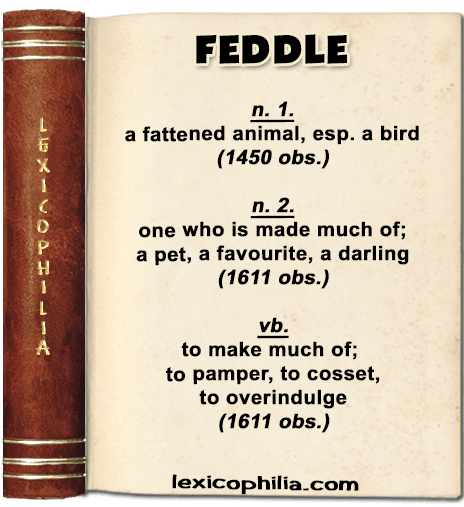
ETYMOLOGY
perhaps representative (with some change of sense) Old English fedels (fatted bird),
the Germanic base of feed (vb.) + the Germanic base of ‑els
EXAMPLE
(for n. 2)
“…It will be of a pretty little Infant: O how heartily I shall love it! I do
already dote upon it; for it will be my dainty Fedle-darling, my genteel Dilli-minion …”
From: The third book of the Works of Mr. Francis Rabelais
Translation by Thomas Urquhart. 1693
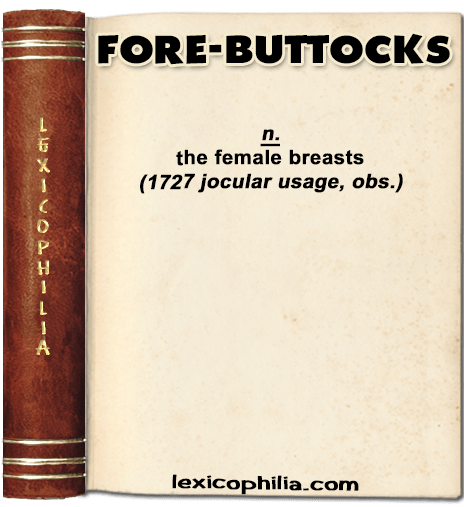
ETYMOLOGY
from fore- (prefix) + buttock (n.)
EXAMPLE
“…Nothing in Nature is so lewd as Peg,
Yet, for the World, she would not shew her Leg!
While bashful Jenny, ev’n at Morning-Prayer,
Spreads her Fore-Buttocks to the Navel bare.
But diff’rent Taste in diff’rent Men prevails,
And one is fired by Heads, and one by Tails;
Some feel no Flames but at the Court or Ball,
And others hunt white Aprons in the Mall…”
From: Sober Advice from Horace: to the young gentlemen about town.
As deliver’d in his second sermon.
Imitated in the manner of Mr. Pope.
…as restored by the Rev’d. R. Bentley, 1734
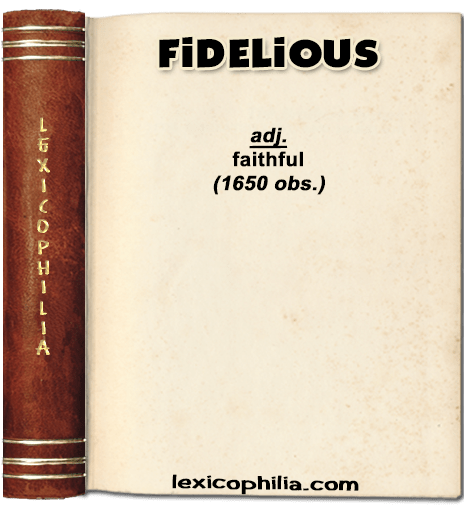
ETYMOLOGY
from Latin fidelis (faithful, loyal) + -ous
EXAMPLE
“…I ever (quoth Rhoxenor) have found thee cordially fidelious, doe but doe as thou hast indented, and expect what wealth, or honour thou canst covet, while Clodomer lives, and when his death, puts the Diadem upon my head, to be my only favourite…”
From: The Loves of Amandus and Sophronia
By Samuel Sheppard, 1650
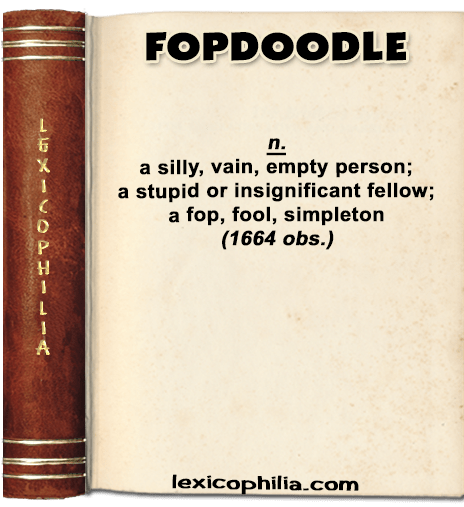
ETYMOLOGY
from fop (n.) + doodle (n.)
EXAMPLE
“…Quoth he, This scheme of th’ heavens set,
Discovers how in fight you met
At Kingston with a may-pole idol,
And that y’ were bang’d both back and side well;
And though you overcame the bear,
The dogs beat you at Brentford fair;
Where sturdy butchers broke your noddle,
And handled you like a fop-doodle…”
From: Hudibras: The Second Part
By Samuel Butler, 1664
 Lexicophilia