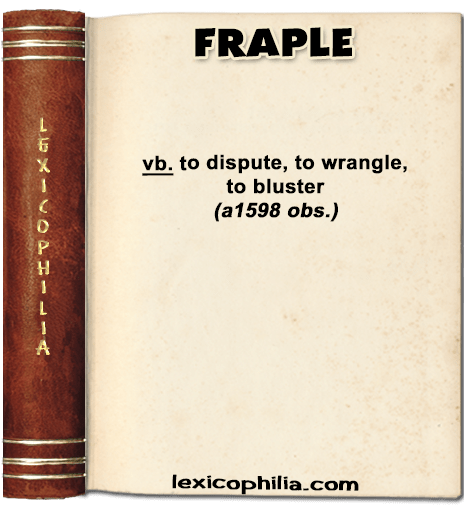
Word of the Day: FRAPLE


ETYMOLOGY
of uncertain origin;
perhaps from the Teutonic root flap and Old French frapillier (to be indignant, murmur)


EXAMPLE
“…Elixir vitae, and the precious Stone,
You know as well as how to make an Apple;
If’te come to the workinge then let you alone,
You know the coullers black brown bay and dapple,
Controwle you once then you begin to fraple.
Swearing and saying, what is fellow is this?
Yet still you worke but ever worke amisse
…”

From: Sir Edward Kelle’s Worke,
In Elias Ashmole’s Theatrum Chemicum Brittanicum, 1652

Word of the Day: FALSILOQUENCE


ETYMOLOGY
from Latin falsiloquus (from falsus (false) + loqui (to speak)) + -ence


EXAMPLE
“…And that their Mutual Forces Join’d,
Harnass’d with Wit so much refin’d;
And so adorn’d instead of Sense,
With Trappings of Falsiloquence,
Might draw misjudging Fools to be,
In Love with their Sincerity;
…”

From: The Fifth and last Part of Vulgus Britannicus
By Edward Ward, 1710

Word of the Day: FROST-BRAINED


ETYMOLOGY
from frost + brained


EXAMPLE
“…MARTIANUS: Madam, we all have so importund him
Laying unto his judgement every thing
That might attract his sences to the crowne;
But he, frost-braind, will not be obtaind
To take upon him this Realmes government
…”

From: No-Body and Some-Body, 1606
“Printed for John Trundle, and are to be sold
at his shop in Barbican, at the signe of No-body.”

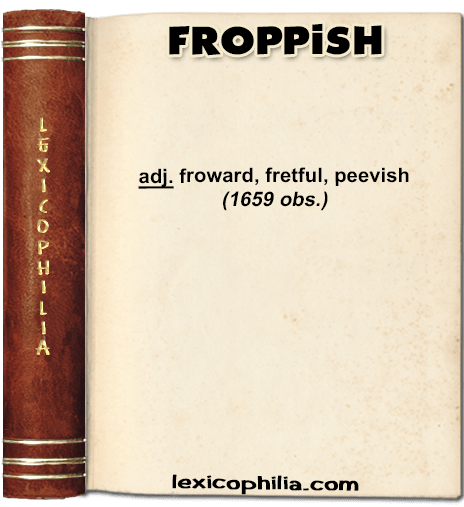
Word of the Day: FROPPISH


ETYMOLOGY
? from frop, variant of frap (to strike, to beat) + -ish


EXAMPLE
“…God doth usually, if not constantly, break their wills by de∣nying them, as one would cross a froward. Child of his stub∣born humour: or else puts a sting into them, that a man had been as good he had been without them, as a man would give a thing to a froppish Child, but it may be with a knock on his Fingers, and a frown to boot.…”

From: Christian letters full of spiritual instructions tending to the promoting of the power of godliness, both in person and families.
By Joseph Alleine, 1659

Word of the Day: FAUNTEKIN


ETYMOLOGY
diminutive of faunt: aphetic form of Old French enfauntenfant;
the shortened form has not been found in French, but Italian has the corresponding fante (boy, servant, foot-soldier), whence German fant


EXAMPLE
“…”Þat is soth,” quod clergye “I se what þow menest,
I shal dwelle as I do my deuore to shewen,
     And conformen fauntekynes and other folke ylered,
Tyl pacience haue preued þe and parfite þe maked…”

From: The Vision of William concerning Piers the Plowman,
By William Langland, 1377

Word of the Day: FALLAXITY


ETYMOLOGY
from Latin fallax: from fallere (to deceive) + -ity


EXAMPLE
“...saying that then it shall appear before his Counsell the great deceit fallaxity and crafty waies cast and invironed to destroy and holy to an nyntyssement of your honor for ever…”

From: The Berkeley Manuscripts
The Lives of the Berkeleys
Lords of the Honour, Castle and Manor of Berkeley
In the County of Gloucester, From 1066 to 1618
John Smyth, a1641

Word of the Day: FACUNDIOUS


ETYMOLOGY
from Latin fācundia (eloquence) + -ous


EXAMPLE
“…Discrete and hardy and wonder vertuous,
And of speche ryght facundious.
And coud him wel in euery thinge demene,
But Menelay of stature was but meane…”

From: The Auncient Historie and Onely Trewe and Syncere Cronicle of the Warres Betwixte the Grecians and the Troyans 
By John Lydgate, 1430

Word of the Day: FRIDAY-FACE


ETYMOLOGY
probably from the time when Friday was a day of abstinence


EXAMPLE
“…The Fox on a time came to visit the Gray, partly for kindred, chiefly for craft, and finding the hole empty of all other company, saving only one Badger enquiring the cause of his solitariness: he described the sudden death of his dam and sire with the rest of his consorts. The Fox made a Friday face, counterfeiting sorrow: but concluding that death’s stroke was inevitable persuaded him to seek some fit mate wherewith to match.…”

From: Greene’s, Groat’s-Worth of Witte, bought with a million of repentance 
Robert Greene, 1592

Word of the Day: FREMESCENT


ETYMOLOGY
as if from Latin fremescentem, pr. pple. of fremescere
freq. vb. from Latin fremere (to roar)


EXAMPLE
“… The tide advances; Syndic Roederer’s and all men’s straits grow straiter and straiter. Fremescent clangor comes from the armed Nationals in the Court; far and wide is the infinite hubbub of tongues …”

From: The French Revolution: A History
By Thomas Carlyle, 1837