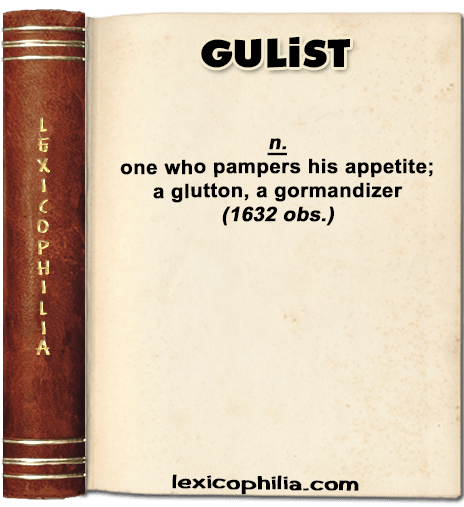
Word of the Day: GULIST

ETYMOLOGY
from Latin gula (gullet, appetite, gluttony) + -ist

EXAMPLE
“… He that sell’s himselfe to the custome of disloyalty to his Creator, become’s ignorant of his offence; and, instead of correction, prove’s unskilfull in the knowledge of his sinne. The gluttonous satiety of our swelling Gulists, argue’s their necessity of offending by forgetfulnes: and their own abundance barr’s them frō the just weighing of the poverty of the distressed. The common drunkard cannot be taken with a due thanks-giving for that superfluity which he corrupt’s, from whence many thirstie soules might sucke a reasonable supply for necessity. …”

From: The Honor of Chastity
By John Featley, 1632

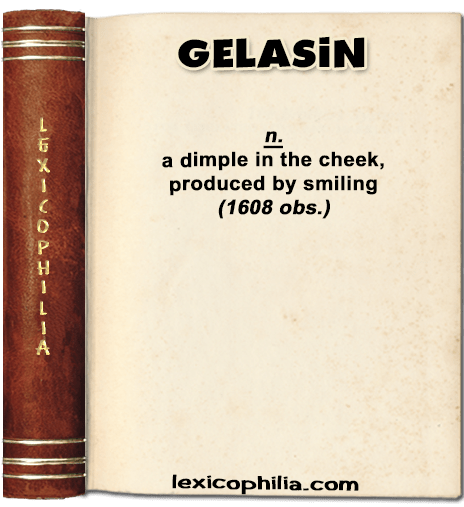
Word of the Day: GELASIN

also GELAZIN

ETYMOLOGY
from French gelasin, from Greek γελασῖνος (gelasinus), from γελᾶν (to laugh)

EXAMPLE
“… The beauty of the face consisteth in a large, square, well extended and cleere front, eye-browes well ranged, thin and subtile, the eye well diuided, cheerefull, sparkling: as for the colour I leaue it doubtfull, the nose leane, the mouth little, the lips coraline, the chinne short and dimpled, the cheekes somewhat rising and in the middle the pleasant gelasin, the eares round and well compact, the whole countenance with a liuely tincture white and vermilion. …”

From: Of Wisdome, three bookes written in French by Peter Charron
Translated by Samson Lennard ?1608

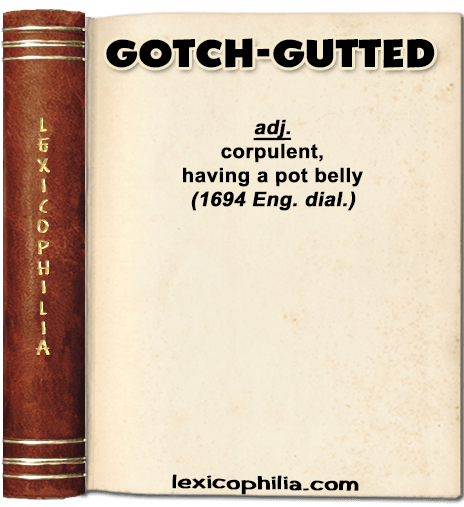
Word of the Day: GOTCH-GUTTED

ETYMOLOGY
from English dialect gotch (a big-bellied earthenware pot or jug) + bellied

EXAMPLE
“… Then did ye see e’r an old Bald-pated, Beetle-Brow’d, Gotch-Gutted, Squint-Ey’d, Sowr-Fac’d Ra­scal, the very Canker-Worm of Heaven and Earth, and Store-House o’ Mischief, Roguery, and Villany, leading o’ two good likely Girls? …”

From: Plautus’s Comedies, 
By Titus Maccius Plautus
Translated by Laurence Echard, 1694

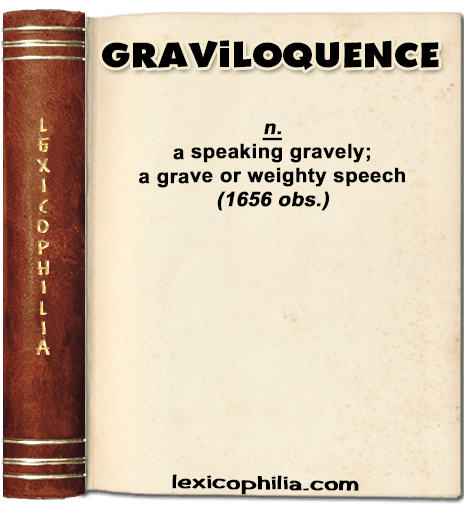
Word of the Day: GRAVILOQUENCE

ETYMOLOGY
from Latin gravis (grave, weighty, important) + loquiloquent- (to speak)

EXAMPLE
“… I treasure her unsentimental, enterprising, and no-nonsense-responsible spirit, her gravitas and graviloquence. I’d like to be capable (at least at times) of such classical conservatism, a necessary leaven for my mushy murky utopian pink political daydreaming …”

From: The Theater of Maria Irene Fornes, 1999

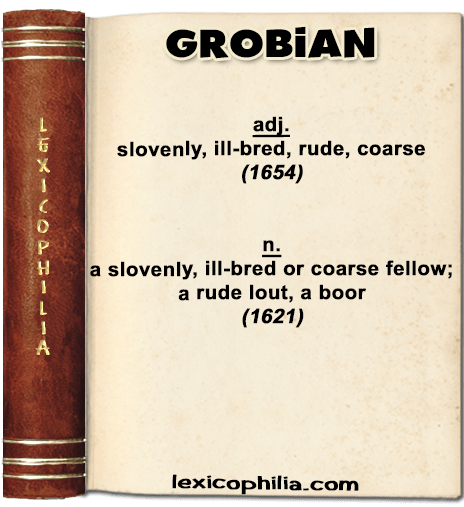
Word of the Day: GROBIAN

ETYMOLOGY
from German Grobian, from medieval Latin Grobianus, name of an imaginary personage, often referred to by writers of the 15th – 6th century in Germany as the type of boorishness,
from German grob (coarse, rude)

EXAMPLE
“…In breefe, he became from an Idiot and a Clowne, to be one of the most compleat Gentlman in Cyprus and did many valorous exploits, and all for the loue of Mistris Iphiginia. In a word, I may say thus much of them all, let them be neuer so clownish, rude and horrid, Gobrians and sluts, if once they be in loue, they will be most neat & spruce and beginne to trick vp, and to haue a good opinion of themselues. …”

From: The Anatomy of Melancholy VVhat It Is
By Robert Burton, 1621

Word of the Day: GALACTOPOTE

ETYMOLOGY
from Latin galactopota (milk-drinker); from Greek γαλακτοπότης (milk drinker)

EXAMPLE
“…Moreover, it not only satiates the country people with abundance of milk and cheese, but also garnishes the tables of the elegant with agreeable and numerous dishes. To some nations, indeed, which are intirely destitute of corn, it furnishes their whole sustenance: hence it is, that very many of the Nomades and Getae are called Galactopotae (milk-drinkers). …”

From: L. Junius Moderatus Columella Of Husbandry
By Lucius Junius Moderatus Columella, 1745

Word of the Day: GROUT-HEAD

ETYMOLOGY
from grout (sediment, dregs, lees), taken as the type of something big and coarse; 
for definition 2: there is confusion with great; perhaps the sound recalled the Dutch groot

EXAMPLE
“…professed her self a nonne in the yeare of our lord a. M. and. lxxv. to serue the deuyll in the monkes hypocresy, & in ye burnynge heates of Sodome. So daynty mowthed wer these greasy grouteheades, and so crafty in their generacyon, that they could fynde out kynges doughters to serue their lustes, and yet apere chast ghostly fathers to the world. Thurstinus a monke of Cane in Normandy…”

From: The First Two Partes of the Actes or vnchast examples of the Englysh Votaryes gathered out of their owne legenades and chronycles
By John Bale, 1551