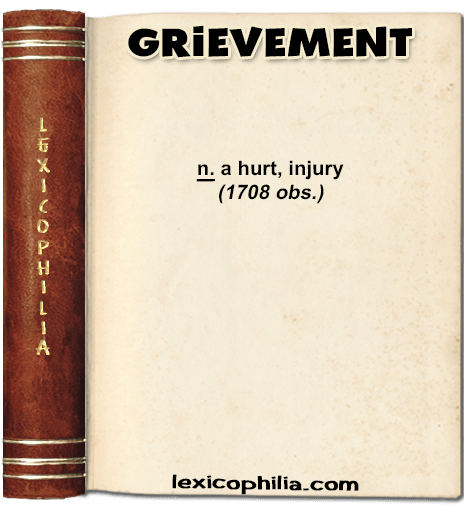
Word of the Day: GRIEVEMENT

ETYMOLOGY
from grieve + -ment

EXAMPLE
“…The manner of his Marching forth,
Some Authors tell us, and his Worth,
His Stature, Courage, Strength and Age,
His Armour and his Equipage,
His Warlike Feats in former Days,
Perform’d in Scotch and Gallick Frays,
His Battels won and great Atchievments,
Wounds, Bruises, Bangs, and other Grievments;
Which Happen’d oft to be his Fate,
For no Man’s always Fortunate:
All which I leave to Ancient story;
Now see the end of all his Glory
…”

From: England’s Reformation from the time of King Henry VIII to the End of Oates’s Plot,
A Poem in Four Canto’s
By Thomas Ward, 1708

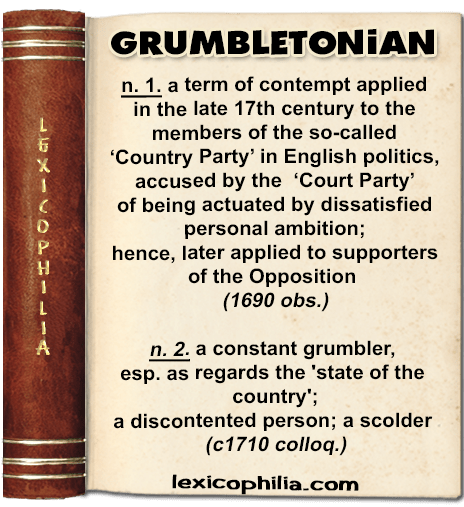
Word of the Day: GRUMBLETONIAN

ETYMOLOGY
from grumble (vb.), in imitation of Muggletonian and Grindletonian, names of religious sects in the 17th century

EXAMPLE
“…Whether great Sect of Grumbletonians in the Countrey, whom nothing will satisfie, been’t the worst Enemies which this Countrey can have?…”

From: Further Quaeries upon the Present State of New-English Affairs
By S.E., 1690

Word of the Day: GABBERIES

ETYMOLOGY
from French gaberie (mockery, jest, deceit)

EXAMPLE
“…Those high-priced, verbose air- beaters, who think their gabberies are the centers of gravity for the entire universe, ought to be sent away back to sit down until they can learn to stand by the pledges in the platform of their party …”

From: The Literary Digest
Volume XXVI, March 1903
Territorial Press on Statehood Failure

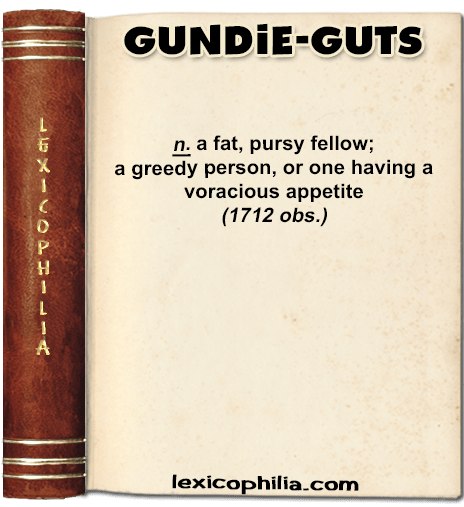
Word of the Day: GUNDIE-GUTS

ETYMOLOGY
from Scottish gundie (greedy, voracious) + guts

EXAMPLE
“…In short, these quarrels grew up to rooted aversions; they gave one another nick-names: she called him gundy-guts, and he called her lousy Peg, though the girl was a tight clever wench as any was, and through her pale looks you might discern spirit and vivacity, which made her not, indeed, a perfect beauty, but something that was agreeable…”

From: John Bull
By John Arbuthnot, 1712

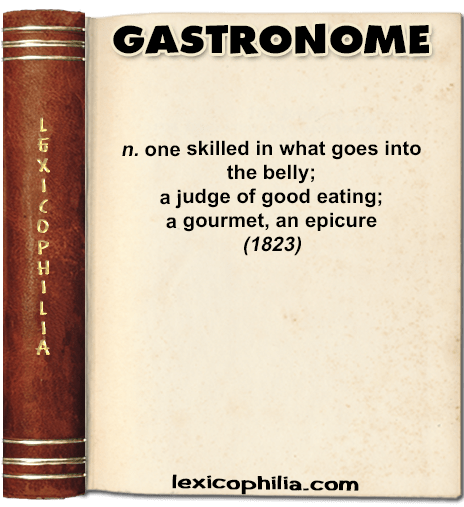
Word of the Day: GASTRONOME

ETYMOLOGY
from French gastronome, back-formation from gastronomie (gastronomy, art of delicate eating)

EXAMPLE
“…Whereas, such and so interesting were the subjects of discussion betwixt Chiffinch and the French cook, that, without heeding the rules of etiquette, they rode on together, amicably abreast, carrying on a conversation on the mysteries of the table, which the ancient Comus, or a modern gastronome, might have listened to with pleasure. It was therefore necessary to venture on them both at once…”

From: Peveril of the Peak
– Sir Walter Scott, 1823

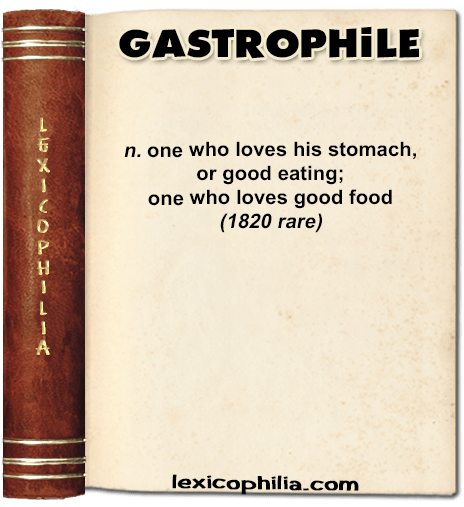
Word of the Day: GASTROPHILE

ETYMOLOGY
– from Greek γαστρ(ο)-, γαστήρ (gaster – stomach) + θίλ-ος (filos – friend)

EXAMPLE
“…From the foregoing observations we must conclude that the glutton practises without any regard to theory; and we call him Gastrophile. The gormand unites theory with practice, and may be denominated Gastronomer…”

From: Tabella Cibaria.
The Bill of Fare:
A Latin Poem,
Implicitly translated and fully explained in copious and interesting notes, relating to the Pleasures of Gastronomy, and the Mysterious Art of Cookery,
Ange Denis M’Quin, 1820

Word of the Day: GOOSECAP

ETYMOLOGY
– from goose (a foolish person) + cap (the head a1659)

EXAMPLE
“…And so will you Sonnes both, like a couple of goosecaps, (if you looke not to it) as your father did, with your own goose quil.…”

From: Martins Months Minde; that is, a certaine report, and true description of the death, and funeralls, of olde Martin Marreprelate, the great makebate of England 
– Thomas Nash, 1589