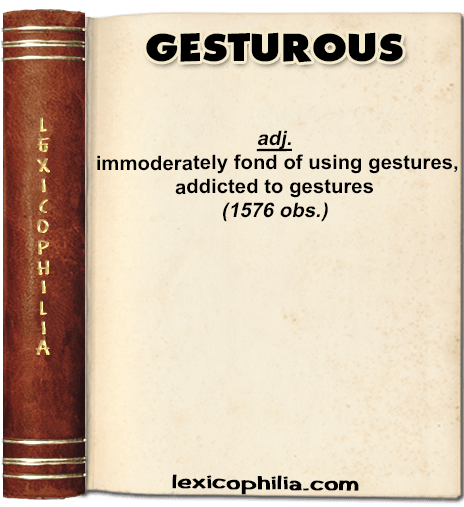
Word of the Day: GESTUROUS


ETYMOLOGY
from gesture + -ous


EXAMPLE
“…vvhich hath learned to spoyle & deuour folk to make vvidovves, destroy their houses, & make their Cities desert. Some be as foyinge, gesturous, and counterfeicting of any thing by ymitacion as Apes. Some Forlyke, are suttle, wylie, deceiptfull, and crafty to entrappe and catche the innocent at aduauntage…”

From: The Touchstone of Complexions
By Levinus Lemnius
Translated by Thomas Newton, 1576
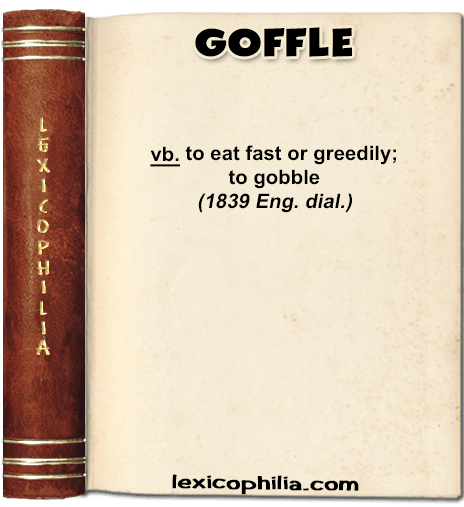
Word of the Day: GOFFLE


ETYMOLOGY
alteration of gobble


EXAMPLE
“…A dinner nice the oad folks have,”
At race-time, ollis ‘ood, –
That day, they had a toad-in-hole,
A dish that’s deadly gud

But when oad Styles to goffle it,
Bargun, he soon ded cry out: –
“Missus! I thinks as how, taa-day,
“Yow’ve put the meller’s eye out!…”

From: John Noakes & Mary Styles:
Or, “An Essex Calf’s” Visit to Tiptree Races
By Charles Clark, 1839

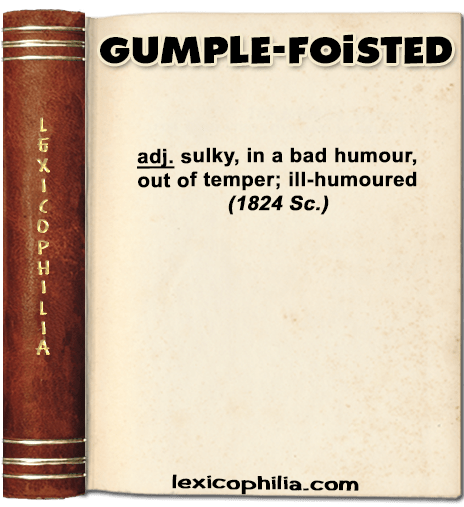
Word of the Day: GUMPLE-FOISTED


ETYMOLOGY
from Scots gumple (to be in a bad mood, to sulk, and as a noun, a fit of the sulks) + feist (found in other formations of similar meaning, e.g. bumple feist (the sulks), amplefeist (a sulky mood)) + -ed


EXAMPLE
“…Aweel, aweel,’ said Peter Peebles, totally unabashed by the repulse, ‘e’en as ye like, a wilful man maun hae his way; but,’ he added, stooping down and endeavouring to gather the spilled snuff from the polished floor, ‘I canna afford to lose my sneeshing for a’ that ye are gumple-foisted wi’ me‘….”

From: Redgauntlet: A Tale of the Eighteenth Century
By Sir Walter Scott, 1824

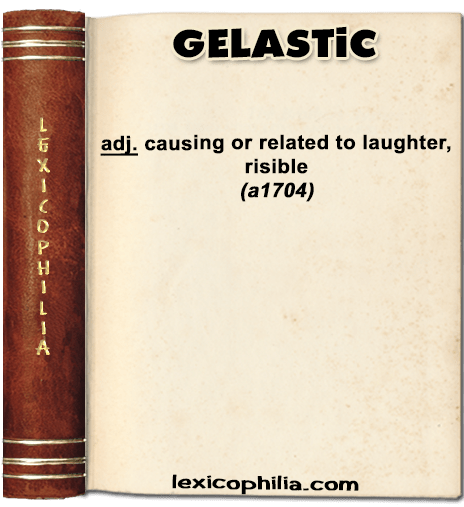
Word of the Day: GELASTIC


ETYMOLOGY
from Greek γελαστικός (gelastikos), from γελᾶν (to laugh)


EXAMPLE
“…or even exempt it from his unexcepting Censure and Undutiful Reflection against that Right Reverend Father of our Church, not without a Gelastick deference to so great a name, no more than without as high a Conception as possibly conceivable of the unappearing performances of so learned a Prelate…”

From: Athenae Britannicae:
Or, A Critical History of the Oxford and Cambridge Writers and Writings
By Myles Davies, 1716

Word of the Day: GIM


ETYMOLOGY
perhaps a variation of jimp (slender, slim, delicate, graceful, neat)


EXAMPLE
“…Hys wifis, Toppa and Partelot, hym by,
As byrd al tyme that hantis bigamy.
The pantyt povn, pasand with plomys gym,
Kest vp his taill, a provd plesand quheill rym,
Yschrowdyt in hys fedrame brycht and scheyn,
Schapand the prent of Argus hundreth eyn
…”

From: Virgil’s Aeneid translated into Scottish verse
By Gavin Douglas, 1513

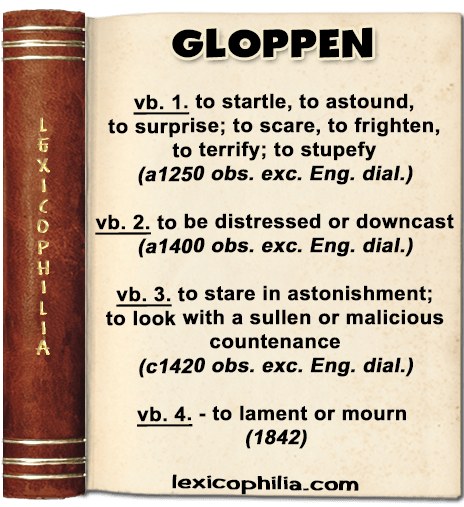
Word of the Day: GLOPPEN


ETYMOLOGY
from Old Norse glupna (to be downcast);
a root of identical form appears in Old Frisian glûpa, Middle Low German glûpen (to lie in wait for), Dutch gluipen (to watch slily, to sneak), Old Swedish glupa (to gape, swallow), Swedish glupande, Danish glubende (ravenous, fierce);
whether there is any etymological connection is uncertain


EXAMPLE (for vb. 1)
“…Quen [he] þar-of son had a sight,
Al was he gloppend for þat light
…”

From: Cursor Mundi
(The Cursur of the World)
A Northumbrian Poem of the XIVth Century

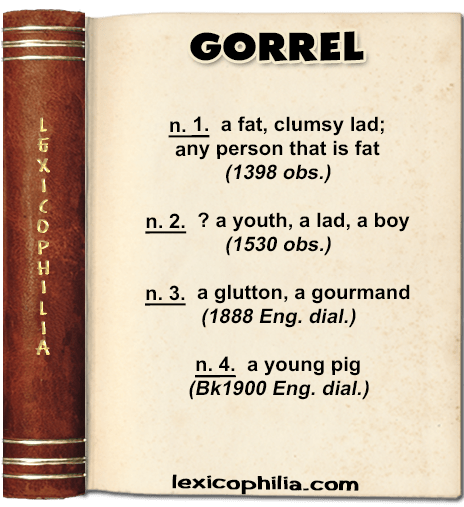
Word of the Day: GORREL


ETYMOLOGY
from Old French gorelgorreau (a pig, hog);
related to Old French gore (sow): of unknown origin.


EXAMPLE (for n. 1.)
“…Crampe that comyth of replycyon fallyth ofte to fatte men and flesshly and well fedde and gorrelles…”

From: Bartholomew de Glanville’s De Proprietatibus Rerum,
Translated by John Trevisa, 1495

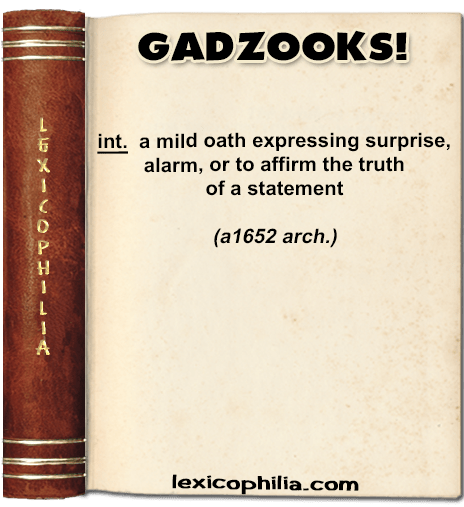
Word of the Day: GADZOOKS!


ETYMOLOGY
from gad (used to express strong feeling) + zooks (origin unknown)


EXAMPLE
“…Buz. Ile first take tother cup, and then out with’t altogether—And now it comes—If my Mistress do bring him home a bastard, she’s but even with him.

Nat. He has one I warrant. Has he cadzooks?…”

From: The English Moor or the Mock-Marriage,
in Five Nevv Playes, viz. The English Moor. The Love-sick Court. Covent Garden Eeeded. The New Academy. The Queen and Concubine,
By Richard Brome, 1659