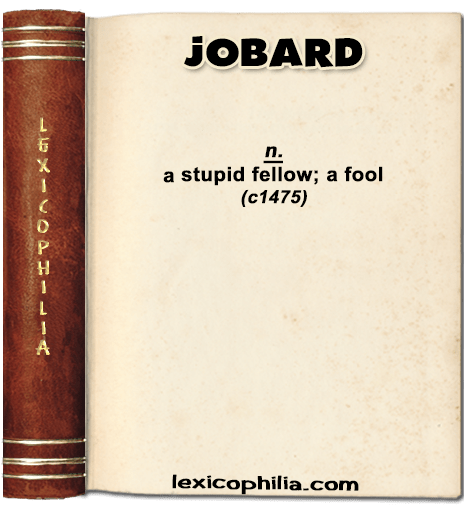
Word of the Day: JOBARD

ETYMOLOGY
from French jobard (a person who is easily fooled or very credulous)

EXAMPLE
“… False supplantyng, clymbyng of foolis
Unto chayers of worldly dignite,
Looke of discrecioune sette
jobbardis upon stoolis,
Whiche hathe distroyed many a comunalte,
Marchol to sitte in Salamons see,
What folwithe after no reason no justice,
Injuste promocioune and parcialite,
By false prerogatyf theyr neyghburghs to dispise.
…”

From: A Selection from the Minor Poems of Dan John Lydgate
Printed for the Percy Society, 1840
The Moralite of the Hors, the Goose, and the Sheepe
Composed c1440
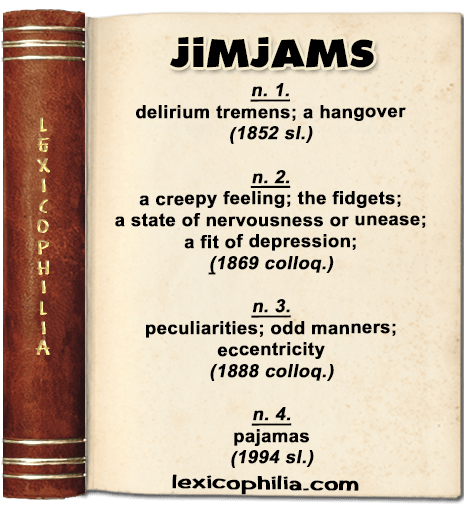
Word of the Day: JIMJAMS

ETYMOLOGY
a reduplicated term, of which the elements are unknown;
from the mid 16th century – in the singular, originally denoted a knickknack or small article

EXAMPLE (for n. 1)
“… Andy Collins, an Irishman, who has lived alone in his cabin, about a mile below us, for a year or more, has been a hard drinker ever since we have known him. He bought his rum by the gallon and kept soaked all the time. Tuesday night he had a bad attack of the jim-jams, and his nearest neighbor, O’Neil, heard him yelling and shrieking like all possessed. …”

From: The Diary of a Forty-Niner
By Chauncey Canfield, 1906
Chapter XVI, February 1, 1852

Word of the Day: JENTACULAR

ETYMOLOGY
from Latin ientaculum (breakfast); (from ientare (to breakfast)) + -ar

EXAMPLE
“… I wonder that you did not, under this head, acquaint us with that wise injunction, which you have caused to be promulgated within your dominions, against the consumption of tea and coffee; a fashionable vice, which tends only to squandring away money, and mispending the morning, since (as you once ingeniously express’d it) nothing more can be expected from those jentacular confabulations. …”

From: Terræ-filius; or, the secret history of the University of Oxford
By Nicholas Amhurst, 1721

Word of the Day: JOCOCIOUS

ETYMOLOGY
compound of jocose and facetious

EXAMPLE
“… “Yes, you have, you saucy baggage, and I will have them again from your ruddy lips,” at the same time smacking them with great glee. The girl was glad to find the ‘squire so jococious, and particularly too, as he gave her a shilling, and a chuck under the chin. …”

From: The Child of Providence
Or, The Noble Orphan, A Novel
By Miss H. L. Porter, 1820

Word of the Day: JOVY

ETYMOLOGY
from Latin Jovius, from Jovis (Jove, poetical equivalent of Jupiter, name of the highest deity of the ancient Romans)

EXAMPLE
“… ‘And now I lepe louy pe [merry foot.] ;
Now I sterte, & now I ffle.
Selde abydyng in O thouht,
Al daungerous I sette at nouht,
…”

From: The Pilgrimage of the Life of Man
English by John Lydgate, 1426,
from the French of Guillaume de Deguileville

Word of the Day: JIGGALORUM

ETYMOLOGY
of uncertain origin; probably influenced by jig and jog

EXAMPLE
“… Even Humfrey King finds an excuse for his own mediocrity in that it is not the lowest: ‘I see my inferiours in the gifts of learning, wisdome, & vnderstanding, torment the Print daily with lighter trifles, and Iiggalorums, then my russet Hermit is, the which hath made me the bolder to shoulder in amongst the’…”

From: Halfe-penny-worth of Wit
By Humphrey King, 1613

Word of the Day: JOLLIMENT

ETYMOLOGY
irregular from jolly (adj.) + -ment

EXAMPLE
“… And therein sate a Ladie fresh and faire,
  Making sweet solace to her selfe alone;
  Sometimes she sung, as loud as larke in aire,
  Sometimes she laught, that nigh her breth was gone,
  Yet was there not with her else any one,
  That might to her moue cause of meriment:
  Matter of merth enough, though there were none
  She could deuise, and thousand waies inuent,
To feede her foolish humour, and vaine
iolliment. …”

From: The Faerie Queene
By Edmund Spenser, 1590

Word of the Day: JIMMYCANE


ETYMOLOGY
probably a jocular variation of hurricane


EXAMPLE
“…”Well, I’ll be everlastin’ly bamboozled! I never seen Doc Barwood melt and’ leak away like that before. I was countin’ on a storm – a reg’lar cyclone an’ jimmycane rolled into one; an’ ther’ wasn’t even a puff o’ wind n’r a clap of thunder...”

From: Ralph Marlowe
A Novel
By James Ball Naylor, 1901

Word of the Day: JECTIGATION


ETYMOLOGY
from French jectigation (‘wagging, shrugging’ (Cotgrave)), 
from medieval Latin jectigare, from jact-ject-, ppl. stem of Latin jacere (to throw)


EXAMPLE
“…both Men and Women seemed to Prophetize and Vaticinate, because of an affected kind of wagging of the Head, shrugging of the Shoulders, and Jectigation of the whole Body, which they used then most punctually…”

From: The Third Book of the Heroick Deeds and Sayings of the Good Pantagruel
By François Rabelais
Translated by Thomas Urquhart and Peter Anthony Motteux, 1693