Word of the Day: LINGUACIOUS

ETYMOLOGY
from Latin linguaci-linguax (loquacious, talkative) (from lingua tongue + -ax [-acious]) + -ous

EXAMPLE
“…These and such like starting-holes and subtilties have made of Physick a Meander, a Wildernesse, and wild labirynth of incertainty and unstable formalities. We desire the linguacious Chymistry of these heads to tell us, how many bitter things there are in taste, which neverthelesse (according to the edict of that rule) are not hot at all?  …”

From: Matæotechnia Medicinæ Praxeōs, The Vanity of the Craft of Physick
By Noah Biggs, 1651

Word of the Day: LATITATE

ETYMOLOGY
from Latin latitat-, participial stem of latitare (to lie hid)

EXAMPLE
“…According to the statement of Townsend, a gardener and discharged servant of Sheriff Lax, but which was afterwards proved to be highly coloured, and in parts wholly false, one of the sheriffs had fled to the Recorder’s bed-room and taken refuge behind the state bed; and other aldermen were latitating in the upper bed-rooms. …”

From: Modern State Trials
By William Townsend, 1850
Trial at Bar of Charles Pinney, Esq. Mayor of Bristol,
On a Criminal Information for Neglect of Duty, in the Court of King’s Bench,
October 25, 26, 27, 29, 30, 31, and November 1, 1832

Word of the Day: LENNO

ETYMOLOGY
from Gaelic leanabh (baby, infant, child)

EXAMPLE
“…Ye’s neir pe pidden work a turn
At ony kind o’ spin, mattam,
But shug your
lenno in a scull,
And tidel highland sing, mattam;
Had awa’, had awa’,
Had awa’ frae me, Donald;
Your jogging sculls and highland sang
Will sound but harsh wi’ me, Donald.
…”

From: Scotish Song
By Joseph Ritson, 1714
Song XI.  Had Awa’ Frae Me, Donald

Word of the Day: LONGITY

ETYMOLOGY
from Latin longitas (length, long duration), from longus (long) + -tas (-ty)

EXAMPLE
“…And had not this beene: yet if your brevity (which is but a shuffling colour, to make shewe of some things which are not) had beene turned into one yeeres or seaven yeeres longity, you could not have shewed, that in substantiall points of faith there was variace among vs. And therfore for that matter you do wel to do as you do, that is, put vp your pipes & make no more noise. …”

From: The Reasons vvhich Doctour Hill hath brought, for the Vpholding of Papistry, which is falselie termed the Catholike religion: Vnmasked and Shewed to be very weake, and vpon examination most insufficient for that purpose.
By George Abbot, 1604

Word of the Day: LIGHTMANS

ETYMOLOGY
from light (adj.) + –mans (suffix forming nouns from adjectives and nouns in 16th century and early 17th century cant)

EXAMPLE
“…Bene lyghtmans to thy quarromes in what lipkē hast thou lipped in this darkemanes; whether in a lybbege or in the strummell? …”
(God morrowe to thy bodye, in what house hast thou lyne in all night whether in a bed, or in the strawe?)

From: A Caueat for commen Cvrsetors vulgarely called Uagabones
By Thomas Harmon, 1567

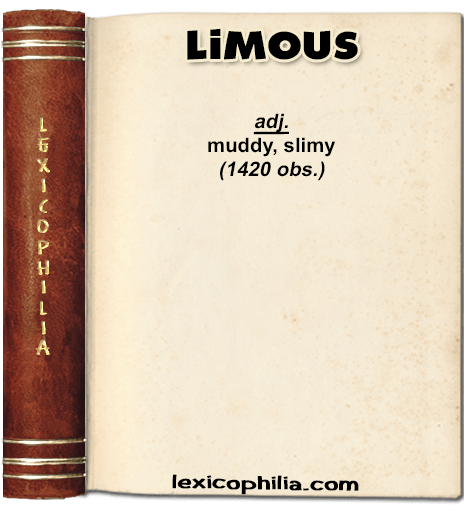
Word of the Day: LIMOUS

ETYMOLOGY
from Latin limosus, from limus (mud, slime)

EXAMPLE
“…This doon, the sydes make up with structure,
And footes VIII it hold in latitude.
With barres bigge is goode to make it sure ;
Or wall it well with ragge or flyntes rude.
In square or round this werk thai may conclude.
If water ther be lymous or enfecte
Admyxtion of salt wol it correcte. …”

(Make it eight feet wide and secure it with courses of wood, the walls being of ragstone or flint. A mixture of salt will correct muddiness.)

From: Palladius on Husbondrie: from the unique MS. of about 1420 A.D. in Colchester Castle

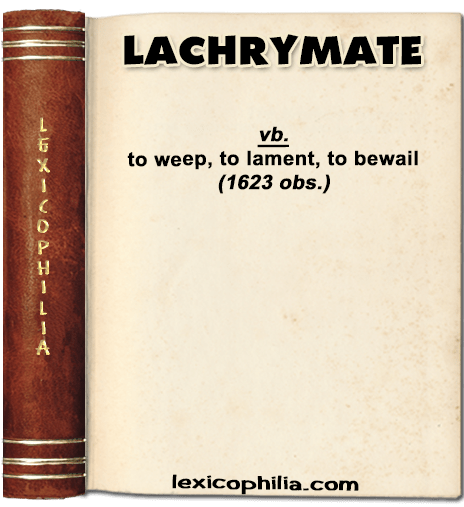
Word of the Day: LACHRYMATE


ETYMOLOGY
from Latin lacrimat-, past participial stem of lacrimare (to weep),  from lacrima (tear)


EXAMPLE
“…Whose cruell tortures did infest her heart:
For ev’ry one did taxe this Virgins Fate,
And her sad sorrowes caus’d them Lachrymate:
Since in her passions she was so extreame,
For to her griefe she limited no meane;
Which so surprest her, that she seem’d ro bee
The very abstract of calamity
…”

From: A small treatise betwixt Arnalte and Lucenda
entituled The Evill-Intreated Lover, or The Mmelancholy Knight
By San Pedro de Diego
Translation by L. Lawrence, 1639


PRONUNCIATION
LACK-ruh-mayt

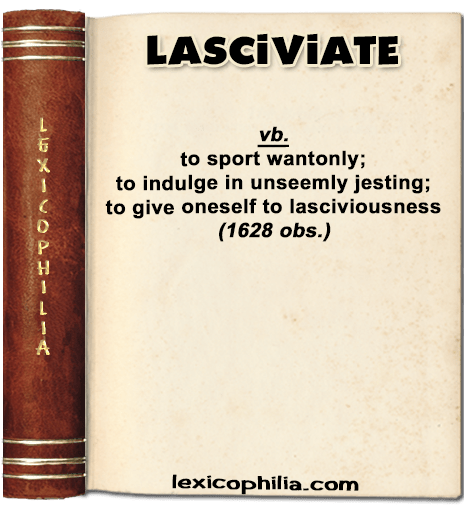
Word of the Day: LASCIVIATE


ETYMOLOGY
irregular, from Latin lascivire, after verbs ending in -iate


EXAMPLE 1
“…A kemb’d Oration will cost both sweate, and the rubbing of the braine. And kemb’d I wish it, not frizzled, nor curl’d. Divinity should not lasciuiate, Vn-wormewooded jests I like well; but they are fitter for the Tauerne, then the Majesty of a Temple. Christ taught the People with Authoritie. Gravitie becomes the Pulpit. Demosthenes confest he became an Orator, by spending more Oyle then Wine…”

From: Resolves, a Duple Century
By Owen Felltham, 1628


EXAMPLE 2
“…But by his smile the Prophet means that the people would be reduced to such straits, that they might not lasciviate, as they had done, in their superstitions; for while the Israelites enjoyed prosperity, they thought everything lawful for them; hence their security, and hence their contempt of the word of the Lord…”

From: Commentaries on the Twelve Minor Prophets.
By John Calvin.
Translation from the Original Latin by the Rev. John Owen, 1846

Word of the Day: LABION


ETYMOLOGY
from Latin labion-labio  also Latin labeon-labeo (a person who has large lips)
from labealabia ‑o


EXAMPLE
“…for it must necessarily be a meanes to hinder their speech by thickning their lips, as experience teacheth in those who either by Nature or by accident have thick, swoln, blabber lips, causing them to speak in their mouth, uttering their words very baldly and indistinctly, and assuredly the same or worse must befall these artificiall Labions, for their Lips must needs hang in their light, and their words stick in the birth, when such unwealdy Pourers out of speech occasion a hinderance to their delivery …”

From: Anthropometamorphosis: = Man Transform’d:
Or, The Artificiall Changling
By John Bulwer, 1653