Word of the Day: OUTBRAID

ETYMOLOGY
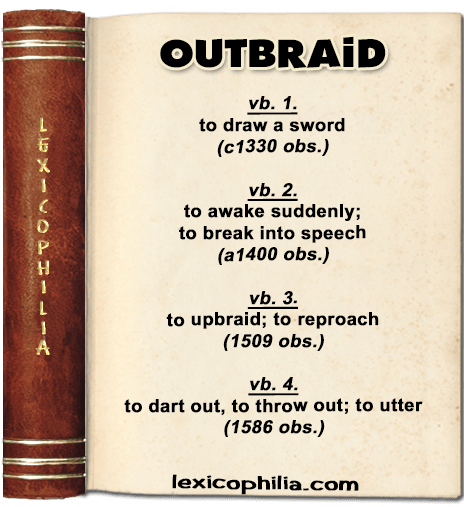
vb. 1. 2. 4. from out- + braid (to make a sudden movement with the hand, etc.; to brandish a spear;. to deal a blow)
vb. 3. altered form of abraid (to reproach, to reprove)

EXAMPLE (for vb. 3.)
“… And for that this displeasour doth hym dere
His frende: he soone
out-braydeth of the same
Hym-self (for malyce) drawynge by the here
So hath this fole by malyce and yll name
His rewarde lost for it rebuked and shame
And no meruayle: for no man that hath skyll
Shall thanke hym for goodnes done agaynst his wyll
…”

From: The Shyp of Folys of the Worlde
By Alexander Barclay, 1509

Word of the Day: OFFENCEFUL

ETYMOLOGY
from offence (n.) + -ful

EXAMPLE
” …Now will I let the little squire shift and cleanse himselfe without me, that he may be longer about fetching the Prouost, and in the meane time will I take my Masters sute (of which the little squire tooke note) and put it on my sweet heart Francischina, who shall presently come and sup ply my Masters place, with his Mistris; for the little squire amaz’d with his late affrights and this suddaine offencefull spectacle of his daughter, tooke no certaine note who it was that accosted her; for if he had, he would haue blam’d me for my Master, only the colour of his garment sticks in his fancie, which when he shall still see where he left it, he will still imagine the same person weares it, and thus shall his daughters honour and my Masters be preseru’d with the finest sugar of inuention. …”

From: May-Day A VVitty Comedie
By George Chapman, 1611

Word of the Day: OBDULCORATE

ETYMOLOGY
from ob- + Latin dulcorat-, past participial stem of dulcorare (to sweeten), 
from dulcor-em (sweetness), from dulcis (sweet)

EXAMPLE
“… Now election of Medicaments may be made from Odour, for this cause, because a sweet oppleasant smell refreshes the spirits, restores strength and vigour to them, exhilarates the principal members and parts, and corroborates their faculties. An ill and stinking smell on the contrary burthens and aggravates the head, vexes the heart, subverts the ventricle, infects the spirits, moves a loathing, causes grievous and laborious purgings, and oftentimes vomitings. And therefore such purging Medicaments are obdulcorated with cordial Electuaries, whereby their ingratefull odour is amended, and the principal parts fortressed against the malign quality of these Medicaments; for all odoriferous Spices are the fountain and principle of life. …”

From: A Medicinal Dispensatory, containing the whole body of physick discovering the natures, properties, and vertues of vegetables, minerals, & animals
By Jean de Renou
Translated by Richard Tomlinson, 1657

Word of the Day: OMNINESCIENT

ETYMOLOGY
from omni- combining form of Latin omnis (all) + nescient from Latin nescientem
pres. pple. of nescire (to be ignorant), from ne (not) + scire (to know)

EXAMPLE
“… The appeal is generally from those who know something to those who know less – and at last to those who are omni-nescient. …”

From: A Report of Proceedings at a Public Meeting of the Merchants, Bankers, and Traders of the City of London, held at the London Tavern, on Wednesday, Dec. 3, 1851
For a Reform of the Board of Customs
Part II. Chapter II. Appeals

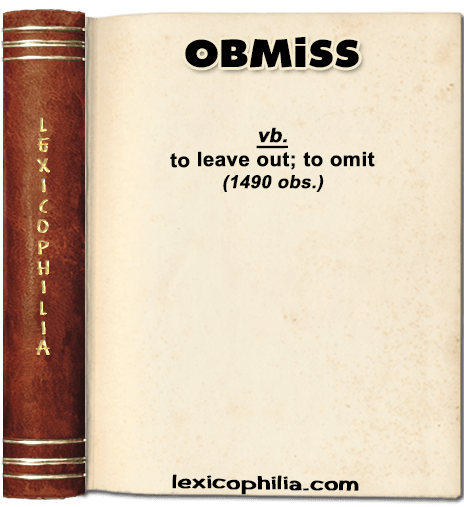
Word of the Day: OBMISS

ETYMOLOGY
from Latin obmiss-, participial stem of obmittere, late spelling of omittere (to omit)

EXAMPLE
“… but to thende that eny gaynsaynge sholde be Imputed ayenst me to haue obmyssed for to dyscute som of the condycyons and euyll operacyons of the cursed proserpyne …”

From: Caxton’s Eneydos, 1490
English from the French Liure Des Eneydes, 1483
Edited by W.T. Culley, and F.J. Furnivall, 1890

Word of the Day: OBSTREPERATE

ETYMOLOGY
from Latin obstreperus (clamorous);
from obstrepere (to make a noise against, shout at, oppose noisily or troublesomely) + -ate

EXAMPLE
“… ——Get on with you, said the abbess.

——Wh – – – – – ysh——ysh——cried Margarita.

Sh – – – a——shu – u——shu – – u—sh – – aw——shaw’d the abbess.

——Whu—v—w—whew—w—w—whuv’d Margarita, pursing up her sweet lips betwixt a hoot and a whistle.

Thump—thump—thump—obstreperated the abbess of Andoüillets with the end of her gold-headed cane against the bottom of the calesh——

The old mule let a f—...”

From: The Life and Opinions of Tristram Shandy, gentleman
By Laurence Sterne, 1765

Word of the Day: OSCITATE

ETYMOLOGY
from Latin oscitat-, past participial stem of oscitare (to open (as a mouth)), 
also oscitari (to gape, yawn), from os mouth + citare (to move, actuate)

EXAMPLE
“… and if he will but imitate some drowsy people at church, by taking a sternutatory, he will arrive at the close without feeling fatigue or ascribing his heaviness to the writer; There are persons whose physical constitutions are so delicate that mere thoughts of taking snuff, (and medicines generally) produce the same effect as inhaling the powder itself: now, if the imagination of the reader has a similar influence over his system, he can have no disposition to oscitate while finishing the chapter; on the contrary, the greatest obstacle to his progress will arise from a disposition to sneeze. …”

From: Transactions of the Society of Literary and Scientific Chiffonniers;
Being Essays on Primitive Arts In Domestic Life.
The Spoon
By Hab’k O. Westman, 1844
Chapter X, Snuff taken with Spoons

Word of the Day: OBJICIENT

ETYMOLOGY
from Latin objicientem, present participle of objicere (to object)

EXAMPLE
“… Yet, it may be observed, in passing, such is precisely the discrepancy of which St. Thomas speaks, in the two passages which have been quoted in support of the objection. But the objicient may still press his difficulty. …”

From: The Metaphysics of the School
By Thomas Harper, 1879
Book III. Attributes of Being
Chapter III. Truth 
Proposition LXXXIII. Every Being, as such, is true.

Word of the Day: ORGULOUS

ETYMOLOGY
from Anglo-Norman orguillous, orgeillus, orgoilous, orgullous,
orgulous, orgulus, orgilousorgillus and Old French orguillus,
orgoillus, orguilleus, orgueilleux;
from  orgueil (pride, haughtiness) + ‑ous 

EXAMPLE 1 (for adj. 1.)
“… yet habbeþ manitime maked of watere wyn; gostliche. wanne þurch his grace maked of þo euele manne good man. of þe orgeilus umble. of þe lechur chaste. of þe niþinge large. and of alle oþre folies; so ha maket of þo watere wyn. þis his si signefiance of þe miracle. …”

From: An Old English miscellany containing a bestiary, Kentish sermons, Proverbs of Alfred, religious poems of the thirteenth century
Edited by Richard Morris, 1872


EXAMPLE 2 (for adj. 1)
”…I was banished from my own country, and was dishonoured, and with hard labour gained I what I have got ; and now I stand in the King’s favour, and he asketh of me my daughters for the Infantes of Carrion. They are of high blood and full orgullous, and I have no liking to this match ; but if our Lord the King adviseth it we can do no other-wise: …”

From: Chronicle of the Cid
By Robert Southey, 1808