Word of the Day: QUICK-MIRE

ETYMOLOGY
from quick (endowed with life, animate [because it shakes or moves]) + mire

EXAMPLE
“… An euyll wyfe hathe nought ado to departe from her houſe leest that she go not in to the quycke myre but and she be commaunded a thynge she wyll do clene the contrary. Certaynly it is a vylaynous reproche unto a woman whan she wyll not obeye unto her huſbande. Wyues and maydens loke that ye lyue honestly and kepe chaſtyte / to the ende that ye wynnę and purchace good fame and good renowne. …”

From: The Shyppe of Fooles
By Sebastian Brant
Translated by Henry Watson, 1509

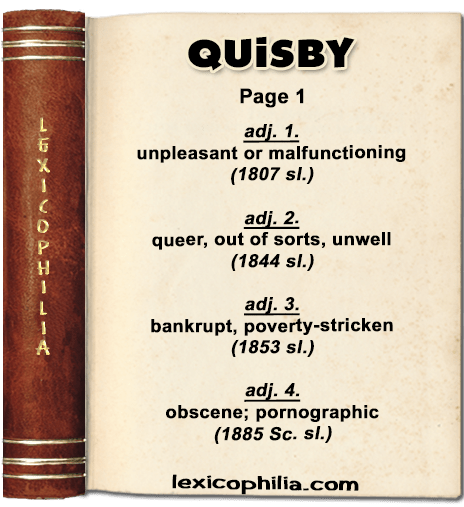
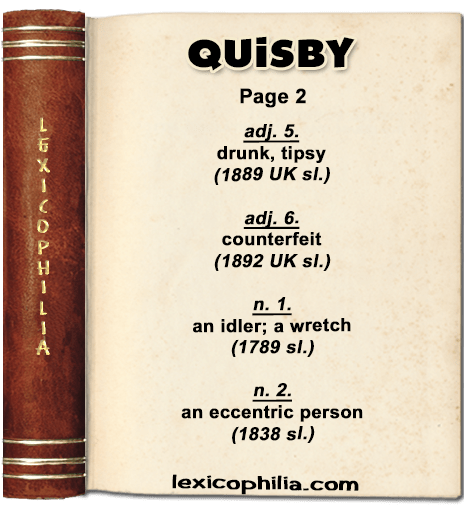
Word of the Day: QUISBY

ETYMOLOGY
of uncertain origin;
possibly from quiz (n.) + -by

EXAMPLE
“… Alibi. What wou’d I do then?
Air. Aye, Sir, what wou’d you do then?
Soph. Cou’dn’t he push a little feeble old quisby like you down into a chair?
Alibi, How, pray?
Soph. Shew him how, Robin?
Air. Why there – (puts him into a chair) Just that way
Alibi. Well, now Old Quisby’s down in the chair – what wou’d he do then?…”

From: The Toy
By John O’Keeffe, 1789

Word of the Day: QUINOMBROM

ETYMOLOGY
of unknown origin

EXAMPLE
“… When you have cast an eye upon this Letter which goeth stuff’d with all Proverbs, old Motts, and Adages, whereof some were used in the time of high bonnets, when men used to wipe their noses on their sleeves, for want of a napkin, you will judge perhaps, that the Author hath some strange freaks, or quinombroms in his noddle, that he hath quicksands, or Mercury, or rather one quarter of the Moon in his pericranium; But you Sir, that have a head so well timbred, will, I presume, passe another judgement. …”

From: Paroimiographia Proverbs, or, Old sayed savves & adages in English (or the Saxon toung), Italian, French, and Spanish
By James Howell, 1659

Word of the Day: QUADRAGENARIOUS

ETYMOLOGY
from Latin quadragenarius (forty years old) + -ous

EXAMPLE
“…Tis my fancy that, having won for himself a fortune, he went on in the same resistless way and won for himself a wife: “taking the biggest,” as usual, by cutting out valiantly from under the guns of a dozen rivals some stout buxom widow suited to his estate and to his medium years – one of those plumply mellow quadrigenarious bodies who especially appeal to the vigorous and well-salted emotion which with sailor-men stands for love …”

From: Harper’s New Monthly Magazine, February, 1895
New York Colonial Privateers’, By Thomas A. Janvier

Word of the Day: QUISQUILIOUS

ETYMOLOGY
from Latin quisquiliae (waste matter, refuse, rubbish) + ous

EXAMPLE
“…He knows not what to say against them; and yet something must be said. They publish too much; more than used to be published: the science is overloaded by the quisquilious matter they rake together and preserve. They publish too soon; before they have taken the requisite time for digestion …”

From: Rationale of Judicial Evidence
By Jeremy Bentham, 1827

Word of the Day: QUAGSWAG


ETYMOLOGY
from quag (of something soft or flabby: to quake) + swag (to move unsteadily, to sway)


EXAMPLE
“…Therefore Iohn Calfe her Cosen gervais once removed with a log from the woodstack, very seriously advised her not to put her selfe into the hazard of quagswagging in the Lee, to be scowred with a buck of linnen clothes, till first she had kindled the paper: this counsel she laid hold on, because he desired her to take nothing, and throw out, for Non de ponte vadit, qui cum sapientia cadit*: matters thus standing, seeing the Masters of the chamber of Accompts, or members of that Committee, did not fully agree amongst themselves in casting up the number of the Almanie whistles, whereof were framed those spectacles for Princes, which have been lately printed at Antwerp…”

*Non de ponte vadit, qui cum sapientia cadit = He who falls with wisdom does not go off the bridge

From: The second book of the works of Mr. Francis Rabelais, Doctor in Physick,
containing five books of the lives, heroick deeds, and sayings of Gargantua, and his sonne Pantagruel.
By François Rabelais
Translation by Thomas Urquhart, 1653

Word of the Day: QUARTER-CLEFT


ETYMOLOGY
from quarter + cleft (n. and adj. split asunder)


EXAMPLE
“…It is the fashion to talk of Lord Ellenborough in contemptuous terms, as a mere nincompoop, or quartercliff, or what else you will, that implies feebleness of intellect and deficiency of talents; but those who so describe him either mistake his character, or wilfully misrepresent it…”

From: Fraser’s Magazine for Town and Country
Vol. IV. August, 1831 to January 1832
Parliamentary Eloquence, No. IV, House of Lords, by Oliver Yorke

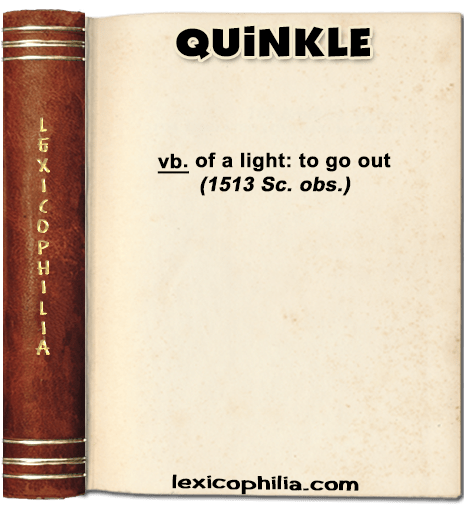
Word of the Day: QUINKLE


ETYMOLOGY
of uncertain origin;
apparently formed on quink = Old English cwincan (to go out, be extinguished)


EXAMPLE
“…The lycht begouth to quynkill owt and faill,
The day to dyrkyn, decline, and devaill;
The gummys rysis, doun fallis the donk rym,
Baith heyr and thair scuggis and schaddois dym
…”

From: Translation of Virgil, Æneid
By Gawin Douglas, 1513

Word of the Day: QUAINTRELLE


ETYMOLOGY
from Middle French (queint-cointerelle feminine of cointerel (beau, fop), from cointe (quaint)


EXAMPLE
“…It folweth nouht that thouh j be thus kembt and a litel make the queyntrelle that for swich cause j am fair I am foul old and slauery foule stinkinge and dungy…”

From: Pilgrimage of the Lyf of the Manhode,
from the French of G. de Guilleville, c1430

Word of the Day: QUADRIVIOUS


ETYMOLOGY
from Latin quadrivium (place where four ways meet) + -ous 


EXAMPLE
“…By means of small galleries directed from the cellars of houses in the vicinity of any square or quadrivious spot, which it is likely a body of troops might occupy as a position, it will be very easy to establish and to spring mines with considerable effect…”

From: Defensive Instructions for the People
By Francis Maceroni