Word of the Day: REFRACTARIOUS


ETYMOLOGY
from Latin refractarius (obstinate, stubborn) + -ous


EXAMPLE
“…Thirdly, if we do well obserue the preposterous & disastrous studies of many schismaticall and refractarious spirits, their heate, their violence, description and vncharitablenes, how vnnaturally they do reiect & reuile their Mother, how passionately they doe blaspheme the Church, which God hath planted with his owne hand, and with what morosity they haue ab-alienated themselues from their Bretheren; they can by no pretext acquit themselues of great vndutifulnes vnto God, being so turbulent in his House, so disobedient to their Mother, & so farre exorbitant in all their courses; not much vnlike to mothes, that fret the cloth, wherein they breed; to water-boughes, which hurt the tree,…”

From: The Picture of a True Protestant:
or, Gods house and husbandry wherein is declared the duty and dignitie of all Gods children, both minister and people.
By Thomas Tuke, 1609

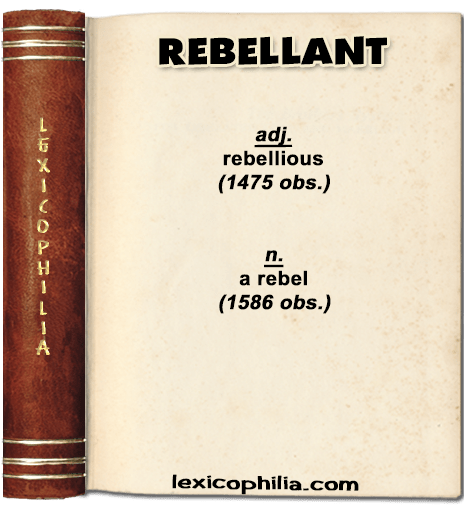
Word of the Day: REBELLANT


ETYMOLOGY
from Old French rebellant, pr. pple. of rebeller (to rebel),
(used as adj. and n. in 14th–16th c.)


EXAMPLE 1 (for adj.)
“…That other infortuny is exterialle, that man scholde haue his inferior rebellante to hym, in that he was inobediente to God his maker…”

From: The Chronicles and Memorials of Great Britain and Ireland During the Middle Ages,
Edited by Churchill Babington, 1869
Polychronicon Ranulphi Higden Monachi Cestrensis (Harley MS. 2261)
By Ranulf Higden


EXAMPLE 2 (for n.)
“…With Tantalus hild starued Ghosts, whose pleasure was their paine,
Whose euer Hords had neuer vse, and gettings had no gaine.
To Besides assisted Soules of Vnthrifts, whose supplies
Did passe from them as Sea through Cieues, whose wastes no wealthes suffise.
Vnto Ixeon stood their Sprights that had their lusts for law,
Rebellants to a common good, and sinning without awe.
To Titius lastly ioyned Ghosts, whose hearts did emptie hate
As Todes their poyson, growing when it seemeth to abate.…”

From: Albions England; or, historicall map of the same island 
By William Warner,

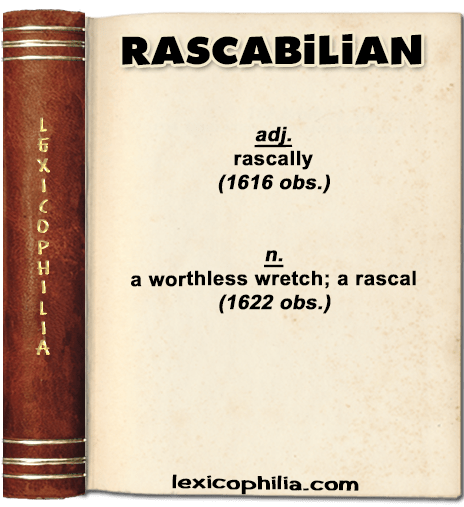
Word of the Day: RASCABILIAN


ETYMOLOGY
derived from rascabilia (rascals collectively)


EXAMPLE
“…Then next, I bequeath to the whole societie of these my carousing companions, as followeth: Namely, drinke, more drinke, a little more drinke, yet more drinke, then a little modicum of Bakers bread: then drinke againe, then more drinke, then yet a little more drinke, and so forth. Item, I appoint Arthur ale-man, the sole and onely Executor of this my last Testament, making Huf-cap the Hunts-man, and Small-braines the Shoomaker, my ioynt superuisers; allowing to euery of them, a full pipe of Tobacco for his paines taken that way. Witnesse hereunto, the whole Rascabilian rabblement of this our damnable Crew…”

From: Tobacco Tortured,
or, The filthie fume of tobacco refined shewing all sorts of subiects, that the inward taking of tobacco fumes, is very pernicious vnto their bodies.
By John Deacon, 1616

Word of the Day: REMORAL


ETYMOLOGY
from Latin remora (delay) + -al


EXAMPLE
“…Besides great Counsellors have their private, and their publique ends; and their private affections do oftentimes yield to their publique judgements, and make them remoral in their friends suits. And therefore noble natures will be rather thankful for good turns received, than ungrateful, that they enjoy not all their own hearts desire…”

From: Collectanea Curiosa; 
Or Miscellaneous Tracts, 
Relating to the History and Antiquities of England and Ireland,
John Gutch, 1781
An Apology for the late Lord Treasurer Sir Robert Cecill, Earl of Salisbury,
Written by Sir Walter Cope, a1625

Word of the Day: RUVID


ETYMOLOGY
from Italian ruvido (rough, rugged, rude, uncivilized, ill-mannered),
from Latin rugidus (creased, wrinkly),
from ruga (crease, small fold, wrinkle) + ‑idus (‑id)


EXAMPLE
for adj. 1

“…Gaza now is called Habalello, and is composed of twelve hundred fire-houses, and sensible against the incursions of Arabs: The ruvid Cittizens, being Turkes, Moores, Jews, domeseticke Arabians, with a few Georgians, & Nostranes …”

From: The Totall Discourse of the Rare Adventures & Painefull Peregrinations of long Nineteene Yeares Travayles from Scotland, to the most famous Kingdomes in Europe, Asia, and Affrica.
By William Lithgow, 1632

Word of the Day: REFICIATE


ETYMOLOGY
irregular from Latin reficere (to rebuild, repair, restore) + -ate


EXAMPLE
“…Bay-berryes calefye much, siccate, attenuate, and discusse flatuosity: they are mixed with medicaments that reficiate the lassitude of the nerves; and with unguents, which calefye and resolve; their oyle expressed or elicited by decoction, deleats and cures scabs, blew places, wheales, and many faedityes of the skin, and discusses effused humours…”

From: A Medical Dispensatory; Containing the Whole Body of Physick
By Jean de Renou, 1657

Word of the Day: REBARBATIVE


ETYMOLOGY
from French rebarbatif (repellent, disagreeable),
from rebarber (to oppose, to stand up to; referring to two men squaring up face to face, beard to beard, aggressively) + -atif


EXAMPLE
“…It is not very clear why Sir Robert Coke (for that is his name) bestows so much trouble and time on this very rebarbative lady; it certainly is not for her undisguised admiration of him, as his own fascinations as well as his position enable him to command as much admiration as he cares for, and, besides, he seems to find it embarrassing; and it is not for the sake of her personal beauty, for she has none…”

From: The Saturday Review of Politics, Literature, Science and Art
Volume 74, November 12, 1892
‘Mrs Bligh’


PRONUNCIATION
ruh-BAR-buh-tiv

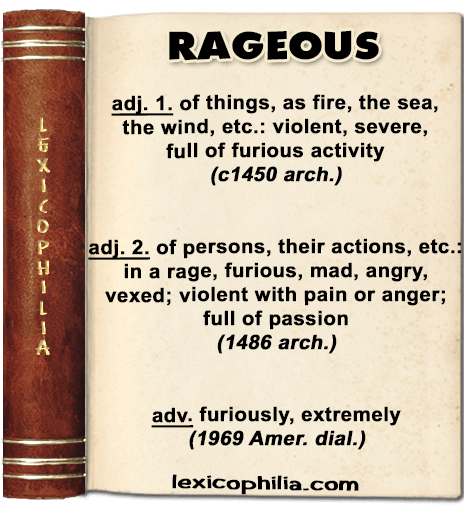
Word of the Day: RAGEOUS


ETYMOLOGY
partly from Anglo-Norman ragous (raging), from rage (rage) + -ous,
and partly directly from rage (n.) + -ous 


EXAMPLE (for adj. 1)
“…What nede y spende more enke or parchement,
That fele the crampe of deth myn hert so nyghe
As thorugh this rageous fyre which hath me hent?
Thus calle y for yowre socoure pitously
…”

From: The English Poems of Charles of Orleans
Edited by R. Steele, 1941
Fortunes Stabilnes, c1450

Word of the Day: RURICOLIST


ETYMOLOGY
from Latin ruricola (a person who tills the land, husbandman, country dweller, rustic)
(from ruri-, combining form of rur-rus (country) + -cola) + -ist


EXAMPLE
“…His hood was half blue and half green, and, over his left ear, was set off with an artificial rose. His appearance did not bespeak the ruricolist, and Dick, who at once detected this, set him down for a burgess of London…”

From: The Life and Times of Dick Whittington
An Historical Romance.
By Richard Whittington, 1841

Word of the Day: RAMPACIOUS


ETYMOLOGY
variant of rampageous, after adjectives ending in -acious


EXAMPLE
“…In the main street of Ipswich, on the left-hand side of the way, a short distance after you have passed through the open space fronting the Town Hall, stands an inn known far and wide by the appellation of the Great White Horse, rendered the more conspicuous by a stone statue of some rampacious animal with flowing mane and tail, distantly resembling an insane cart-horse, which is elevated above the principal door…”

From: The Pickwick Papers
By Charles Dickens, 1836