ETYMOLOGY
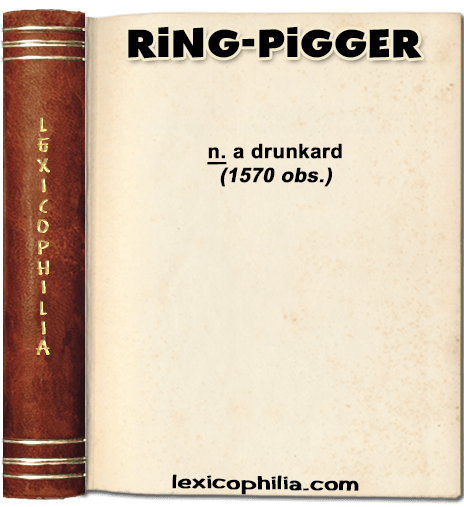
formed by compounding, from ring
EXAMPLE
He was a ring-pigger and a debauchee, and his family were divided in opinion as to whether he died from the effects of drink or from licentious living.

ETYMOLOGY
formed by compounding, from ring
EXAMPLE
He was a ring-pigger and a debauchee, and his family were divided in opinion as to whether he died from the effects of drink or from licentious living.

ETYMOLOGY
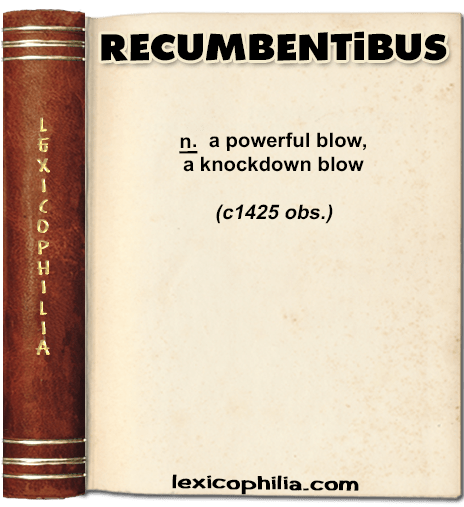
a humorous use of Latin recumbentibus, ablative plural of recumbens, present participle of recumbere (recumb – to lean, recline, rest)
EXAMPLE
“…Ector sone to him gan take,
He thoght him venge of that wrake;
Ector bare his sword on hye,—
For he hadde no spere him bye,—
He ȝaff the kyng Episcropus
Suche a recumbentibus,
He smot In-two bothe helme & mayle,
Coleret and the ventayle…”
From: The Laud Troy Book;
an anonymous Middle English poem dealing with the background and events of the Trojan War, dating from around 1400

ETYMOLOGY
from recray (to tire or wear out), from Anglo-Norman recreire, recreere and Middle French recroire (to desist, give up, to acknowledge oneself defeated, to yield in battle, to fail to go back on what one has said, to tire (something) out, to become tired out (especially of a horse), to confess (something), to go back on one’s sentiments or beliefs)
EXAMPLE
“…The toke[n]s ar not good
To be true Englysh blood
For if they vnderstood
His traytourly dispyght
He was a recrayed knyght
A subtyll sysmatyke
Ryght nere an heretyke
Of grace out of the state
And dyed excomunycate…”
From: Agaynst the Scottes
By John Skelton, a1529

ETYMOLOGY
from Latin rumor (a rumour), and foras (abroad)
EXAMPLE
Don’t gossip or rumiforate. When rumours are spread, a person’s reputation or character can be greatly damaged, even when the rumours aren’t true.

ETYMOLOGY
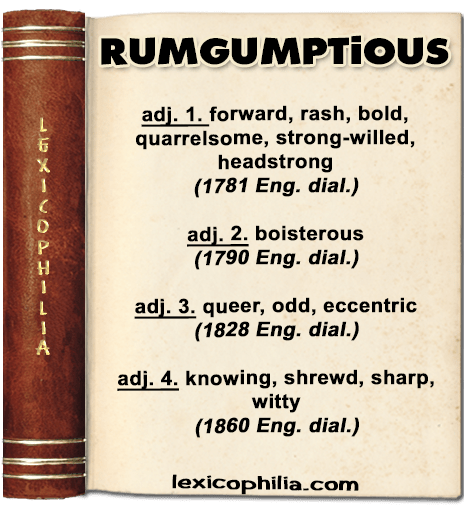
from rumgumption (good sense, shrewdness)
EXAMPLE
“…who’d have thought of that?–he’s a turning rumgumtious, and no mistake. Howsomdever, I must turn it over in my mind, and be even with him, somehow–I owes him one for that. I say, admiral…”
From: Varney the Vampire
By Thomas Peckett Prest, 1847

ETYMOLOGY
from Latin rhonchus (a snoring) + sonans, p. pr. of sonare (to sound)
EXAMPLE
“…Out marches the paleontologist Collett,
And with his little hammer
And scientific grammar
First knocks a mammoth tooth,
To put into his grip-sack;
Then constructs an awful name
By means of which to skip back
With a great rhonchisonant fury, on
The epochs carboniferous and Silurian…”
From: Biographical and Historical Record of Vermillion County, Indiana, 1888

ETYMOLOGY
from rake (vb.) + shame (n.).; perhaps suggested by rake-hell
EXAMPLE
“…An vgly monster of men, with a face as grieslie as a Beare, came vnto him, accompanied with a traine of rakeshames…”
From: Honours Conquest: wherein is conteined the famous hystorie of Edward of Lancaster
By Henry Roberts, 1598

ETYMOLOGY
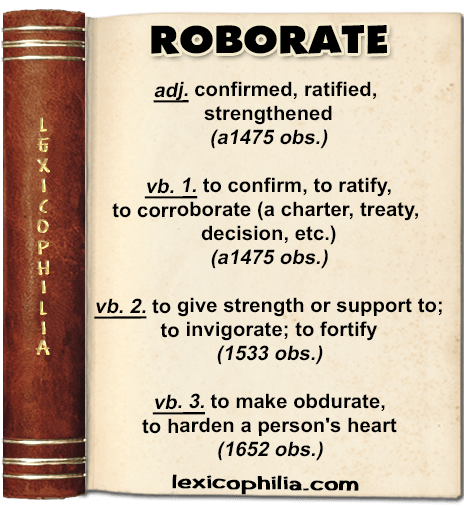
from Middle English roboraten, from Latin roboratus,
past participle of roborare (to strengthen, confirm),
from robor-, robur (strength)
EXAMPLE
“…This pope roborate the sentence of excommunicacion ageyne Frederyke the emperoure…”
From: Ranulf Higden’s Polychronicon
Translated by John Trevisa, a1475

ETYMOLOGY
??? – perhaps from the Scottish ‘rattlebag‘ (a bag filled with small stones and hung on the end of a stick to make a rattling noise)
EXAMPLE
“…In the North of England children call, or used to call, thunder Rattley-bags, and to sing this couplet during a storm –
Rowley, Rowley, Rattley-bags,
Take the lasses and leave the lads…”
From: Notes on the Folk-Lore of the Northern Counties of England and the Borders
By William Henderson, 1879

ETYMOLOGY
from rutter (a dashing gallant) + -kin
EXAMPLE
“…COURTLY ABUSION. Huffa, huffa, taunderum, taunderum tayne, huffa, huffa
CLOAKED COLLUSION (To the audience.) This was properly prated, sirs. Wat said a?…”
COURTLY ABUSION. Rutty bully jolly rutterkin, heyda!
CLOAKED COLLUSION. De que pays este vous…”
From: Magnyfycence
By John Skelton, a1529