ETYMOLOGY
from Latin scientissimus, superl. of sciens (knowing) + -ous
EXAMPLE
“…Scientissimous Interpreters of the Laws of England…”
From: Judges Judged out of their Own Mouthes,
or, The Question Resolved by Magna Charta, &c.
John Jones, 1650

ETYMOLOGY
from Latin scientissimus, superl. of sciens (knowing) + -ous
EXAMPLE
“…Scientissimous Interpreters of the Laws of England…”
From: Judges Judged out of their Own Mouthes,
or, The Question Resolved by Magna Charta, &c.
John Jones, 1650

ETYMOLOGY
from Old French surcuidant (present participle of surcuidier)
from popular Latin supercōgitāre ,
from super- (super- prefix) + cōgitāre (to think, to cogitate)
EXAMPLE
“…and yet they were but febly enformed in maister Porphiris problemes, and haue waded but weakly in his thre maner of clerkly workes, analeticall, topicall, and logycall: howbeit they were puffed so full of vaynglorious pompe and surcudant elacyon, that popholy and peuysshe presumpcion proyoked them to publysshe and to preche to people imprudet perilously…”
From: Honorificatissimo: Replycacion agaynst Yong Scolers
By John Skelton, 1528

ETYMOLOGY
from Latin scrūtārī (to examine, scrutinize)
EXAMPLE
“…In no other maner or fassyon tem
Be the yeres of men whyche so sone over go
My synne and inequite why doste thou scrute so
And yet thou knowest that in me no synne shall be fande
Sythe no man may eschape thy mortall hande …”
From: The Prymer, Salysbery Use, 1536

ETYMOLOGY
from shiksa (in Jewish speech, a gentile girl)
EXAMPLE
“…The Parson is on the highfly in a fantail banger and a milky mill tog. He got the cant of togs from a shickster whose husband’s in a bone-box. He’ll gammon the swells. He touched one for an alderman the first ten minutes…”
From: The Sydney Slang Dictionary, 1880

ETYMOLOGY
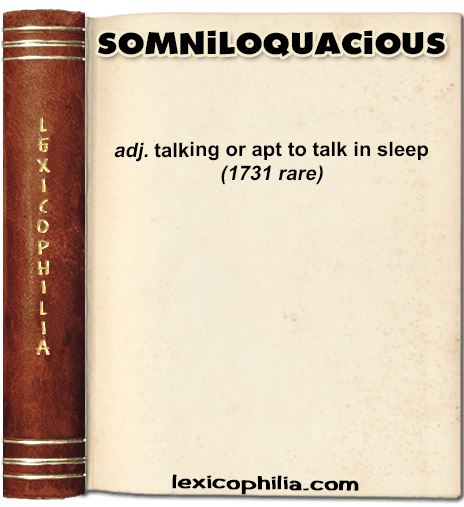
from somni- (combining form of Latin somnus sleep), + loquacious
EXAMPLE
My somniloquacious sister kept me awake so many nights that I finally wore earplugs.

ETYMOLOGY
from salad + -ing
EXAMPLE
“…Sow also (if you please) for early Colly-flowers.
Sow Chervil, Lettuce, Radish, and other (more delicate) Salletings; if you will raise in the Hot-bed.
In over wet, or hard weather, cleanse, mend, sharpen and prepare Garden-tools…”
From: Kalendarium Hortense:
Or, The Gard’ners Almanac
– John Evelyn, 1666

ETYMOLOGY
from slip + skin
EXAMPLE
“…A pretty slip-skin conveyance to sift Masse into no Masse, and Popish into not Popish; yet saving this passing fine sophistical boulting hatch, so long as she symbolises in form, and pranks herself in the weeds of Popish Mass…”
From: Animadversions upon the Remonstrants Defence against Smectymnuus
by John Milton, 1641

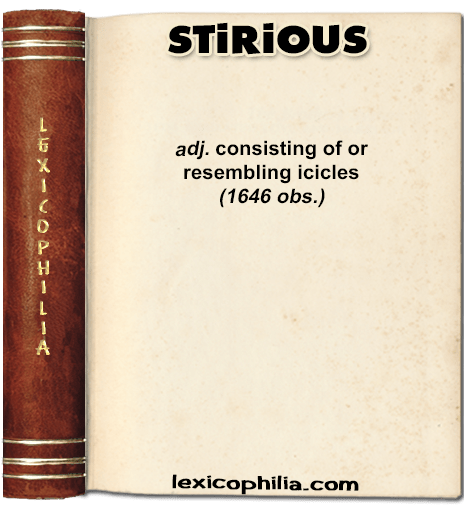
ETYMOLOGY
from stiria (an icicle) + -ous
EXAMPLE
“…The ground of this opinion might be, first the conclusions of some men from experience, for as much as Crystall is found sometimes in rockes, and in some places not much unlike the stirious or stillicidious dependencies of Ice; which notwithstanding may happen either in places which havee been forsaken or left bare by the earth, or may be petrifications, or Minerall indurations, like other gemmes proceeding from percolations of the earth disposed unto such concretions…”
From: Pseudodoxia Epidemica,
or, Enquiries into very many received tenents and commonly presumed truths
By Thomas Browne

ETYMOLOGY
from Latin scrībĕre (to write) + -acious
EXAMPLE
“…We have some Letters of Popes, (though not many; for Popes were then not very scribacious, or not so pragmatical; whence to supply that defect, lest Popes should seem not able to write, or to have slept almost 400 years, they have forged divers for them, and those so wise ones, that we who love the memory of those good Popes, disdain to acknowledge them Authours of such idle stuff; we have yet some Letters)…”
From: A Treatise of the Pope’s Supremacy:
to which is added a Discourse Concerning the Unity of the Church
– Isaac Barrow, a1677

ETYMOLOGY
from straddle (with the legs astride)
EXAMPLE
“…If he even seen a straddle-bug start to go anywheres, he would bet you how long it would take him to get wherever he was going to, and if you took him up, he would foller that straddle-bug to Mexico but what he would find out where he was bound for and how long he was on the road. …”
From: The Notorious Jumping Frog of Calaveras County,
By S. L. Clemens (Mark Twain), 1867