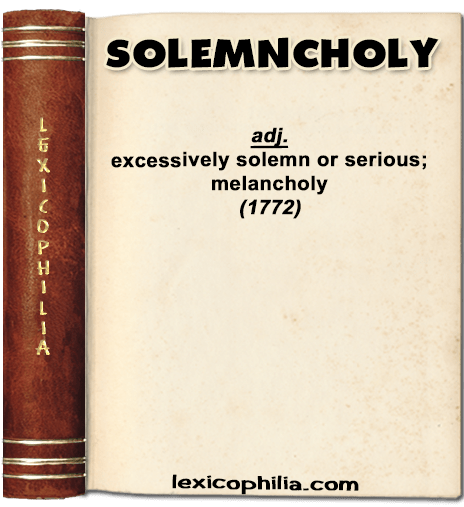
Word of the Day: SOLEMNCHOLY

ETYMOLOGY
fancifully from solemn (adj.), after melancholy

EXAMPLE
[Dr. John Beatty to Philip Fithian]
Philadelphia, December 18th, 1772

“… I rode that evening you left me as far as Cormans; being very Solemncholly and somewhat tired, I concluded to stay there all night; and very early next morning breakfasted at Gloucester and got into Philadelphia before Eleven of the clock …”

From: Journal and Letters
By Philip Vickers Fithian, 1900

Word of the Day: SINISTER-HANDED

ETYMOLOGY
from sinister:  from Old French  senestresinistre or Latin sinister (left, left-hand)

EXAMPLE
… That which still makes her mirth to flow,
Is our
sinister-handed woe,
Which downwards on its head doth go,
And, ere that it is sown, doth grow.
This makes her spleen contract,
And her just pleasure feast:
For the unjustest act
Is still the pleasant’st jest.
…”

From: Lucasta: Posthume Poems
Lucasta Laughing
By Richard Lovelace, a1657

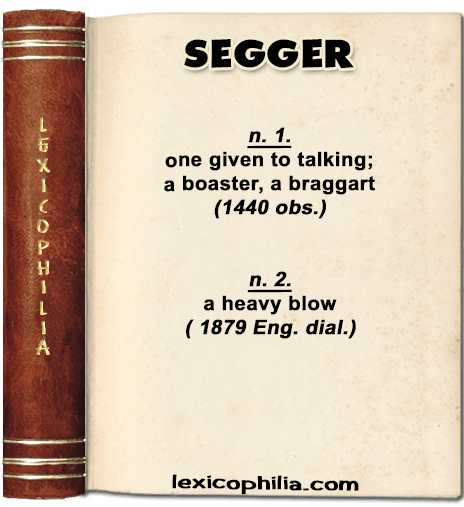
Word of the Day: SEGGER

ETYMOLOGY
from segge (to say) + -er

EXAMPLE (for n.1.)
“… As yoe are a lorde most lofsom of lyre
Vndir sir Pilate that lyfis in this empire,
Ȝone
segger that callis hymselffe a sire
With tresoure and tene sall we taste hym.
Of yoone losell his bale schall he brewe,
Do trottes on for that traytoure apas
In hast.
…”

From: York Mysteries, c1440
The Agony and Betrayal

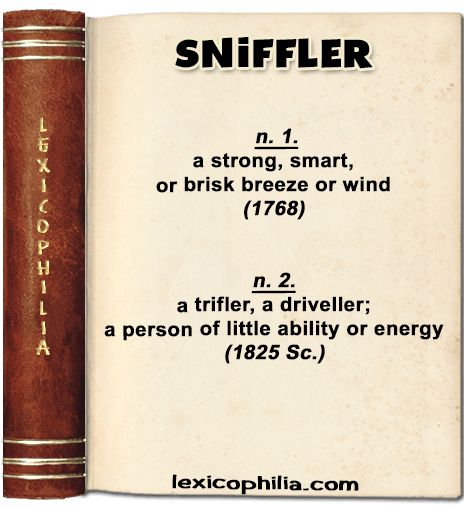
Word of the Day: SNIFFLER

ETYMOLOGY
from sniffle (vb.) + -er

EXAMPLE (for n. 1.)
“… Gin this be courting, well I wat ’tis clear,
I gat na sik a teazle this seven year :
Sae ye maun gee your answer now perqueer,
I maunna ilka day be coming here,
To get sic
sniflers ; courting’s nae a jest.
Another day like this’ll be my priest.’
…”

From: Helenore: Or the Fortunate Shepherdess, a Pastoral Tale
By Alexander Ross, 1768

Word of the Day: SUDATE

ETYMOLOGY
from Latin sudat-, past participial stem of sudare (to sweat)

EXAMPLE
“… Take five Wallenuttes with their shelles, glowe them in the fyere then proiecte them in a gobblet with oulde wine, cover the same least the vigor therof exhalate. Drincke then the Wine as warm as you may, & then rest theron, and cause yourselfe to be well deckede, because you might sudate, and it will helpe. …”

From: The Boock of Physicke
By Oswald Gaebelkhover
Translated by A.M., 1599

Word of the Day: STOTAY

ETYMOLOGY
possibly from Old French estoutoierestoteier (to fall into disorder)

EXAMPLE
“… Þo cried þat freoly foode:
“Whi spille ȝe innocens bloode?”
And alle þei stoteyd and stoode,
Þis ferlys to frayne. …”

From: The Pistill of Susan – a Middle English adaptation of the Old Testament Apocryphal book The History of Susanna, a1400

Word of the Day: SMICKER

ETYMOLOGY
from Old English smicer (possessing charm and attractive; beautiful)

EXAMPLE 1 (for adj. 1)
“… Þatt wollde ben effninng wiþþ Godd
Abufenn alle shaffte,
Þurrh whatt he fell off heffne dun
Inntill niþ hellepine,
& warrþ till atell defell þær
Off shene & smikerr enngell. …”

From: The Ormulum (Burchfield transcript), c1175


EXAMPLE 2 (for vb. 1)
“…Humph. This will not pass; for, though I’m stuft in the head, yet I can blow my Nose as well as another to smell things out. No, no, I see I may make love long enough before you smicker at me. You may e’en keep your Portion, I shall find my Land in the old Place. …”

From: The Man’s the Master, a comedy
By Sir William D’Avenant, 1668